

SEO vs SEM is not a choice between free traffic and paid traffic. SEO is the work that earns organic visibility over time through crawlable pages, useful content, authority, and technical health. SEM usually means paid search campaigns, especially ads that reach people while they are searching for a product, service, or problem.
The useful decision is operational: use SEO when the search task deserves a durable page and the site can support it. Use SEM when speed, testing, or guaranteed placement matters. Use both when paid search can teach the team which messages and landing pages deserve long-term organic investment.
The Ahrefs SEO vs SEM article that surfaced this opportunity explains the channel difference clearly. The Searvora angle is the decision layer after that definition: budget horizon, page readiness, measurement confidence, AI-search visibility, and the handoff from search insight into shipped work.
The Short SEO vs SEM Decision
Use this table before asking for another channel forecast.
| Decision factor | SEO should lead when | SEM should lead when | Use both when |
|---|---|---|---|
| Time horizon | The page can compound for months or years | You need demand now or have a short campaign window | Paid tests can validate the query before organic work scales |
| Budget shape | You can fund content, technical fixes, and refresh work | You can pay for traffic while conversion economics hold | Paid spend buys learning while SEO builds the owned asset |
| Page readiness | The site has crawlable, indexable, useful pages for the search task | The landing page can convert but organic authority is not ready | The landing page needs paid evidence and organic eligibility checks |
| Measurement | You can track impressions, clicks, rankings, assisted conversions, and page cohorts | You can track spend, CPC, conversion rate, and return | Shared dashboards compare demand, quality, and downstream movement |
| Risk | You can wait for validation and handle algorithm/search-result changes | You can cap spend and pause weak tests quickly | Paid protects learning speed while SEO protects long-term efficiency |
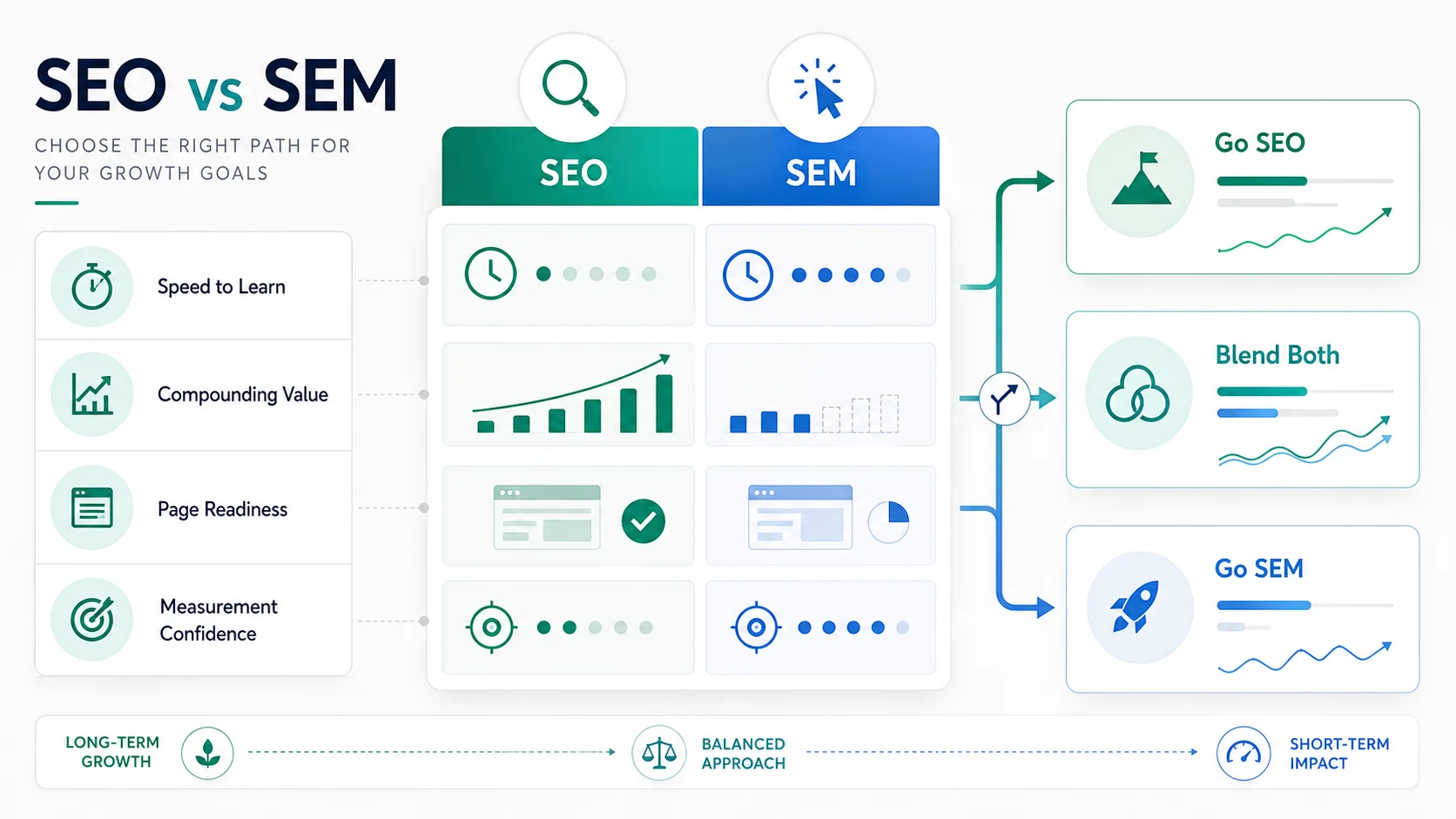
The strongest search programs do not treat SEO and SEM as rival teams. They use each channel for the job it is built to do.
When SEO Should Lead
SEO should lead when the search task deserves a durable owned page. That is usually true for category education, product comparisons, technical how-to content, problem-aware articles, glossary pages that route to action, and buyer questions that appear repeatedly.
Organic search work is slower because the page needs to be discovered, indexed, understood, ranked, selected, and maintained. But that slower path can compound. A good page can earn impressions, links, internal routes, AI-search citations, and assisted conversions long after the first publish date.
Use SEO first when these conditions are true:
- The query reflects a repeatable customer problem.
- The answer can live on a crawlable public page.
- The page type is clear: product, comparison, article, tool, support page, or hub.
- The team can improve technical eligibility, internal links, and content quality.
- The expected value is not limited to one short campaign.
This is where nearby Searvora workflows matter. If the question is what organic traffic means, start with organic traffic as page-level evidence. If the growth plan needs budget confidence, pair the decision with SEO forecasting. If the site is already losing visibility, diagnose the organic traffic drop before choosing a channel fix.
When SEM Should Lead
SEM should lead when speed, control, or test volume matters more than compounding ownership. A paid search campaign can put a message in front of searchers while the organic page is still earning trust.
Google's Search campaign documentation describes the basic paid-search promise: reach people actively searching for products or services. That makes SEM useful when the team needs to test demand, validate offer language, support a launch, protect a branded query, or learn which terms convert before funding larger SEO work.
Use SEM first when:
| Situation | Why SEM helps | Watch out for |
|---|---|---|
| New offer | You need fast market feedback | Paid clicks can validate demand without proving long-term organic fit |
| High-intent query | Searchers are ready to compare or buy | CPC and conversion rate must support the economics |
| Landing page test | You need message and offer data | A converting ad page may still be weak for organic search |
| Short promotion | The window is time-bound | SEO may not mature before the campaign ends |
| Brand defense | Competitors bid on brand or comparison terms | Paid coverage should not hide weak organic pages |
SEM is not automatically easier. Google Ads quality and landing-page systems still reward relevance, usefulness, and page experience. Google's ad quality guidance and landing page performance guidance both point back to the same operational truth: the page still matters.
Use Paid Search To Teach Organic Work
Paid search data is most useful for SEO when it answers a page decision. Do not dump every search term into a blog calendar. Translate paid evidence into page jobs.
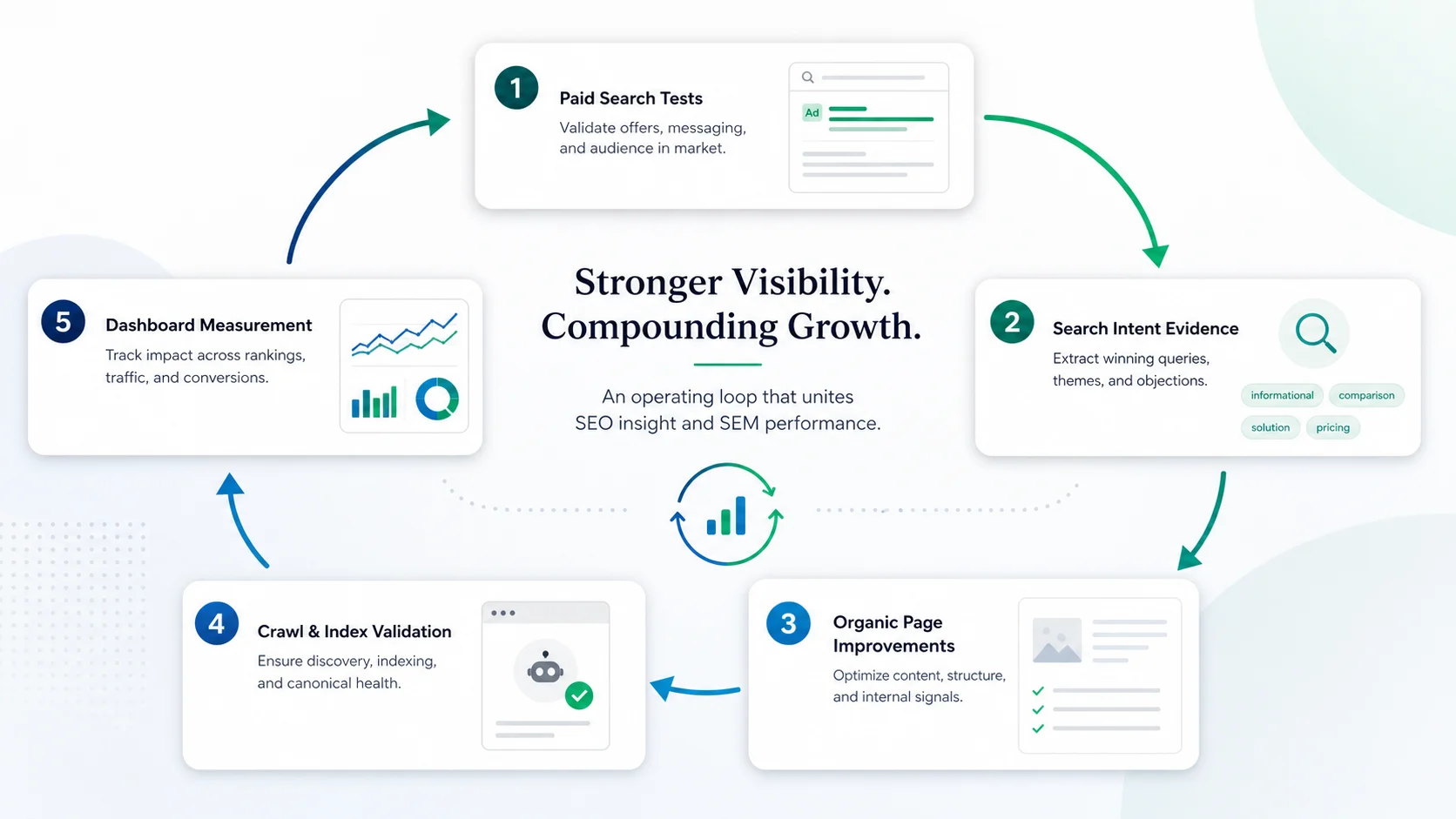
Use this loop:
- Run paid tests against a narrow offer, product category, or problem statement.
- Segment search terms by intent: information, comparison, solution, pricing, support, or brand.
- Identify which queries deserve owned pages and which only need ad coverage.
- Improve or create the organic page that matches the winning search task.
- Validate crawl access, indexability, title, H1, internal links, canonical, and sitemap state.
- Measure organic impressions, paid efficiency, assisted conversions, and AI-search mentions together.
The last step is important. Paid search can show what people click now, but SEO needs a page that can be discovered and trusted. If the page is blocked, duplicated, canonicalized away, or buried in weak internal links, the paid insight will not turn into durable organic visibility.
Build A Shared Measurement Model
SEO and SEM reporting often fail because each channel optimizes its own scoreboard. Paid search reports cost, clicks, CPC, conversions, and return. SEO reports impressions, clicks, rankings, traffic, and pages. The decision needs both, plus page readiness.
Google's Search Console and Analytics guidance is useful because it connects search visibility with what happens after the visit. For SEO vs SEM decisions, add paid search data and review the same landing-page groups.
Use one measurement view:
| Metric group | SEO evidence | SEM evidence | Shared decision |
|---|---|---|---|
| Demand | Impressions, queries, SERP features, AI-search mentions | Search terms, impression share, click volume | Is the search task real and repeatable? |
| Page fit | Landing page, title, H1, internal links, content depth | Ad relevance, landing-page conversion rate | Does the page answer the right promise? |
| Eligibility | Crawl access, indexability, canonicals, sitemap, speed | Landing-page status, mobile experience, policy readiness | Can search systems and users trust the page? |
| Economics | Assisted conversions, qualified movement, refresh cost | Spend, CPC, CPA, ROAS, margin | Which channel should receive the next dollar? |
| Learning speed | Ranking and traffic trend windows | Test result speed and budget caps | Do you need quick learning or compounding return? |
This model prevents the usual argument. The paid team is not "buying traffic because SEO is slow." The SEO team is not "free traffic because ads cost money." Both teams are deciding which search tasks deserve temporary spend, durable pages, technical fixes, or both.
Where Searvora Fits
Searvora's AI SEO Consultant fits the planning layer when the team has mixed search signals and needs a prioritized action plan. The product page positions it around pattern-based diagnosis, impact-effort scoring, fix-ready guidance, and cross-team handoff. That is the shape of an SEO vs SEM decision when the question is no longer theoretical.
Use Searvora this way:
| Decision step | Searvora role | Output |
|---|---|---|
| Read the signal | Combine dashboard, crawl, content, and page evidence | Clear search-task context |
| Classify the page job | Decide whether the target should be product, article, comparison, hub, or support | Better canonical target |
| Prioritize work | Rank SEO, SEM support, content, and technical fixes by impact and effort | Owner-ready action queue |
| Validate the page | Use crawler evidence for indexability, links, canonicals, metadata, and sitemap state | Confidence before organic work scales |
| Monitor results | Compare organic movement, paid tests, and AI-search visibility | Next budget or fix decision |
If the page is already live, connect the consultant decision with the AI SEO dashboard so the team can watch page-type cohorts, anomaly signals, and opportunity queues instead of rebuilding the same channel debate every month.
SEO vs SEM Checklist
Use this checklist before funding the next search initiative:
- Name the search task, not only the keyword.
- Decide the best page type for that task.
- Check whether an existing page already owns the job.
- Use SEM when speed, testing, launch timing, or guaranteed visibility matters.
- Use SEO when the task deserves a durable, crawlable, indexable page.
- Use both when paid search can teach organic page strategy.
- Validate landing-page quality, page experience, and conversion path before scaling spend.
- Validate crawl access, indexability, internal links, canonicals, and sitemap state before expecting SEO growth.
- Measure paid and organic outcomes by the same landing-page group.
- Reassign budget when the evidence changes.
SEO vs SEM is a channel comparison, but the real work is a page decision. Choose the channel that creates the fastest useful evidence, then turn that evidence into the page, campaign, or fix that can be measured again.