
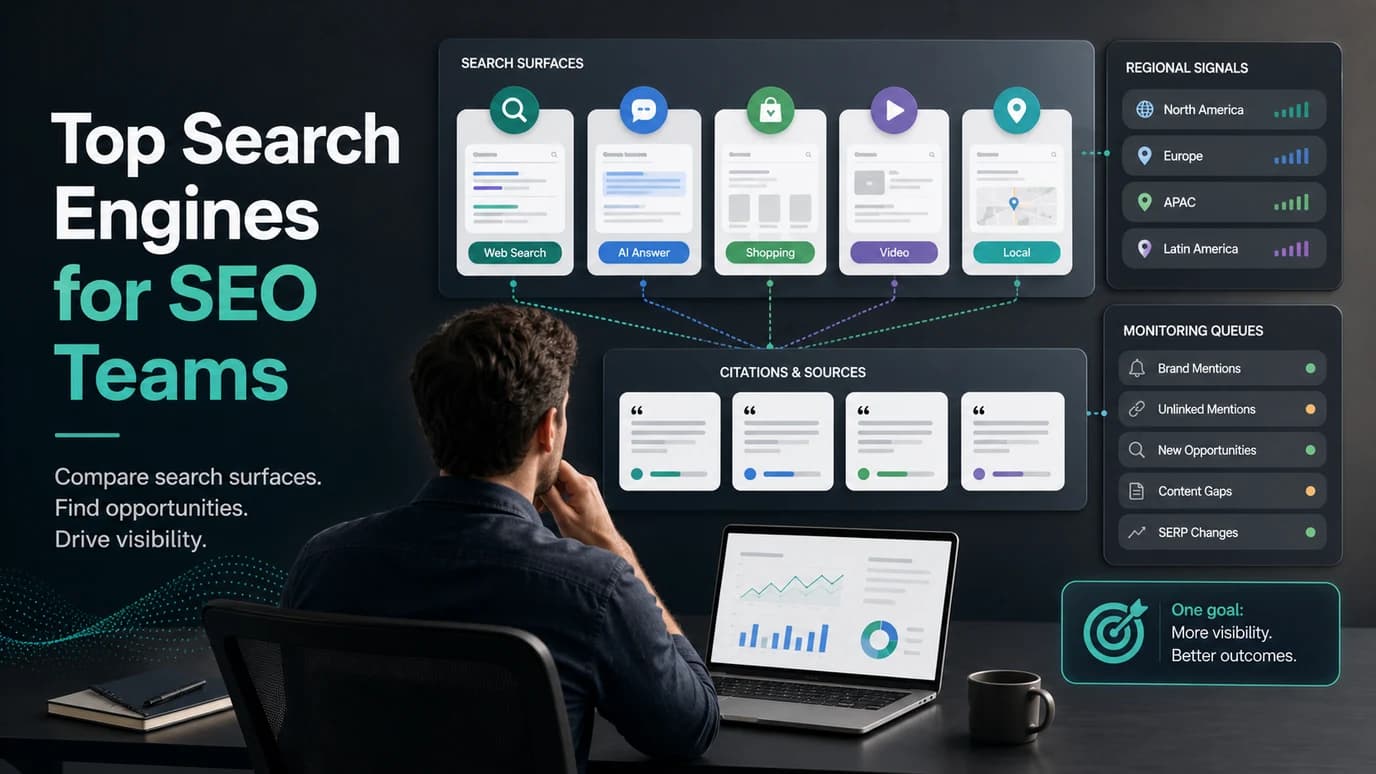
The top search engines for SEO teams are not only the biggest names by market share. They are the search surfaces that can change discovery, clicks, brand visibility, AI answer citations, and regional demand for the audience you care about.
Start with Google, because most teams still have to earn visibility there first. Then decide whether Bing, Yahoo, DuckDuckGo, Brave Search, Baidu, Yandex, Ecosia, and answer engines deserve active monitoring for your market. The right answer is not "track everything." The right answer is a repeatable monitoring model.
Market Share Is The Starting Point
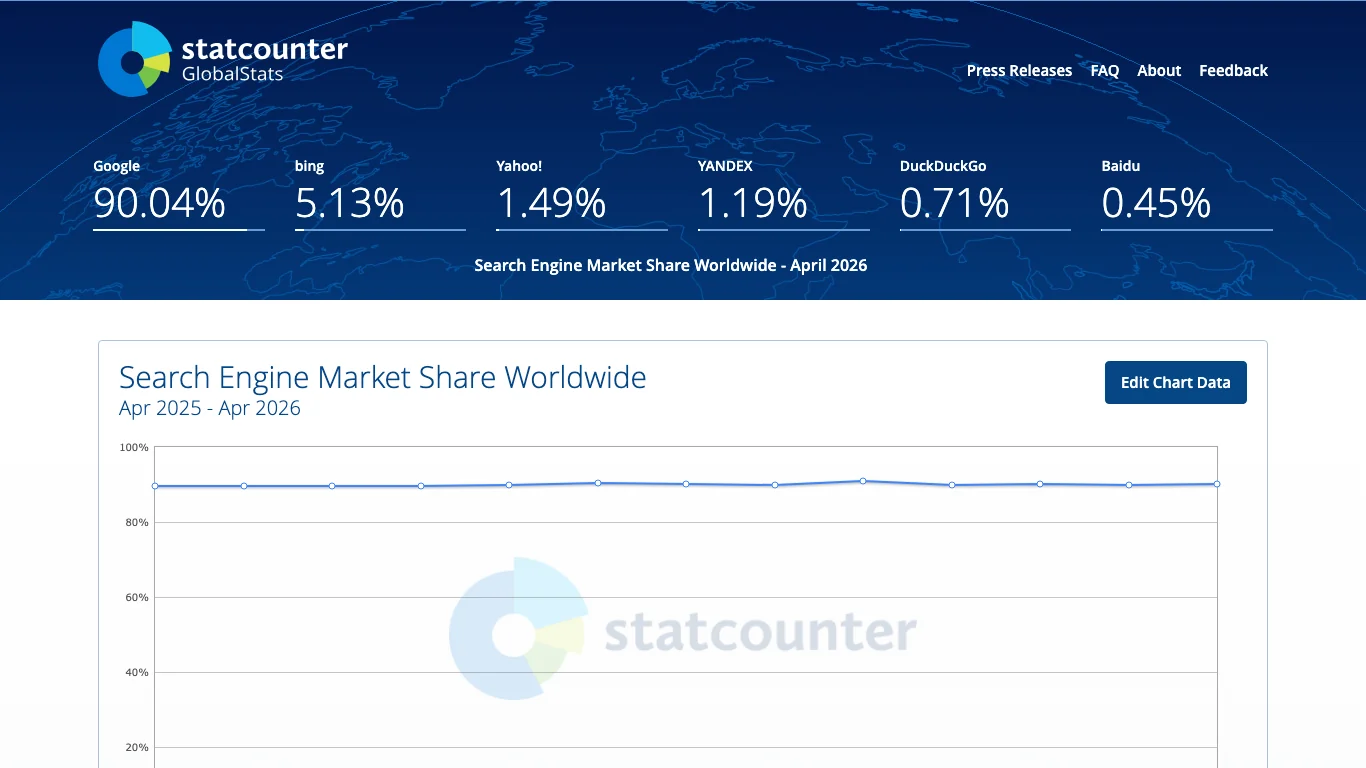
StatCounter's global search engine market share snapshot for June 2026 shows why most SEO programs still start with Google: Google sits at 91.27%, Bing at 4.68%, Yahoo at 1.28%, Yandex at 0.79%, DuckDuckGo at 0.67%, and Baidu at 0.43%.
That ranking is useful, but it is not the same as an SEO plan. A B2B SaaS team selling mostly in the United States may treat Bing as a real secondary surface because Microsoft products, Edge, Windows, and Copilot shape parts of the journey. A privacy tool may care more about DuckDuckGo and Brave Search than the global average suggests. A company entering China cannot read Baidu's global share and conclude it is optional.
Use market share as the first filter, then add four operational filters:
| Filter | Question to ask | Why it matters |
|---|---|---|
| Audience fit | Does this engine matter in your countries, devices, browsers, or buyer segments? | Global rank can hide regional or browser-specific demand |
| Optimization surface | Can you directly improve crawling, indexing, snippets, feeds, local entities, or citations? | Some surfaces reward normal SEO work, while others need entity and source-page discipline |
| AI answer behavior | Does the engine summarize, cite, or blend answers in a way that changes clicks? | Visibility can move from blue links to cited source pages |
| Measurement path | Can you track impressions, referrals, rankings, citations, or at least evidence samples? | If you cannot measure it at all, keep it in a lighter watchlist |
Top Search Engines To Compare First
This is the practical shortlist for most SEO and GEO teams. The table separates "important" from "monitor weekly."
| Search engine or surface | Best reason to care | Monitoring level |
|---|---|---|
| Google Search | Primary organic discovery, AI Overviews, rich results, local and product surfaces | Core weekly |
| Bing | Microsoft ecosystem visibility, Copilot-connected search, second-source diagnostics | Core or secondary |
| Yahoo Search | Residual web-search demand and audience segments that still use Yahoo properties | Light secondary |
| DuckDuckGo | Privacy-first audience, non-Google query behavior, brand trust research | Watchlist or secondary |
| Brave Search | Independent index, privacy-focused users, built-in AI answer behavior | Watchlist for AI and privacy markets |
| Baidu | Essential for China-facing search visibility | Core only for China strategy |
| Yandex | Important for markets where Yandex has real user share | Core only for relevant regions |
| Ecosia | Climate-positioned search audience, useful for values-led brands | Watchlist |
| Perplexity and answer engines | Citation and source-page visibility rather than classic rankings | Evidence sampling |
The mistake is treating this as a trophy list. A better workflow is to pick one core engine, one secondary engine, and one experimental answer surface for each important market. Then review whether that mix still matches real traffic, sales conversations, and brand mentions.
Google Search Still Sets The Baseline
Google is still the baseline because it shapes the largest share of web search, the richest SEO documentation ecosystem, and many of the page-quality assumptions that other engines partially mirror. The official Google Search page also makes clear that Search is no longer only a list of links; Google keeps pushing more ways to search and more AI-assisted experiences.
For SEO teams, the Google workflow should include:
- Keep every important page crawlable, indexable, canonical, and internally linked.
- Track page groups by template, directory, country, and funnel job.
- Watch query movement and click loss when AI-style answers or SERP features appear.
- Validate snippet eligibility with titles, meta descriptions, structured data, images, and source quality.
- Record when a visibility change is likely technical, editorial, competitive, or SERP-layout driven.
Google should own the deepest measurement layer. Search Console data, crawl data, rank evidence, and answer-surface samples all belong in the same review, especially when AI Overviews appear for important queries. If that is already part of your workflow, the next useful companion is a disciplined process for tracking AI Overviews when search data is messy.
Bing Is The Secondary Engine Worth Treating Seriously
Bing is smaller than Google, but it is not just a rounding error. The official Microsoft Bing page positions Bing as an AI-powered search and answer engine, and that matters because Bing visibility can intersect with Microsoft Edge, Windows, Copilot, and enterprise browsing habits.
Treat Bing as a second diagnostic layer when:
| Situation | Why Bing helps |
|---|---|
| Google visibility drops but Bing is stable | The issue may be Google-specific, SERP-layout driven, or query-intent related |
| Bing visibility improves before Google | The page may have technical eligibility and relevance, but Google needs stronger authority or source quality |
| Microsoft-heavy buyers matter | Bing and Copilot-connected experiences can influence discovery even with lower global share |
| AI answer citations are part of the review | Bing's answer experience can reveal which pages are citation-ready in a different ecosystem |
Do not copy Google reports and call that Bing monitoring. Use the same page groups, but review the differences: which URLs appear, which snippets win, which brand pages are cited, and whether non-Google search demand is giving you an early signal.
Privacy-First Search Engines Need A Different Lens
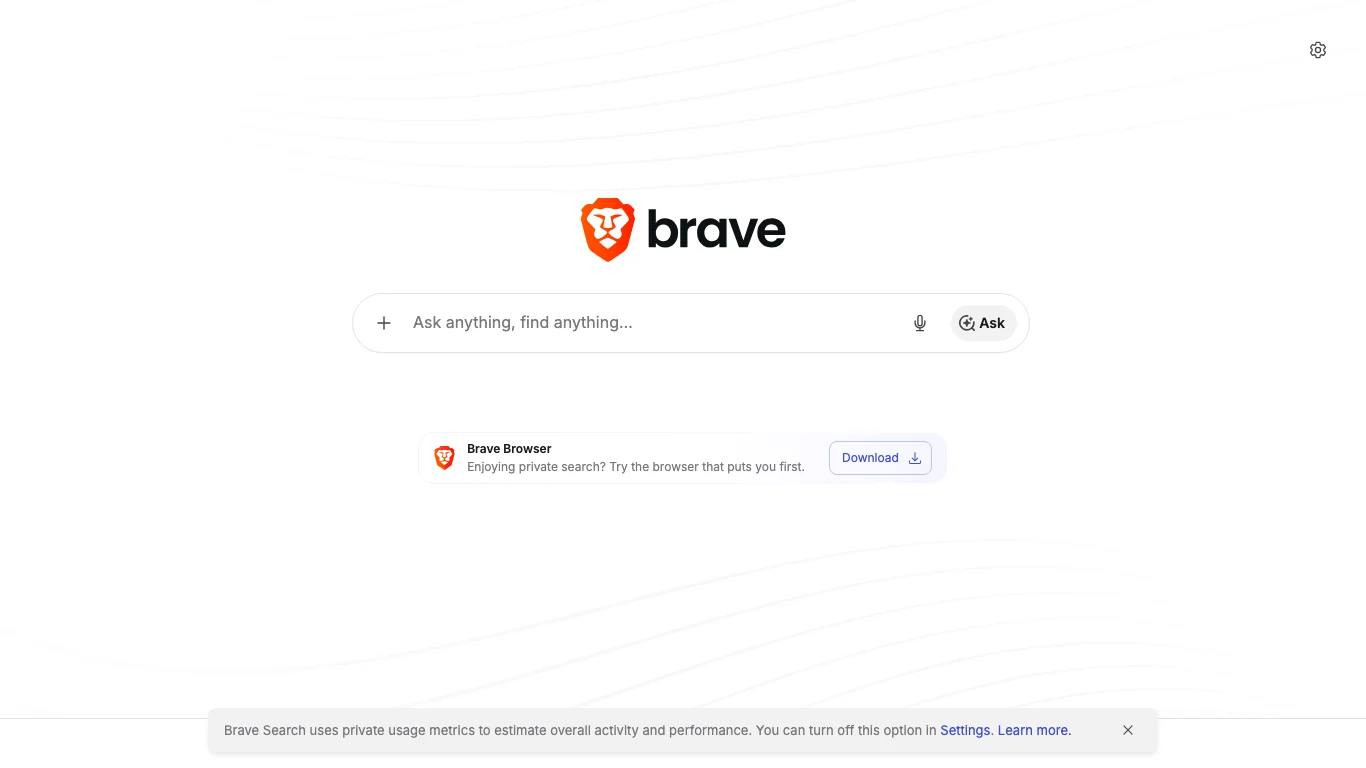
DuckDuckGo, Brave Search, and Ecosia are not usually where a broad SEO program starts. They become important when the audience is privacy-conscious, browser-choice aware, technical, climate-oriented, or skeptical of heavily personalized search.
The official DuckDuckGo about page emphasizes private search and browsing. Brave Search emphasizes an independent search index and AI answer features. Ecosia connects search usage with climate action.
For SEO teams, the monitoring question is not "Can we rank in every privacy engine?" It is:
- Do branded queries return the right official pages?
- Do category queries surface your strongest educational pages?
- Do snippets summarize the page accurately?
- Do AI answer features cite or omit your owned sources?
- Do referrals or customer conversations show audience overlap?
This is where classic rankings are too thin. A privacy-first search review should be closer to an evidence log: query, engine, visible sources, snippet quality, cited pages, brand mention, and next action. If the brand is trying to become visible in answer systems, connect this review to the broader brand mentions in AI answers evidence loop.
Regional Engines Are Core Only When The Market Is Core
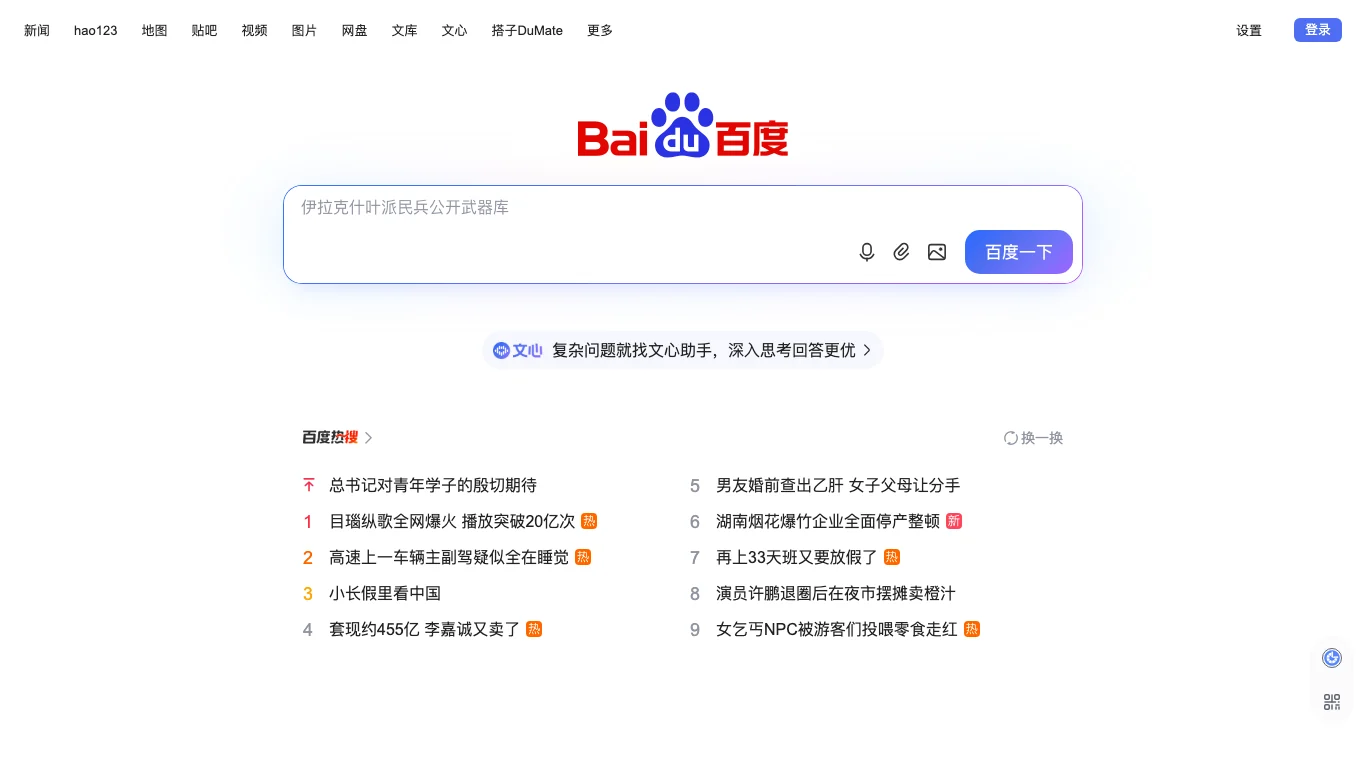
Baidu and Yandex should not be casual checkboxes in a global SEO report. They need market context, language context, compliance awareness, and local search behavior. If China is a strategic market, Baidu deserves its own search workflow. If Russia or nearby markets are strategic, Yandex deserves the same kind of local review.
For a regional engine, use a separate checklist:
| Check | What it changes |
|---|---|
| Language and localization | Machine-translated pages rarely create strong search trust |
| Regional hosting and accessibility | Crawlers and users may experience the site differently by region |
| Local entity signals | Brand profiles, local mentions, and trusted sources can matter more than a global homepage |
| Technical eligibility | Robots, canonicals, redirects, JavaScript rendering, and speed should be tested from the target market |
| Reporting ownership | Someone must know whether a change is SEO, localization, legal, or infrastructure work |
Do not let a global dashboard flatten these markets into one line item. A regional engine should either have owner-ready monitoring or stay out of the weekly core report.
AI Answer Surfaces Change The Definition
The phrase "top search engines" used to mean web indexes. Now SEO teams also need to watch answer experiences that summarize sources, cite pages, or hide classic rankings behind a generated response.
That includes Google AI Overviews, Bing answer experiences, Brave's AI answers, Perplexity-like answer engines, and other assistants that turn search into synthesis. These surfaces are not all measured the same way. Some offer public search pages, some route through apps, and some change quickly. The common SEO job is to make the brand and source pages easy to understand, cite, and validate.
Use this lightweight AI answer review:
| Review item | What to record |
|---|---|
| Query set | Brand, category, comparison, problem, and support queries |
| Answer presence | Whether an AI-style answer appears |
| Source pages | Which domains and URLs are cited or visibly used |
| Brand treatment | Whether your brand is mentioned accurately, omitted, or confused with a competitor |
| Page readiness | Whether your owned pages give answer systems concise, source-ready information |
| Follow-up action | Update page, add source section, improve schema, strengthen internal links, or monitor only |
For Google-specific work, pair this with the Google AI Overviews workflow. For broader search surfaces, keep the same evidence shape so the team can compare engines without reinventing reporting every week.
How To Decide What Your Team Should Track
Use this operating model before expanding the report:
- Put Google in the core report unless your business has an unusual audience constraint.
- Add Bing when Microsoft ecosystem, B2B, enterprise, or AI answer visibility matters.
- Add one privacy-first engine only if your audience or product category justifies it.
- Add Baidu, Yandex, or another regional engine only when the market has an owner and localization plan.
- Add AI answer surfaces as an evidence log, not as a fake ranking table.
- Review the mix quarterly and remove surfaces that produce no useful decision.
The output should be simple: a core report, a secondary watchlist, and an experimental evidence log. Anything more becomes dashboard theater.
Top search engines matter because they expose different parts of demand. Google shows the main market. Bing shows a useful second ecosystem. Privacy-first engines reveal audience trust signals. Regional engines decide whether international work is real. AI answer surfaces show whether your pages are becoming citeable sources.
Track the engines that can change your next action. Keep the rest in a watchlist until the evidence says they deserve more.