

The main types of marketing include content marketing, SEO, email, social media, community, creator partnerships, affiliate marketing, referrals, public relations, events, product marketing, direct outreach, account-based marketing, paid search, paid social, display advertising, video, and offline marketing.
That list is only useful if it changes a decision. A search-led growth team should compare each type by the audience job it serves, the durable asset it creates, how quickly it can produce a signal, who owns it, and how the result will be validated. The goal is not to activate every channel. It is to choose a small mix that compounds instead of creating disconnected activity.
Separate Marketing Types From Campaigns, Channels, And Tactics
Marketing language becomes confusing when four different planning levels are treated as synonyms.
| Planning level | What it means | Example |
|---|---|---|
| Marketing type or discipline | A repeatable capability with its own methods, skills, and evidence | Content marketing or public relations |
| Channel | The surface used to reach an audience | Google Search, email, a community, or an industry event |
| Campaign | A coordinated effort with a defined objective and time window | A product launch or seasonal promotion |
| Tactic | A specific action inside a discipline, channel, or campaign | Publish a comparison page or send a partner briefing |
The distinction matters because one campaign can use several types of marketing. A product launch may combine product marketing, email, PR, paid search, and content. The types of marketing campaigns framework helps choose the bounded initiative. This article helps choose the durable disciplines that should support it.
Map 18 Types Of Marketing To The Work They Actually Do
There is no universal taxonomy. Some teams split digital and offline marketing into dozens of subtypes; others group several disciplines under demand generation. The practical map below uses 18 common types and gives each one an operating job.
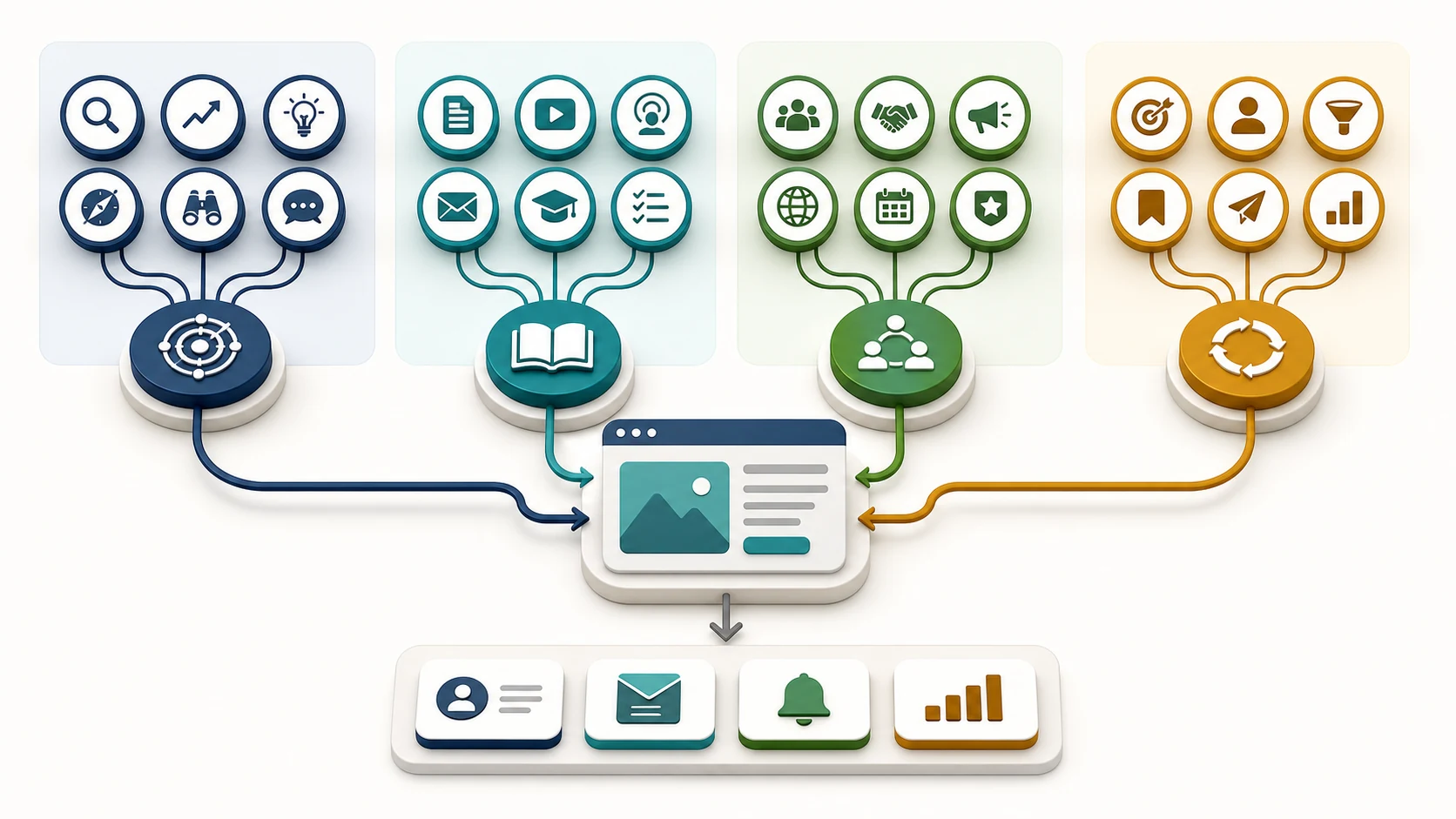
| Marketing type | Primary job | Durable owned asset | Useful early evidence |
|---|---|---|---|
| Content marketing | Educate an audience and build reusable demand capture | Articles, guides, hubs, tools, or research | Qualified discovery, assisted next-page movement, and citations |
| Search engine optimization | Make useful pages discoverable, understandable, and technically eligible | Search-ready product, article, tool, and landing pages | Query fit, impressions, crawl health, and indexation |
| Email marketing | Move a known audience toward the next useful decision | Nurture paths, newsletters, guides, and product proof | Qualified clicks, replies, return visits, and downstream action |
| Social media marketing | Distribute ideas and participate where an audience already gathers | Reusable posts linked to a canonical source | Relevant engagement, profile discovery, and source-page visits |
| Community marketing | Build repeated participation around a shared problem or identity | Community hub, event archive, FAQ, or public resource | Returning participation and recurring questions |
| Influencer and creator marketing | Borrow trusted distribution from a relevant expert or creator | Co-created resource, demonstration, interview, or landing page | Audience fit, qualified referrals, and reusable expert evidence |
| Affiliate marketing | Reward third parties for attributable customer acquisition | Affiliate landing pages, partner resources, and comparison proof | Approved-partner activation and qualified conversions |
| Referral marketing | Turn satisfied customers or partners into introductions | Referral path, advocacy page, and shareable proof | Invitation quality, participation, and referred conversion |
| Public relations | Earn attention and editorial validation | Data study, expert source, company evidence, or newsworthy page | Relevant coverage, source citations, and brand discovery |
| Partnership marketing | Combine complementary audiences, products, or expertise | Co-marketing page, integration story, webinar, or joint resource | Partner-qualified reach and shared pipeline quality |
| Event marketing | Create concentrated learning, access, or participation | Event page, session archive, recap, and follow-up resource | Registrations, attendance quality, questions, and return visits |
| Product marketing | Explain who a product is for, what problem it solves, and why it is credible | Product page, use-case page, comparison, and launch source | Message comprehension, qualified product discovery, and adoption |
| Account-based marketing | Coordinate high-value outreach around named organizations | Account-relevant landing pages, proof, and sales enablement | Account engagement, buying-group coverage, and opportunity movement |
| Direct and outbound marketing | Reach a defined prospect without waiting for discovery | Outreach sequences, targeted pages, and sales resources | Positive replies, meeting quality, and reason-coded rejection |
| Paid search marketing | Capture existing query demand with controlled messages | Focused landing pages and offer-specific proof | Search-term quality, landing-page match, and conversion efficiency |
| Paid social marketing | Create or capture demand through audience targeting | Campaign landing pages, creative proof, and retargeting paths | Qualified attention, audience response, and assisted conversion |
| Display and programmatic advertising | Build reach or re-engage known audiences across publisher inventory | Destination pages and consistent campaign evidence | View quality, incremental reach, and assisted return behavior |
| Video, audio, and offline marketing | Teach, demonstrate, or build memory beyond text-first web channels | Video library, podcast archive, event resource, or campaign source page | Completion quality, branded discovery, direct response, and reuse |
The Ahrefs overview of common marketing types uses examples to make a broad taxonomy concrete. The operational step is to route each discipline into an owned asset, evidence source, owner, and review window before investing in distribution.
Choose The Mix With Five Filters
A lean team rarely needs 18 active disciplines. Use five filters to narrow the list.
1. Start with the audience job
Name what the audience is trying to do: recognize a problem, learn a category, compare options, gain internal approval, implement a solution, or stay successful after purchase. A discipline is useful only when it can improve that decision.
2. Identify the durable asset
Every serious marketing plan should name what the company will still own when distribution slows. That may be a product page, comparison, article, tool, data study, event archive, email list, partner resource, or customer proof page.
If the plan creates only posts, impressions, or rented-platform activity, the team may have to rebuild the same attention every month.
3. Match the time-to-signal
Paid search and direct outreach can produce fast feedback. SEO, community, partnerships, and brand work often take longer to compound. A good mix combines a fast learning loop with at least one durable system.
4. Check the evidence burden
Some types require claims the team must be able to support. PR needs a source worth citing. Product marketing needs accurate capabilities and proof. Creator, affiliate, and referral programs need clear terms and disclosure controls. A data study needs a defensible method and refresh plan.
5. Assign an owner and stop rule
Name who will create the asset, run distribution, answer responses, check technical eligibility, and decide whether to continue. Set a review window and a stop, change, or scale rule before the work begins.
| Constraint | Favor first | Be careful with |
|---|---|---|
| Small team with deep expertise | SEO, content, email, partnerships | Too many daily social channels |
| Need fast offer feedback | Paid search, direct outreach, product marketing | Judging long-term SEO after a few days |
| Strong customer outcomes | Referral, advocacy, product marketing, PR | Publishing claims without approved evidence |
| Technical or complex product | Content, SEO, video, events, community | Short creative that removes necessary context |
| Low category awareness | PR, creators, events, social, category content | Expecting product-keyword demand to exist already |
Build Around An Owned Search Asset
Search-led marketing does not mean every activity must be SEO. It means the plan has a durable public source that can be discovered, linked, revisited, and understood after a campaign ends.
For example:
- PR can point to an original study rather than a press release with no reusable evidence.
- Events can produce a maintained recap, session archive, and answers to recurring questions.
- Creator partnerships can lead to a factual demonstration or co-created guide instead of a temporary mention.
- Paid search can test message and offer fit on a focused landing page without turning ad terms into automatic blog briefs.
- Community discussions can reveal repeated public questions, which become anonymized patterns for the content marketing workflow.
Google's SEO Starter Guide emphasizes helpful, well-organized content that search engines can crawl and understand. Marketing distribution cannot compensate for a destination that is blocked, duplicated, vague, or mismatched to the promise that brought the visitor there.
Before distribution starts, check that the main destination:
- serves one clear audience job;
- has a title, H1, opening answer, and CTA that agree;
- returns a clean success response and is indexable when organic discovery matters;
- uses the intended canonical URL;
- has at least one natural internal-link path;
- keeps key facts in visible text, tables, or steps;
- states products, organizations, dates, methods, and evidence consistently;
- has a refresh, consolidation, redirect, or retirement rule.
Keep Organic And Paid Roles Separate
Paid and organic marketing can share evidence, but they should not share an accounting shortcut.
Paid search controls bids, budgets, match types, audience rules, and ads. Organic search controls page jobs, information gain, crawl access, internal links, indexability, and long-term maintenance. A paid query that converts may justify a commercial landing page, not an informational article. An article that earns qualified organic discovery may still be a poor ad destination.
Use paid activity to learn about message resonance, search terms, objections, and landing-page fit. Then make a separate organic page decision:
| Evidence from paid activity | Organic decision to make |
|---|---|
| A query produces qualified leads | Decide whether the canonical target should be a product, service, comparison, tool, or article page |
| An ad message earns attention | Verify that the page can substantiate the promise in visible content |
| One audience segment responds | Decide whether it needs a distinct page job or only adapted distribution |
| A campaign ends | Preserve, consolidate, redirect, refresh, or retire the destination by a written rule |
This boundary prevents a growth team from declaring paid clicks to be organic progress or turning every converting ad term into another competing article.
Measure The Asset, The Distribution, And The Decision
Marketing reports often mix activity, asset quality, search visibility, and business outcomes into one total. Separate them so the team knows what to change.
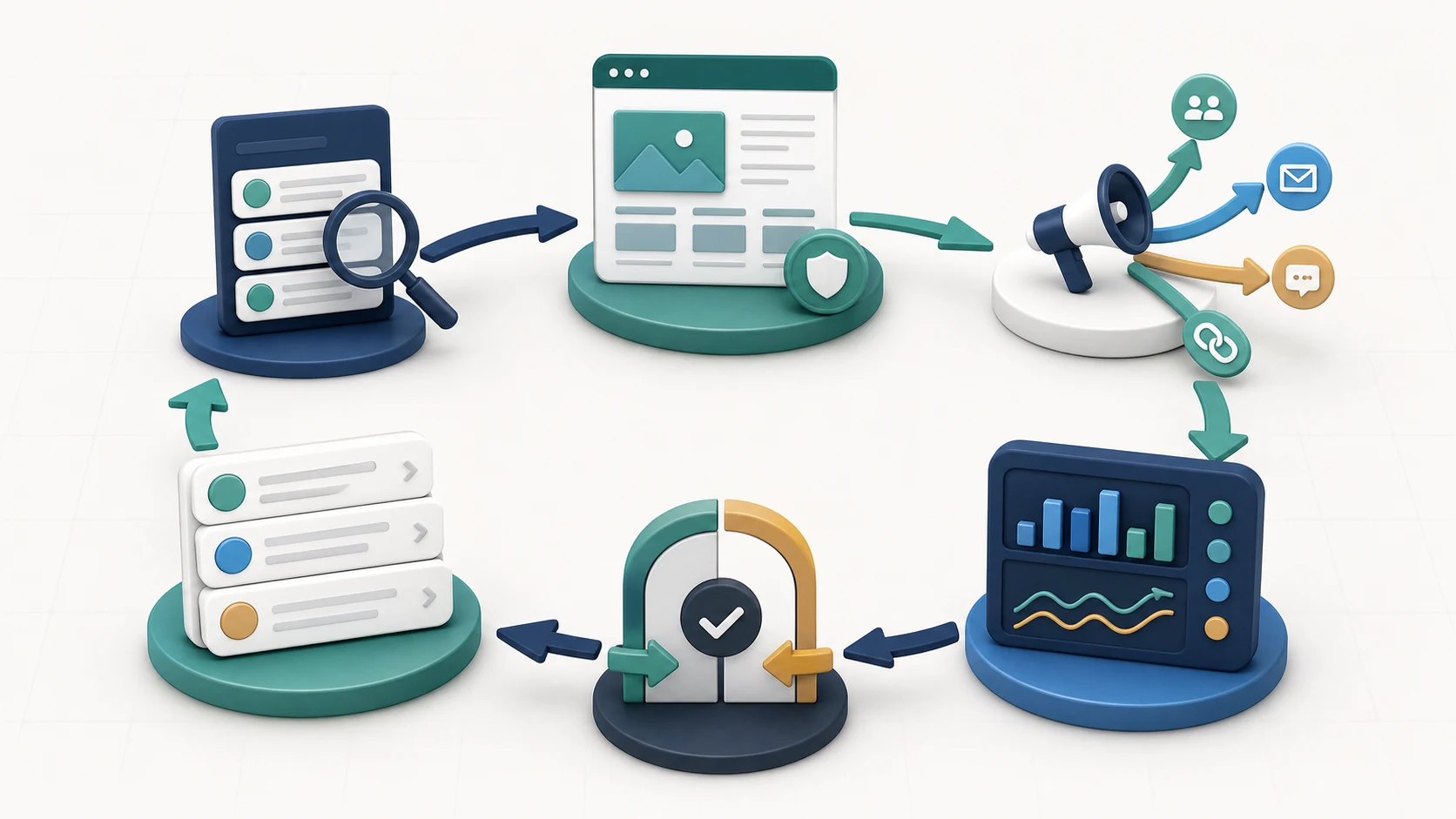
| Measurement layer | What to inspect | Decision it should support |
|---|---|---|
| Baseline | Existing demand, crawl state, page coverage, brand visibility, and current conversion path | Whether the opportunity is real and what must exist first |
| Owned asset | Intent match, evidence, usability, canonical, indexability, and internal links | Create, refresh, consolidate, change page type, or stop |
| Distribution | Qualified reach, clicks, replies, attendance, referrals, and partner response | Continue, narrow, change the message, or change the channel |
| Organic search | Query mix, impressions, clicks, page fit, links, and indexation | Protect, expand, merge, or repair the asset |
| AI search | Brand and entity framing, cited sources, answer consistency, and extractable evidence | Clarify the public source or strengthen supporting proof |
| Business result | Qualified leads, adoption, revenue assistance, retention, or support reduction | Decide whether the discipline deserves more resources |
Record the baseline before launch, annotate material changes, and wait for an evidence-appropriate review window. Search, community, partnerships, and brand programs should not be judged on the same clock as paid search or direct outreach.
The marketing funnel framework is useful when the unresolved question is which stage needs help. The types-of-marketing decision is different: it determines which repeatable capability, owned asset, and validation loop should move that audience forward.
Where Searvora Fits
Searvora AI SEO Consultant is designed for the decision layer between noisy evidence and assigned work. The current product surface focuses on diagnosing patterns, ranking work by impact and effort, and turning recommendations into owner-ready action queues.
Use that workflow when a marketing plan produces too many possible articles, landing pages, technical fixes, campaigns, and owners. The useful output is a short ranked queue that states:
- the audience job and selected marketing discipline;
- the canonical asset to create, refresh, or protect;
- the evidence behind the decision;
- the owner and implementation boundary;
- the review window and validation check;
- the stop, change, or scale rule.
Marketing Mix Decision Checklist
Before activating another type of marketing:
- Name the audience decision that needs to change.
- Separate the discipline from its channels, campaigns, and tactics.
- Choose one primary type and only the supporting types it genuinely needs.
- Name the durable owned asset that will remain useful after distribution slows.
- Check for an existing URL with the same keyword, page type, and user job.
- Define the information gain or proof the asset will add.
- Verify crawl access, canonical, indexability, internal links, and visible evidence.
- Assign the asset owner, distribution owner, and validation owner.
- Record a baseline and an evidence-appropriate review window.
- Write the continue, change, consolidate, or stop rule before launch.
The right marketing mix is usually smaller than the first brainstorm. Pick the discipline that serves the audience job, build the asset that can compound, use distribution to create learning, and keep only the work that produces better evidence or a stronger owned growth surface.