

Learning how to get customers does not start with a long list of tactics. Start with the route that has the clearest evidence already available to your team: real search demand, a reachable buyer list, a credible paid offer, or people who can genuinely recommend you.
The Ahrefs article that surfaced this opportunity groups acquisition into four broad routes. That is a useful starting point. The missing operator layer is deciding which route deserves a focused first test, what proof to collect, and when to stop before a lean team spreads itself across every channel.
Start With The Constraint That Matters
Every channel can work in the abstract. The better question is what constraint is limiting you now.
| If this is true | Start by testing | Why it fits | Do not assume |
|---|---|---|---|
| Buyers already search for the problem you solve | Organic search | A useful page can keep earning attention after the first launch | A high-volume keyword automatically means the page will convert |
| You can name a narrow set of people or accounts with a shared problem | Direct outreach | You can learn quickly from real objections and replies | A large contact list creates relevance by itself |
| You have a clear offer and a controlled budget | Paid distribution | You can test message-to-landing-page fit on a short feedback loop | Spend can compensate for a weak page or unclear audience |
| Customers, partners, or a community already trust the work | Word of mouth | Existing trust can create qualified introductions and proof | A referral request will work without a specific reason to share |
The goal is not to crown one channel as universally best. It is to choose one route that your team can run with enough focus to learn something useful. A broader types of marketing mix may still matter later, but it is not a substitute for making a first acquisition decision.
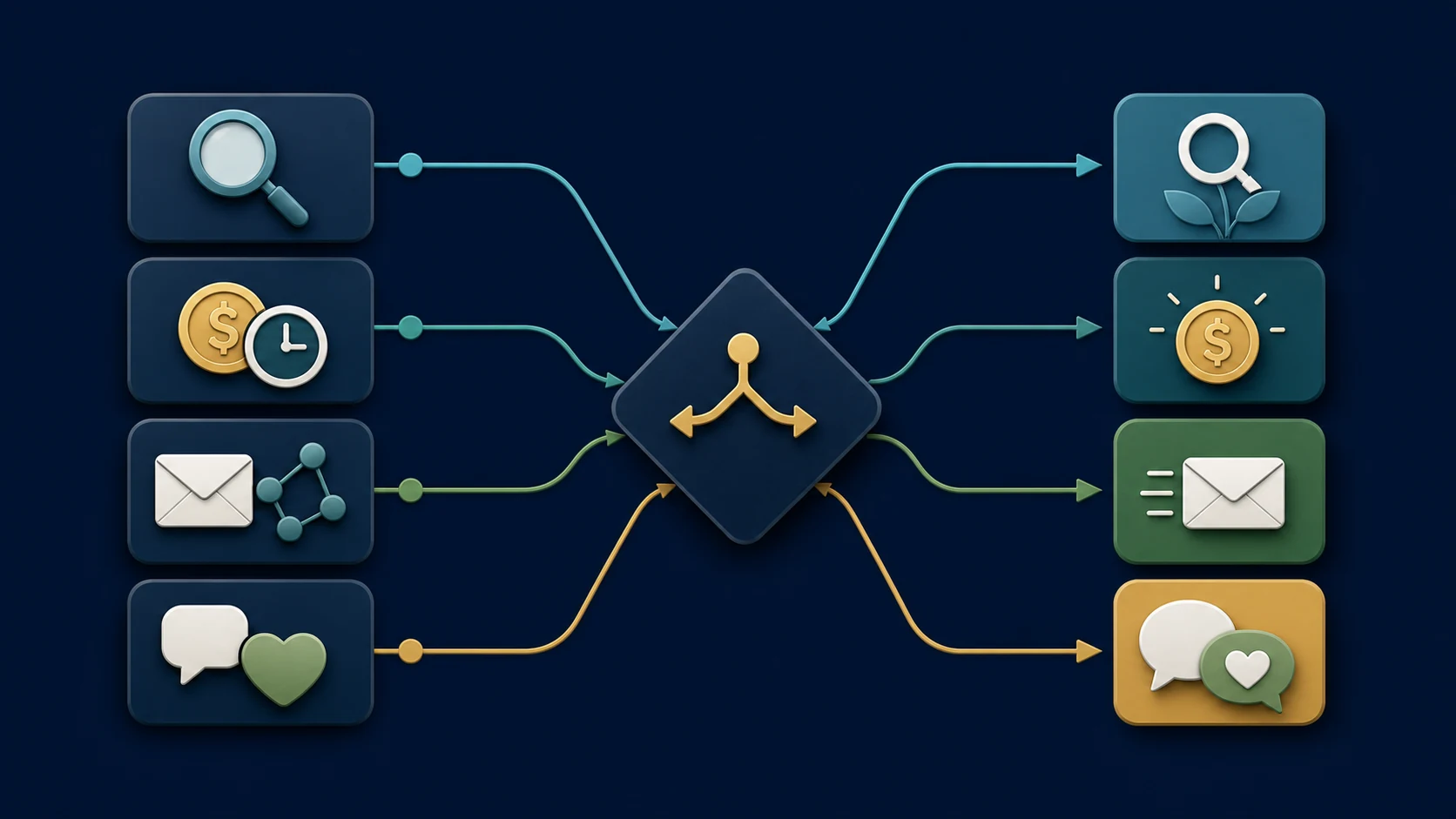
Compare The Four Routes By Evidence
Use a route only when you can name the input, the first test, and the signal that would change your next decision.
Organic Search
Choose search when prospects use words that point to a real page job: a problem to solve, a product to compare, a service to evaluate, or a question that needs a durable answer. The first asset is usually a page that matches that job, not a pile of loosely related posts.
Your earliest evidence can be query relevance, qualified visits, page engagement, assisted conversations, or recurring questions that the page starts to answer. Build the page around the search task, then connect it to a content marketing workflow that can refresh and expand the asset instead of treating publication as the finish line.
Paid Distribution
Choose paid distribution when you can describe a narrow audience, a clear offer, and the landing-page action you want them to take. Treat the first spend as message research. If the audience does not understand the promise or the page cannot earn the next step, more budget only makes the ambiguity more expensive.
Keep the test small enough that a weak result causes a specific change: audience, offer, landing page, or channel. Do not change all four at once.
Direct Outreach
Choose outreach when the buyer list is short enough to research and the message can be made specific. A useful first test is not a bulk sequence. It is a small group where you can explain why the problem matters to each recipient and capture the objections that repeat.
Use those objections to improve your sales page, comparison page, content brief, or offer. Outreach is valuable even before it scales because it turns vague positioning into evidence.
Word Of Mouth
Choose word of mouth when people already have a reason to talk about the outcome you helped create. Make the request easy to act on: a clear referral profile, a concrete result, and a way for the referrer to introduce you without inventing a pitch.
The durable asset is not a generic referral program. It is a repeatable experience worth recommending and a library of proof that makes the recommendation feel safe.
Choose One Route With A Short Scorecard
You do not need a complex attribution model to choose a first route. Compare each option against four questions:
- Demand or access: Do you have evidence that this audience exists and can be reached?
- Time to learning: Can the team observe a useful response before attention or budget runs out?
- Credibility: Do you have a page, offer, proof point, or relationship that makes the first ask believable?
- Compounding value: If the test works, does it create a reusable asset, a stronger audience signal, or a better relationship?
If search wins, write down the exact page type before researching keywords. A service query may need a landing page, a comparison query may need a decision guide, and an educational query may need an article. The SEO content workflow is useful here because it keeps the page type tied to the user task rather than to a raw keyword list.
If outreach wins, name the narrow account pattern and the single objection you want to learn about. If paid wins, name the landing-page action and the one message variable you are testing. If word of mouth wins, name who is most likely to introduce you and what makes the introduction useful to both sides.
Create A Test That Can Change Your Mind
A channel test becomes wasteful when success is undefined or every result is explained away. Before launch, decide what you will do after three possible outcomes:
| Result | What it usually means | Next action |
|---|---|---|
| The right people respond and take the intended next step | The route may deserve another focused cycle | Improve the asset or message, then repeat with one controlled change |
| People respond but misunderstand the value | The audience may be real, but the promise or page is weak | Rewrite the offer, page framing, or qualification rule before scaling |
| The route produces little qualified response | The route is not yet supported by enough demand, trust, or relevance | Pause it and test the next-best route rather than adding more tactics |
Keep a small evidence log: source, audience, promise, page or message used, response pattern, owner, and next review date. That log matters more than a vanity dashboard because it lets the next decision start from what the team actually learned.

Make Search Work Like An Asset
Search is often the best first route when the problem has durable demand and your team can create a page that makes a clearer decision than the current results. It is a poor first route when you need immediate feedback but cannot publish, improve, or earn trust around the page.
When search is the right bet, use it as an operating loop:
- Map the buyer question to one page type and one primary action.
- Check that the page can be crawled, indexed, internally linked, and understood without sales-call context.
- Publish a page that answers the task before it promotes the product.
- Review query, page, conversion, and content-gap signals together.
- Improve the page or add the next supporting asset only after the first page has a clear job.
This is where Searvora can help with the decision rather than with a generic channel recommendation. Its AI SEO Consultant is designed for strategy, prioritization, and execution guidance, so a team can turn search and AI-search signals into a scoped next action instead of another unranked idea list.
Review The Route Before You Add Another
Add a second channel only after the first one has produced a decision, not just activity. A useful review asks:
- Did we reach the intended audience?
- Did they understand the problem and promise?
- Did the page, message, or relationship create a next step?
- What evidence says we should repeat, improve, pause, or switch routes?
- What durable asset or learning do we keep even if we stop?
That sequence protects a lean team from the common failure mode of doing a little paid, a little content, a little outreach, and a little community work without learning enough from any of them. Pick one route, make the first decision testable, and let the next channel earn its place.