

A marketing funnel is a way to organize how people move from first awareness to evaluation, purchase, and repeat use. That definition is useful, but it does not tell an SEO or content team what to publish next.
The useful version of a marketing funnel turns every stage into a page job. It says which search tasks deserve articles, which need landing pages, which existing URLs should be refreshed, what proof the reader needs, and how the team will validate the work after it ships.
The public Ahrefs marketing funnel article explains the concept and the buyer journey. Searvora's information gain is the operating layer: page jobs, crawl readiness, AI-search evidence, owner queues, and validation windows.
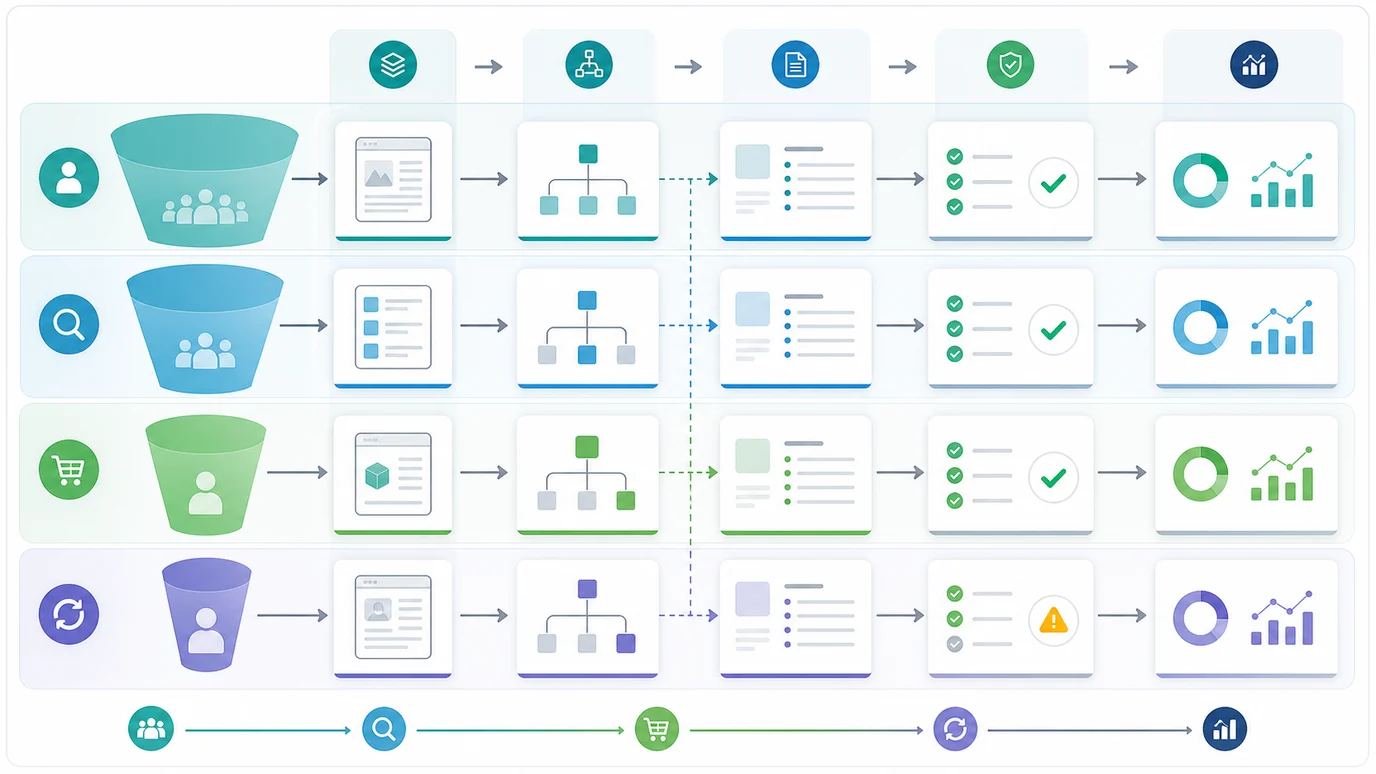
What A Marketing Funnel Should Decide
Do not start funnel planning by asking how many articles each stage needs. Start by naming the decision each stage should improve.
| Funnel question | SEO decision it should create | Common mistake |
|---|---|---|
| What problem is the audience discovering? | Which awareness articles or hubs should explain the topic? | Publishing generic definitions with no next step |
| What options are they comparing? | Which comparison, review, or decision pages should exist? | Treating every comparison query as a blog post |
| What proof do they need before acting? | Which landing pages, examples, screenshots, or case-style sections are required? | Asking an educational article to do conversion work |
| What blocks adoption or retention? | Which support, refresh, or workflow pages should be improved? | Ignoring post-purchase search demand |
This keeps the funnel from becoming a diagram nobody uses. A stage is only useful when it changes the page type, owner, internal links, proof requirements, or measurement plan.
Map Stages To Page Jobs
Search-led funnel planning works best when each stage has a job, not just a label.
| Stage | Reader task | Best page jobs | Evidence to check |
|---|---|---|---|
| Awareness | Understand the problem or category | Explainer, parent hub, glossary-style article, trend analysis | Query language, People Also Ask patterns, AI-answer mentions, existing hub coverage |
| Consideration | Compare options or methods | Decision guide, comparison article, tool roundup, alternatives page | SERP page types, competitor URL shape, internal product fit, source proof needed |
| Conversion | Decide whether to use a product, service, or workflow | Product page, pricing page, case-style proof, implementation guide | CTA fit, objection patterns, screenshots, crawl/indexability of money pages |
| Retention | Make the workflow succeed after adoption | Support article, checklist, refresh guide, troubleshooting path | Support demand, failing templates, repeated crawl issues, content decay signals |
The page job test also protects against cannibalization. Two pages can support the same funnel without competing. They become a problem only when they target the same core keyword, same page type, and same user task.
That is why a marketing funnel article can link naturally to a content marketing workflow without replacing it. The funnel decides where demand belongs. The content workflow decides how approved pages move through briefs, drafting, publishing, and refresh.
Turn Funnel Planning Into A Content Queue
A funnel is operational when it produces a queue your team can ship. Use this sequence before writing titles:
- Gather competitor URLs, Search Console queries, customer questions, product objections, and existing URL evidence.
- Group opportunities by funnel stage and reader task.
- Choose the page type before choosing the headline.
- Check existing Searvora URLs for same-keyword, same-type, same-job overlap.
- Define the information gain that makes the new or refreshed page worth shipping.
- Assign the owner, proof requirements, internal links, and validation window.
For competitor-led gaps, this is where a content gap analysis helps. The goal is not to copy the page that ranks. The goal is to decide whether your site can answer the same job with clearer structure, better evidence, a sharper workflow, or a better next action.
Use this queue table:
| Queue field | What to write |
|---|---|
| Funnel stage | Awareness, consideration, conversion, or retention |
| Reader job | The task the searcher is trying to complete |
| Page type | Article, hub, landing page, tool, comparison, support, or refresh |
| Current closest URL | Existing page to update, link, or protect from cannibalization |
| Information gain | The workflow, proof, table, screenshot, or decision rule you can add |
| Owner | SEO, content, product marketing, engineering, ecommerce, or support |
| Validation window | Next crawl, next reporting cycle, or a fixed review date |
Add Crawl And AI Search Readiness
Marketing funnel planning usually focuses on messaging. Search-led funnel planning adds eligibility and visibility checks before the brief ships.
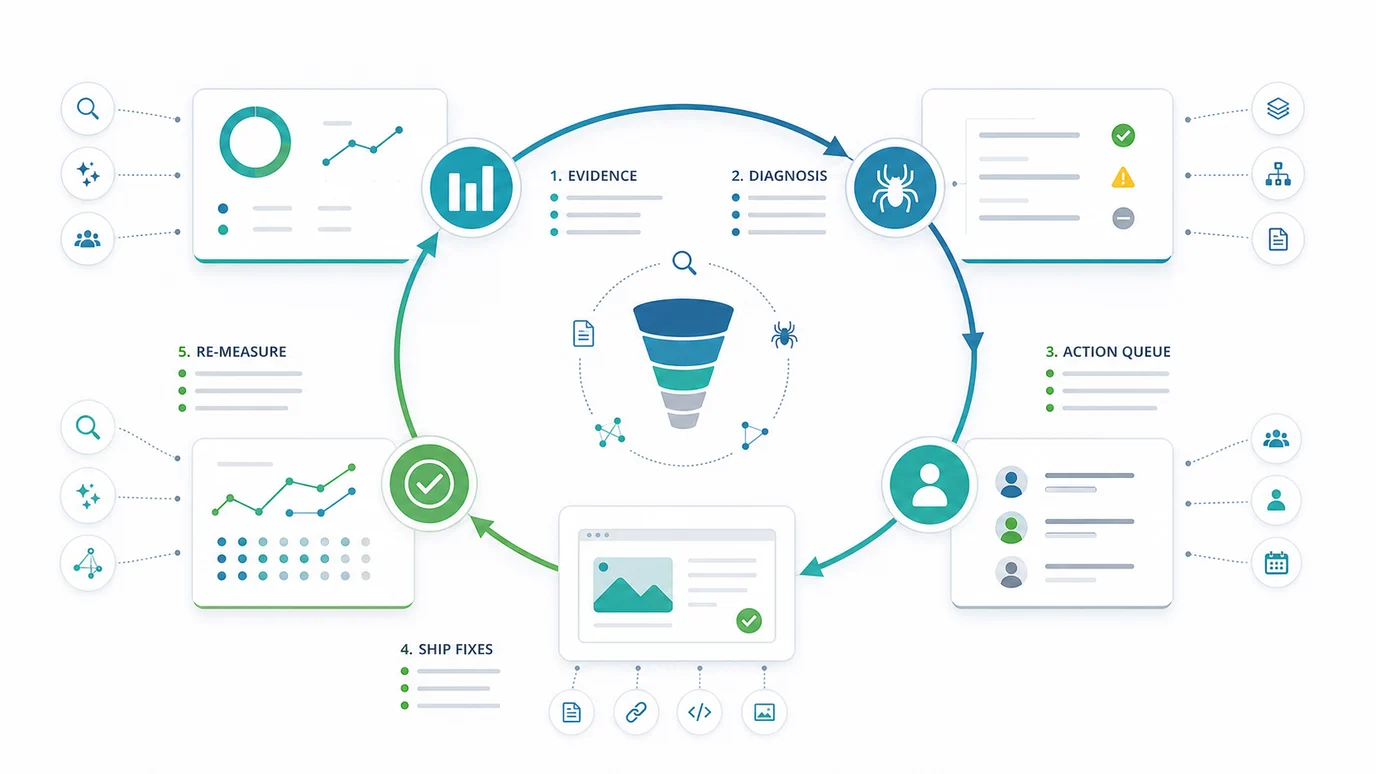
Add these checks to every approved funnel item:
| Readiness check | Why it matters | Better decision |
|---|---|---|
| Crawl access | A page cannot support the funnel if search engines cannot reach or index it | Fix robots, redirects, canonicals, sitemap, or internal links before rewriting |
| Page type fit | Searchers at different stages need different assets | Build a hub, product page, tool, article, or support page intentionally |
| AI-answer clarity | AI search systems need extractable definitions, examples, and source pages | Add plain-language answers, named entities, and source-ready sections |
| Internal-link path | Readers need a next page that matches their stage | Link from awareness to consideration, not always straight to conversion |
| Proof requirement | Later-stage pages need stronger evidence than beginner explainers | Add screenshots, examples, public docs, or product details where the claim needs support |
For measurement, Google's Search Console performance report can help compare queries and pages after the work ships. Pair that with crawl evidence so the team does not mistake an eligibility problem for a messaging problem.
Measure The Funnel By Stage
Sitewide traffic is too blunt for funnel work. A healthy awareness page may create impressions and internal-link paths before it creates conversions. A consideration page may earn fewer visits but better product-fit engagement. A retention page may protect existing users rather than create new demand.
Measure by page job:
| Funnel stage | Useful signal | Watch out for |
|---|---|---|
| Awareness | Impressions, query variety, AI mentions, hub entry paths | Traffic with no internal-link movement |
| Consideration | Comparison queries, return visits, CTA relevance, decision-page clicks | Rankings that attract the wrong buyer stage |
| Conversion | Product-page visits, assisted demos, pricing engagement, qualified actions | Educational traffic being forced into sales CTAs |
| Retention | Support search demand, refresh recovery, issue reduction, repeat content use | Publishing new content when an existing page needs repair |
This is where keyword strategy becomes the planning companion. Keyword strategy prioritizes the roadmap. Marketing funnel planning decides whether the opportunity belongs in awareness, consideration, conversion, or retention before a page is approved.
Where Searvora Fits
Searvora AI SEO Consultant fits the strategy and prioritization layer of this workflow. The local product page positions it around pattern-based diagnosis, priority scoring, fix-ready guidance, and execution alignment. Those are the exact decisions a search-led marketing funnel needs after raw opportunities are grouped.
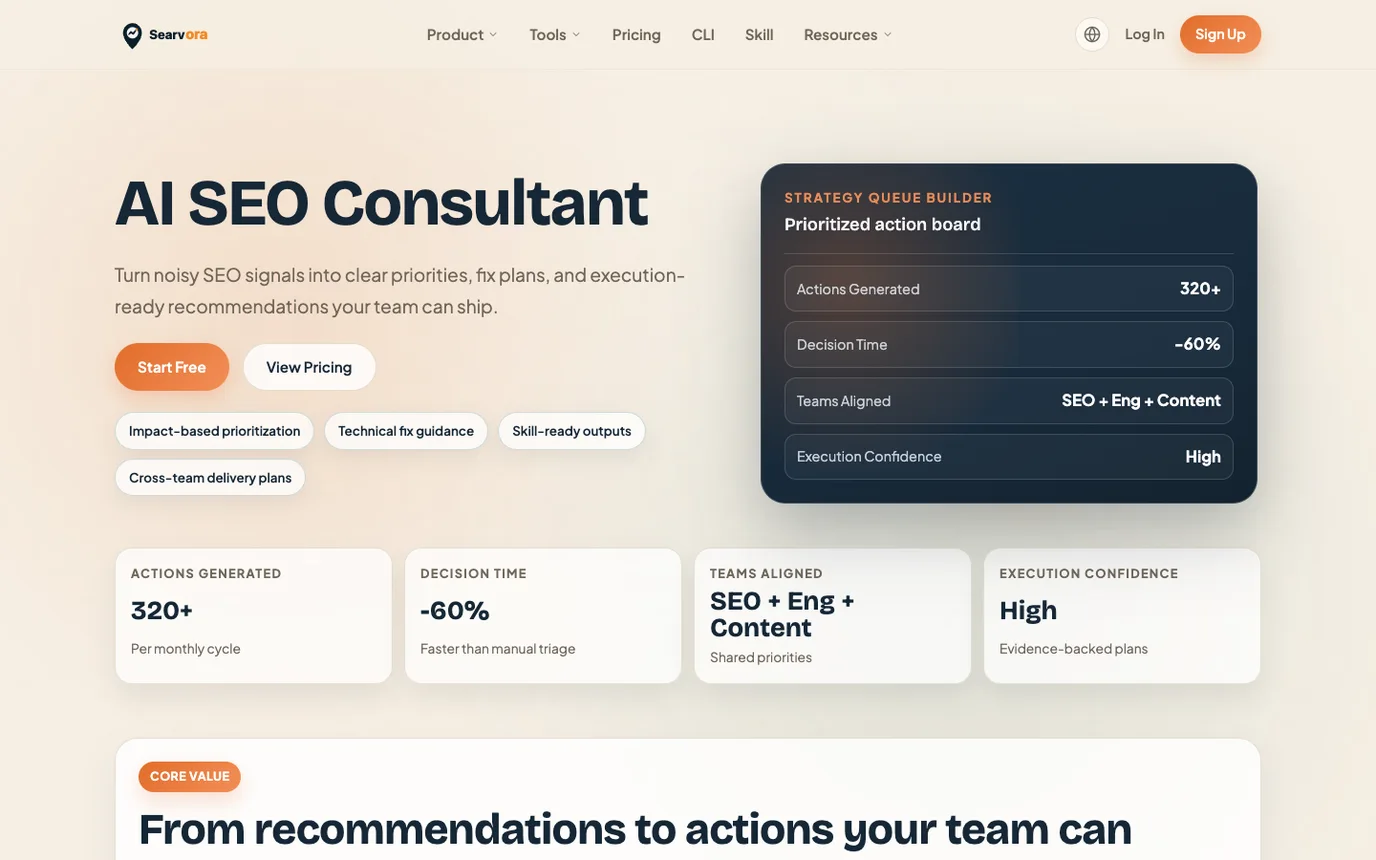
Use Searvora AI SEO Consultant when the funnel queue is noisy:
| Input | Consultant role | Output |
|---|---|---|
| Competitor URLs | Separate article, landing, tool, and hub intent | Draftable gaps or non-blog page recommendations |
| Search demand | Group opportunities by page job and funnel stage | Prioritized create, refresh, merge, defer, or monitor decisions |
| Crawl and content signals | Catch eligibility blockers before content work starts | Fix-ready technical or editorial actions |
| Dashboard movement | Decide whether a stage is gaining, stalling, or drifting | Owner queues with validation windows |
Marketing Funnel Checklist
Run this checklist before approving the next funnel page:
- Name the funnel stage and reader job.
- Choose the page type before drafting the title.
- Check the closest existing URL for same-keyword, same-type, same-job overlap.
- Define the information gain in one sentence.
- Add the proof requirement for the stage.
- Choose one primary product or next-page handoff.
- Confirm crawl, canonical, sitemap, and internal-link eligibility.
- Decide which AI-search or source-page signal matters.
- Assign an owner and validation window.
- Re-measure by stage, not only by sitewide traffic.
A marketing funnel is useful when it changes the work. If it only names awareness, consideration, conversion, and retention, it is a slide. If it routes search demand into page jobs, proof requirements, owners, and validation, it becomes an SEO operating plan.