

URL structure SEO is the work of making important page addresses readable, stable, crawlable, and easy to consolidate. A good URL helps users predict the page, helps crawlers avoid noise, and helps operators connect crawl data, canonical signals, sitemaps, analytics, and redirects without guessing which version is real.
The official Screaming Frog URL Structure guide is a useful primer on URL components and clean naming. The Searvora angle is the operating layer around that advice: decide URL patterns before publishing, control parameters before they multiply, and validate the live site with crawl evidence after changes ship.
Start With The Page Job
A URL is not just a keyword container. It is a contract about what the page does and where it belongs in the site.
Google's URL structure best practices recommend crawlable URLs that are logical and intelligible to humans. That is the right baseline, but operators still need a practical decision process before a slug reaches production.
Use this table before approving a new URL:
| Decision | Strong answer | Review when |
|---|---|---|
| Page job | The URL maps to one clear task, topic, product, or collection | The page mixes multiple intents or could become several pages |
| Folder path | The path explains hierarchy without becoming a maze | The page is buried because the CMS mirrors internal departments |
| Slug | The words are readable, lowercase, hyphenated, and stable | The slug is stuffed, vague, auto-generated, or likely to change |
| Canonical target | One preferred version exists before launch | Case variants, trailing slash variants, parameters, or duplicate routes exist |
| Discovery plan | Internal links and sitemap inclusion support the URL | The page depends on search, filters, or orphan discovery |
Make URL Patterns A Pre Publish Decision
URL structure gets expensive when every template makes its own decision. Blog posts use one pattern, product pages use another, collections add filters, localized routes add language folders, and support docs may keep legacy paths for years.
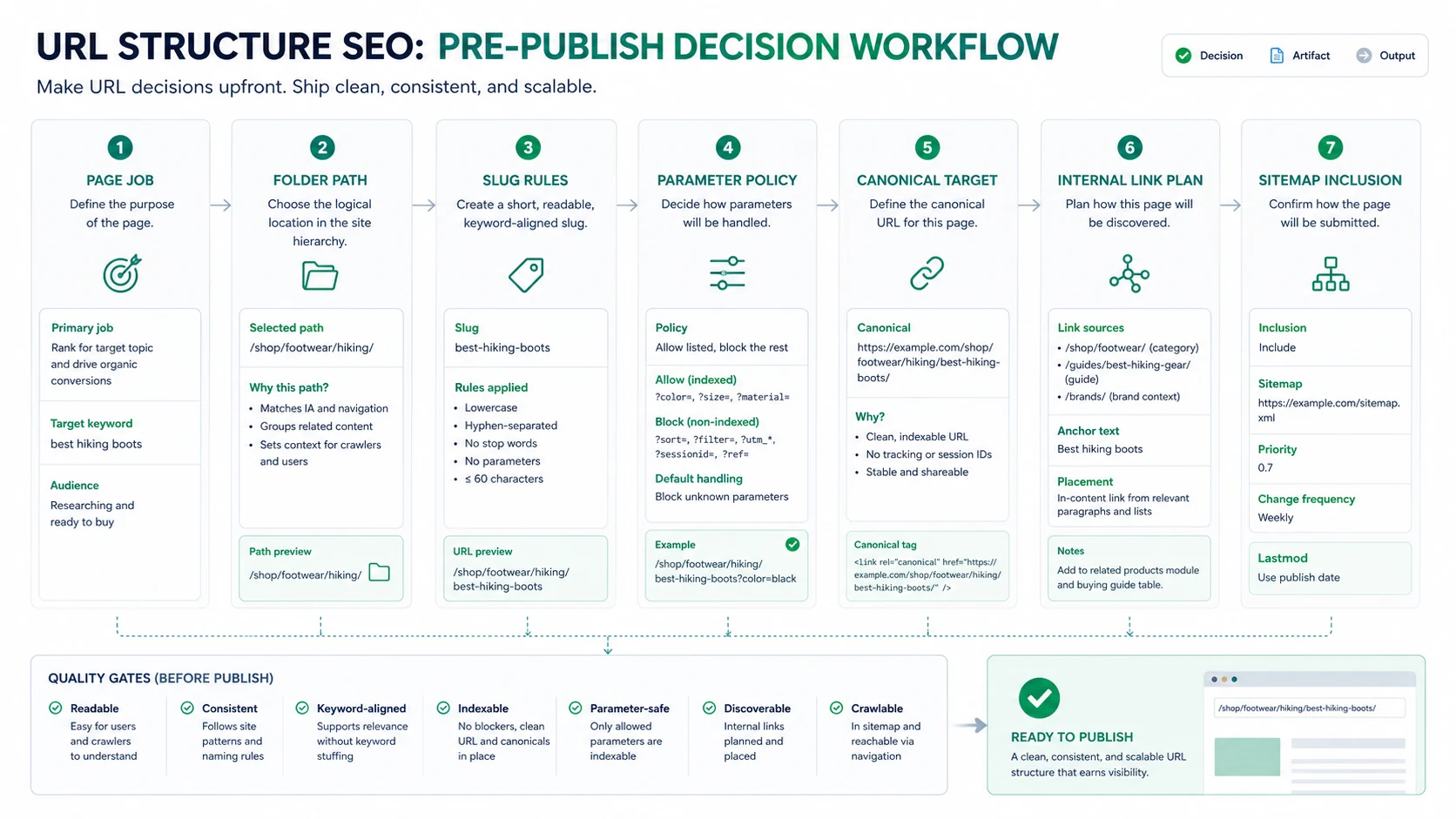
Create a pattern rule for each major page type:
- Name the page type and primary user task.
- Choose the folder depth that helps users and crawlers understand the section.
- Set slug rules for lowercase text, hyphens, stop words, dates, and future edits.
- Decide whether parameters are allowed, blocked, canonicalized, or indexable.
- Define the canonical URL before the page launches.
- Plan internal links from parent pages, hubs, navigation, or related articles.
- Add the URL to the sitemap only when it is canonical and indexable.
This is where URL structure connects to the broader technical SEO workflow. A clean path can still fail if the page is noindexed, blocked, canonicalized elsewhere, missing from internal links, or sitting behind redirect chains.
Control Parameters Before They Multiply
Parameters are where many clean URL systems quietly become crawl traps. Sorting, filtering, tracking, pagination, session IDs, and internal campaign parameters can create many URLs for the same page family.
Google's faceted navigation guidance explains the risk: parameter combinations can create very large URL spaces, which can waste crawling on low-value variants and slow discovery of useful pages.
Separate parameters into four groups:
| Parameter type | Default handling | Example |
|---|---|---|
| Tracking | Strip from canonical and internal links | utm_source, gclid, fbclid |
| Sorting | Usually keep non-indexable | sort=price, sort=popular |
| Filtering | Allow only combinations with unique demand and content value | color=black, size=large |
| Pagination or state | Decide by template and crawl value | page=2, view=grid |
For ecommerce and large content libraries, pair this with faceted navigation SEO. The goal is not to block every parameter. The goal is to know which URLs deserve discovery, which variants should consolidate, and which combinations should never become crawlable inventory.
Keep Canonical Signals Aligned
URL structure SEO becomes much clearer when every canonical signal agrees. The preferred URL should be the one in internal links, canonical tags, redirects, sitemaps, hreflang sets, and reporting dashboards.
Google's canonicalization documentation describes redirects and rel="canonical" as strong signals, while sitemap inclusion is a weaker signal that can still help. Those signals work better together than in conflict.
Use this alignment check:
| Signal | Healthy state | Failure pattern |
|---|---|---|
| Internal links | Links point directly to the preferred canonical URL | Navigation links to redirects, parameters, or old slugs |
| Canonical tag | Self-canonical on the preferred version | Canonical points to a different folder, locale, or parameter |
| Redirects | Old URLs permanently redirect to the chosen replacement | Chains, loops, mixed temporary redirects, or no redirect after a slug change |
| Sitemap | Lists only canonical, indexable URLs | Includes redirected, noindex, duplicate, or parameter variants |
| Hreflang | Each locale points to the correct language equivalent | Alternates point to non-canonical or missing locale URLs |
For multilingual sites, Google's multi-regional and multilingual guidance recommends distinct URLs for language versions and explicit signals such as hreflang annotations, sitemaps, and links. That means locale folders are not only a translation decision. They are part of the URL structure QA surface.
Audit Existing URL Structures With Crawl Evidence
Most URL structure problems are easier to see in a crawl than in a CMS list. A crawl shows whether the site uses the pattern consistently, whether old paths still receive links, and whether duplicate variants are competing with the preferred version.
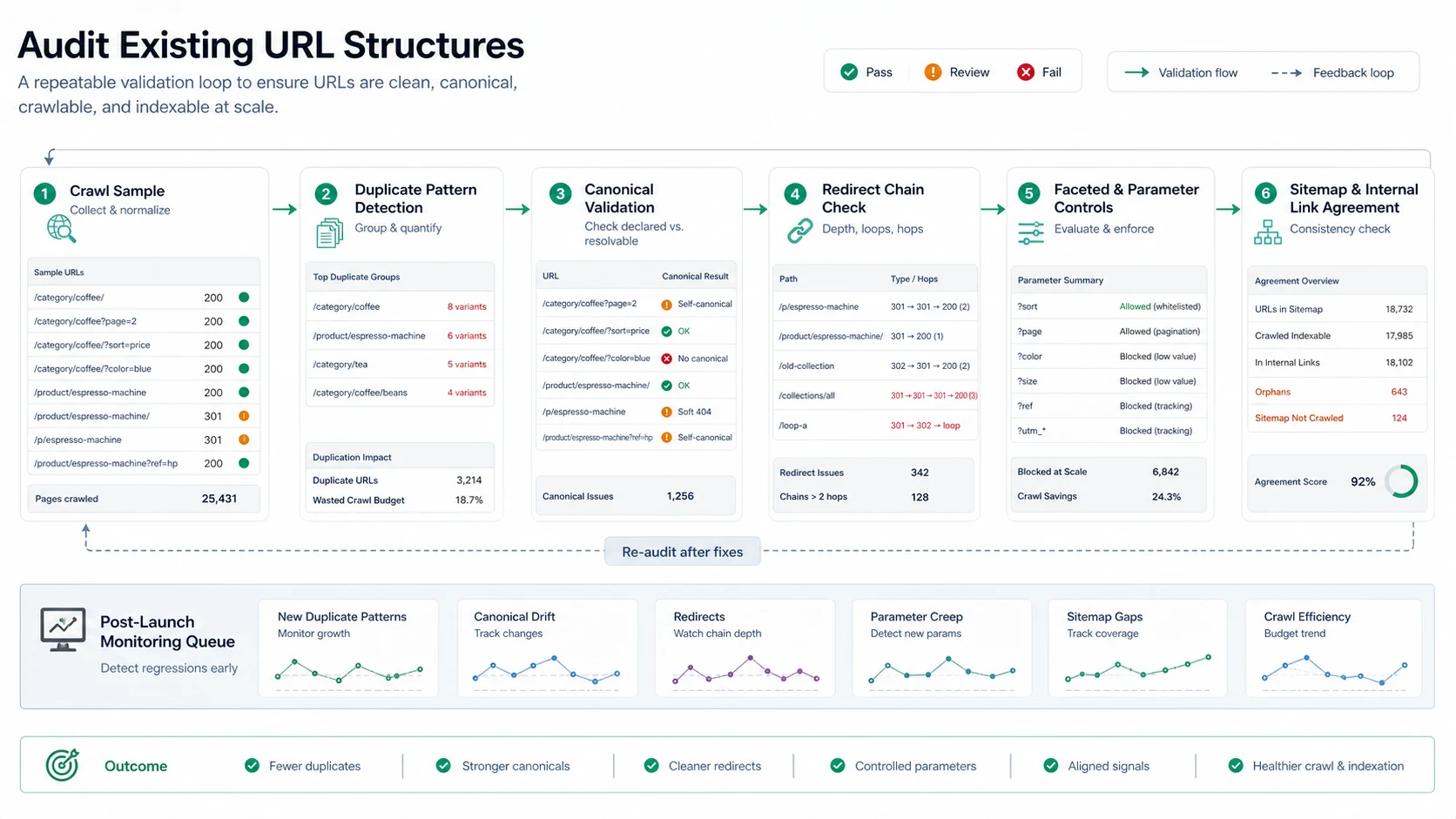
Export these fields before changing any URL:
- Final URL, status code, and redirect chain.
- Indexability and robots directives.
- Canonical URL and canonical match status.
- Crawl depth, inlinks, and source templates.
- Sitemap inclusion and sitemap URL variant.
- Hreflang alternates when localized pages exist.
- Parameter patterns, duplicate groups, and sorted or filtered variants.
- Organic landing-page data for URLs that may need redirects.
Changing a URL without this baseline can turn a naming cleanup into a migration problem. If a page already has links, rankings, references, or conversions, the safer move may be to improve internal links, canonicals, and templates first. Use redirects when the old path truly needs to retire.
If the audit exposes many old links, use the internal links for SEO workflow after the URL decision. Internal links should reinforce the preferred URL instead of asking redirects and canonicals to clean up every path.
Where Searvora Fits
Searvora SEO Spider Crawler fits when URL structure needs to become a repeatable QA workflow, not a one-time naming discussion. Use it to crawl status codes, redirect chains, canonicals, indexability, internal links, sitemap inclusion, hreflang sets, and template groups before assigning URL fixes.
| Searvora workflow step | What the team gets |
|---|---|
| Crawl the current site | A URL inventory with status, canonical, redirect, link, and sitemap evidence |
| Group by page type | Blog, product, collection, locale, and support patterns become visible |
| Flag consolidation issues | Parameter variants, mixed casing, trailing slash drift, and duplicate routes are easier to prioritize |
| Validate after release | Re-crawls show whether redirects, canonicals, links, and sitemaps now agree |
URL Structure SEO Checklist
Use this checklist before approving a new URL pattern or changing an existing one:
- Define the page job and the primary keyword family.
- Choose a folder path that reflects site architecture, not internal team structure.
- Keep slugs readable, lowercase, hyphenated, and stable.
- Avoid fragments for content that search engines need to crawl.
- Decide which parameters are indexable, canonicalized, blocked, or stripped.
- Confirm the preferred canonical URL before launch.
- Link internally to the canonical URL, not a redirect or parameter variant.
- Add only canonical, indexable URLs to XML sitemaps.
- Validate hreflang and locale paths for multilingual pages.
- Re-crawl after releases, migrations, CMS changes, and major template updates.
URL structure SEO is not about making every address short. It is about making every important address durable enough that users, crawlers, canonical signals, internal links, sitemaps, and reporting tools all recognize the same page.