

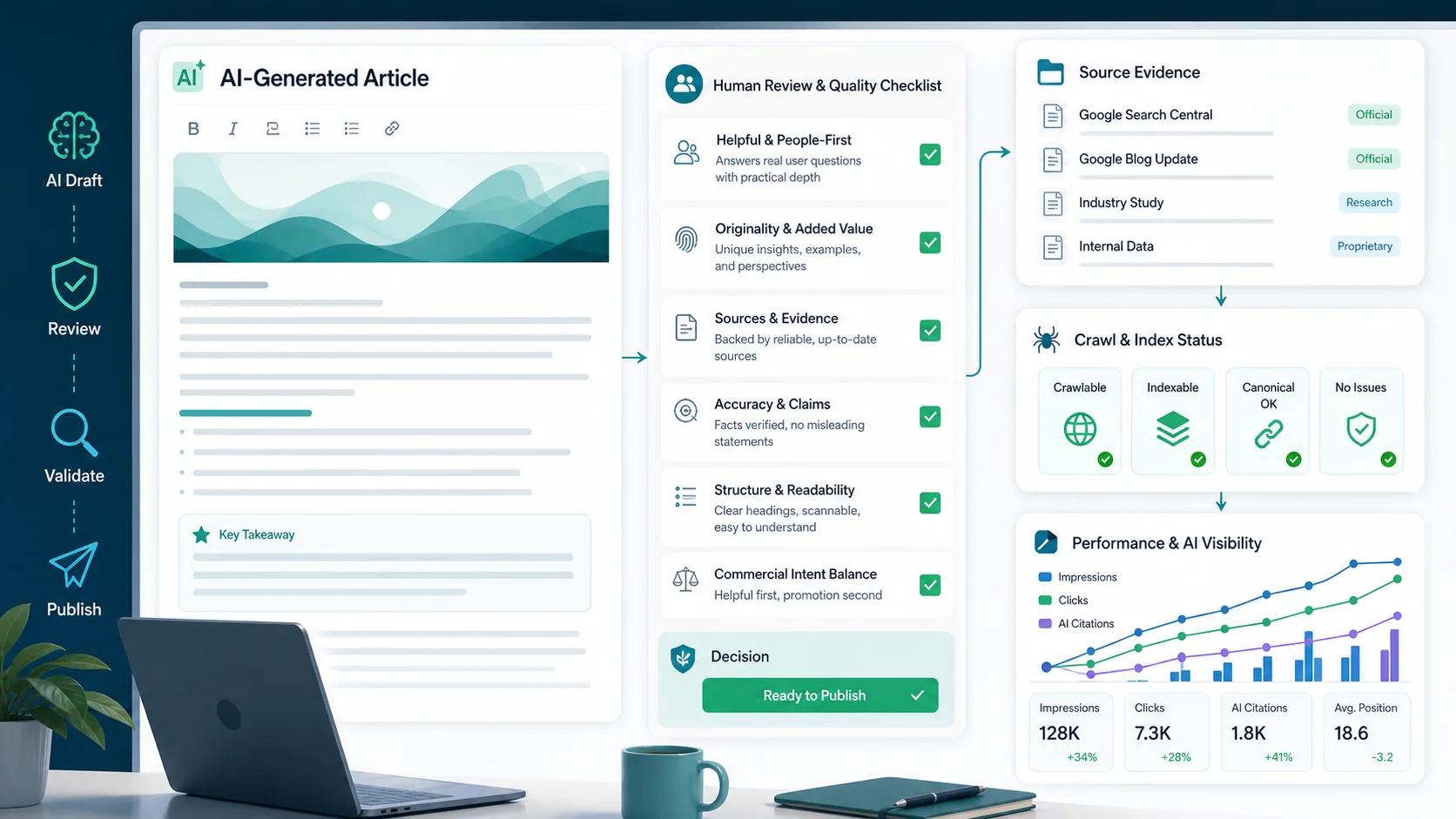
AI-generated content and Google rankings should be judged through a quality gate, not a panic rule. AI help does not create ranking risk by itself; the risk appears when the page is unhelpful, inaccurate, thin, hard to crawl, or published at scale without original value and human judgment.
The Ahrefs data study that surfaced this competitor opportunity analyzed 600,000 pages and argued that AI assistance is common in top results. Searvora's information gain is the operating layer: separate authorship from quality, then decide whether an AI-assisted page is useful enough to ship, monitor, or rewrite.
The Safer Answer Is Quality Over Authorship
Google's public guidance on AI-generated content in Search focuses on usefulness, originality, and whether content is made primarily to manipulate ranking. Its people-first content guidance asks whether a page helps readers, shows evidence, and avoids thin automation.
That means the practical question is not "did AI touch this draft?" The better question is "does this page deserve to be indexed, cited, and shown for the task?"
| Risk signal | What it means | Better action |
|---|---|---|
| Generic explanation with no examples | AI made the page smoother but not more useful | Add specific steps, tradeoffs, examples, or source evidence |
| Unsupported product or policy claims | The page may mislead readers and reviewers | Verify against official pages before publishing |
| Same article repeated across many variants | The site may create thin scaled content | Consolidate, differentiate, or stop the batch |
| Crawling or indexing is unclear | Content quality cannot matter if the URL is ineligible | Check status, canonical, noindex, sitemap, and internal links |
| No post-publish measurement | The team cannot tell whether the page helped | Set a query group, owner, and review window |
Use A Publish Gate Before Blaming AI
Most AI-content mistakes happen before publication. A team has a topic, asks for a draft, polishes the wording, and ships before checking whether the page has a distinct job.
Use this gate before any AI-assisted article goes live:
- Name the search task in one sentence.
- Confirm the right page type: article, tool, landing page, hub, template, or no new page.
- Check whether an existing URL already serves the same core keyword, page type, and user job.
- Add original value: examples, decision rules, screenshots, tables, workflows, or firsthand product context.
- Link claims to official or clearly named sources.
- Validate crawl access, canonical, noindex, sitemap inclusion, and internal links.
- Set a recheck window for rankings, impressions, clicks, and AI-search citation behavior.
This is where AI-assisted content can outperform rushed human copy. AI can speed up structure and drafting, but only a quality gate can decide whether the output is useful enough to publish.
Separate Helpful AI Use From Scaled Churn
AI can support useful content work. It can also make bad content easier to produce. The difference is whether the output changes the page's evidence and utility.
| AI use case | Usually safe when | Risky when |
|---|---|---|
| Outline generation | The outline is revised against search intent and existing coverage | The outline becomes a generic article with no information gain |
| Drafting | Human review adds examples, accuracy checks, and clear source context | The draft invents claims or repeats obvious advice |
| Content refresh | The update improves facts, structure, internal links, and validation | The update only rephrases old paragraphs |
| Localization or expansion | The page still matches local intent and product reality | The same thin content is cloned across locales or topics |
| Metadata help | Title and description match the real page promise | Snippets overpromise what the page does not answer |
If the page is only "AI-written but longer," it is not ready. If the page is clearer, better sourced, easier to crawl, and easier to validate, AI assistance is not the problem.
The existing AI content optimization workflow goes deeper on deciding whether an existing page should be updated. This article is narrower: it is the go/no-go gate for AI-generated content and Google rankings.
Check The Technical Layer Before Publishing
A useful AI-assisted article still needs the boring technical checks. Search systems need to discover, crawl, index, and understand the page before quality signals can help.
Run these checks before the article leaves review:
| Check | Pass condition | Owner |
|---|---|---|
| Status code | Final URL returns a clean 200 response | SEO or engineering |
| Canonical | Canonical points to the intended live URL | SEO |
| Indexability | No accidental noindex, robots block, or blocked rendered content | SEO or engineering |
| Sitemap and links | Sitemap and relevant internal links point to the same URL | SEO or content |
| Visible evidence | Main claims, tables, and examples are visible in the body | Content |
| Snippet fit | Title and meta description match the page promise | Content or SEO |
The content optimization workflow is useful when the page already exists and needs a refresh brief. For a new AI-assisted article, this technical pass should happen before launch so the team does not confuse an indexing problem with an AI-content problem.
Validate Rankings And AI Visibility After Launch
Do not decide that AI-generated content helped or hurt after one ranking check. Save a baseline, publish the page, and review the same evidence after search systems have time to crawl and reassess the URL.
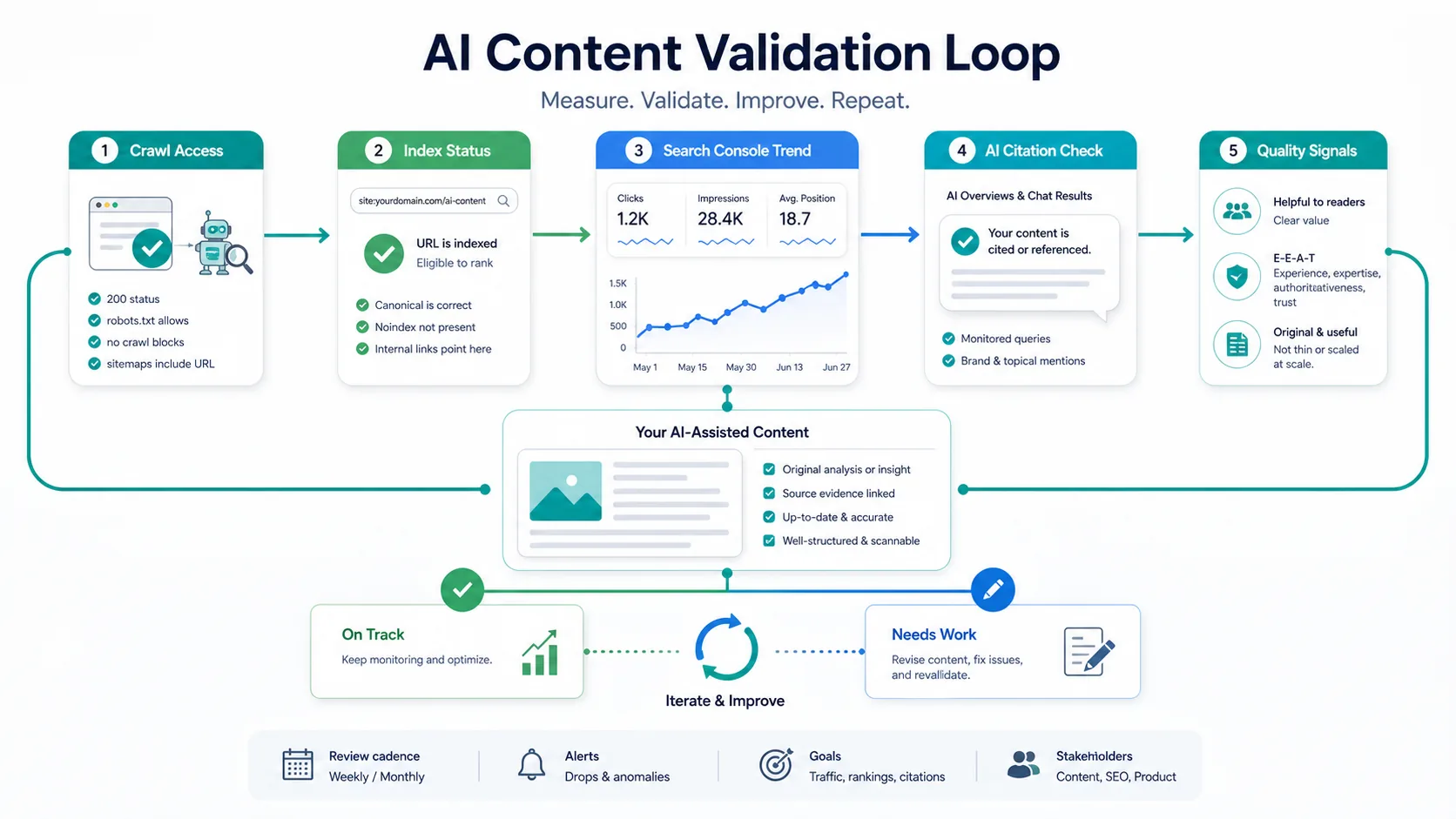
Use this validation loop:
- Save the target query group, ranking URLs, impressions, clicks, and current AI-search citation evidence.
- Confirm the live article renders the intended title, H1, body, images, canonical, and internal links.
- Recheck crawl and index eligibility after publishing.
- Review Search Console movement by query group and page, not only sitewide averages.
- Check whether AI answers cite the page, cite competitors, or ignore the topic.
- Decide the next action: leave it, refresh evidence, consolidate overlap, add internal links, or rewrite.
Google's AI search guidance still points teams toward helpful content, visible text, technical eligibility, and source quality. That is the same loop classic SEO needs, with one extra evidence layer for AI citations and source-page usefulness.
Where Searvora Fits
Use Blogify when AI-assisted content needs a repeatable publishing gate instead of a loose prompt. The current Searvora product page positions Blogify around store-aware topic intelligence, structured SEO drafting, internal links, metadata, product context, multilingual workflows, and Shopify draft handoff.
That makes Blogify most useful after the team has approved the page job and needs the draft to move through structured SEO blocks, review-ready content, and publish workflow checks. Pair that with Google ranking factors when the team needs to separate ranking myths from practical quality checks, and use content structure for AI search visibility when the draft needs more extractable answers, tables, and evidence.
The Practical Checklist
Before approving AI-generated content and Google rankings risk, answer these questions:
- Does the page answer a distinct search task?
- Is the page type correct for the query?
- Does existing Searvora or site content already serve the same job?
- Does the article add examples, evidence, or decision support beyond generic wording?
- Are claims tied to official, public, or first-party sources?
- Is the URL crawlable, indexable, canonical, internally linked, and in the sitemap?
- Are the title, H1, intro, visuals, and tables visible in the rendered page?
- Is there a Search Console and AI-citation review plan after launch?
AI-generated content hurts Google rankings when it becomes low-quality content at scale. It does not become dangerous because a model helped with drafting. The durable workflow is to publish only the AI-assisted pages that are useful, original enough, technically eligible, and measurable after they ship.