

AI search prompt tracking is the practice of keeping a small, purpose-built set of questions, checking the same set over time, and turning repeatable changes into page work. The point is not to collect every possible prompt or celebrate one favorable answer. It is to know which query groups matter, which owned page should support each group, and what the team will do when the pattern changes.
That is different from a conventional keyword list. A keyword list can be broad and still be useful for discovery. A prompt-tracking set must be stable enough to recheck and specific enough to create a next action. If a prompt cannot change a page, a message, a technical check, or a watchlist decision, it does not belong in the first version of the set.
Start With A Prompt Portfolio, Not A Giant List
Begin with four groups. They keep the set useful without pretending that every prompt has the same job.
| Prompt group | What it tests | Useful source material | What a change can mean |
|---|---|---|---|
| Brand | How the company, product, or people are described | Branded questions, sales objections, support language | Entity clarity, proof, or product messaging may need work |
| Category | Whether a source page answers the core market problem | Category pages, feature pages, high-value explainers | The category definition, examples, or internal linking may be weak |
| Comparison | How options are framed when a reader is choosing | Alternatives, comparison questions, migration concerns | A comparison page, use-case proof, or product positioning may need attention |
| Evidence-seeking | Which pages are used to support a factual answer | How-to questions, technical checks, research questions | The owned source page may need stronger evidence, structure, or technical eligibility |

Do not force every group to contain the same number of prompts. A small B2B product may start with three category questions, two comparison questions, and a handful of evidence-seeking prompts. The useful test is coverage of decision-making jobs, not an arbitrary count.
Source Prompts From Work Your Team Already Does
The first prompt set should not come from a blank brainstorming session. Start with the language already connected to traffic, conversion, content, and customer questions.
- Pull questions from important page groups and existing search queries.
- Add category questions that buyers, analysts, or journalists would ask before knowing your brand.
- Capture comparison and migration questions from sales, support, and competitive research.
- Add evidence-seeking prompts for pages that should be cited, recommended, or trusted.
- Include a limited number of prompts where a competitor appears consistently and you have a credible source-page response.
The AI visibility evidence loop is a useful companion here. It explains why prompt checks, mentions, citations, crawl signals, and next actions should be recorded separately. A prompt set becomes more useful when it connects to a source URL instead of only recording whether a brand name appeared.
Avoid copying every phrasing variant. If five prompts ask the same category question, keep one primary wording and one meaningful variation only when it changes the user job. This makes it possible to tell whether a change is in the answer landscape or in your own sampling.
Give Every Prompt A Page Hypothesis And An Owner
Before the first check, write down the page that should earn trust for each prompt. The page may be a product page, a reference article, a comparison page, a support page, or no page at all. That decision prevents the team from rewriting a blog post when the real gap belongs in product copy or technical SEO.
| Field | What to record | Why it prevents bad decisions |
|---|---|---|
| Exact prompt | The wording, market, language, and platform checked | Lets the team rerun the same test |
| Prompt group | Brand, category, comparison, or evidence-seeking | Preserves the reader job behind the question |
| Page hypothesis | The owned URL that should answer or support the query | Stops accidental cannibalization and random rewrites |
| Observation | Mentions, cited sources, answer framing, and stability | Separates evidence from interpretation |
| Action owner | Content, product marketing, technical SEO, or SEO lead | Makes the change shippable |
| Recheck condition | What must be true before the next review | Keeps short-term volatility from becoming a false win |
For example, a category prompt may map to one authoritative explainer, while an evidence-seeking prompt may map to a technical guide with a clear definition, examples, and strong internal links. A competitor mention does not automatically mean a new article is needed. First ask whether the right existing page is visible, technically eligible, and built for the same reader job.
Track A Repeatable Cadence Instead Of Single Answers
AI answers can change because the wording changes, the source mix changes, the system interprets the question differently, or the prompt was checked in a different context. Treat one answer as an observation, not a conclusion.
Use a cadence that matches the decision. A high-value comparison group may deserve a regular review. A long-tail evidence-seeking group may only need a monthly check or a recheck after a source-page update. Preserve the same core context each time so the result is comparable.
Record the following beside each check:
- the prompt, date, market, language, and platform;
- whether an answer was present and whether it was materially stable;
- the brands and source URLs that appeared;
- the owned page that should have supported the answer;
- the change that was shipped or the reason the prompt remains on watch;
- the date and condition for the next review.

Use this triage table to keep the conversation honest:
| Pattern | Better interpretation | Next action |
|---|---|---|
| No meaningful change across checks | The current set may be stable enough to monitor less often | Keep the cadence; do not manufacture a fix |
| One unusual answer with no repeat | The observation may be volatile or context-specific | Add a note and move it to a short watchlist |
| A repeatable competitor source appears | Another page may better satisfy the same evidence-seeking job | Compare page type, directness, proof, and technical eligibility |
| An owned page appears but is framed weakly | The page may have visibility without a clear positioning or proof layer | Improve the page's answer block, examples, or entity language |
| An owned page should appear but does not | The issue may be page fit, content depth, crawlability, or internal links | Diagnose the source page before creating another article |
Turn Material Changes Into A Small Validation Queue
The monitor is only useful when it produces bounded work. For every material pattern, choose one action that can be verified. Avoid a vague brief such as “improve AI visibility.” A good item names the page, the gap, the owner, and the recheck condition.
| Finding | Smallest useful action | Validation question |
|---|---|---|
| The prompt maps to the wrong owned URL | Consolidate or clarify the canonical page role | Does one page now answer the exact user job first? |
| A competitor has a more direct source page | Add a concise answer, evidence, and supporting links to the right owned page | Is the source page now easier to identify and verify? |
| The source page is technically weak | Check indexability, canonical, rendered content, sitemap, and internal links | Can search systems discover and render the page that should win? |
| The answer is unstable | Keep the group in a watchlist with a fixed recheck window | Does the pattern repeat before a team spends time on it? |
| A category gap is real | Create or update the best-fit article, hub, or product page | Is the page type correct before writing begins? |
The AI search competitor comparison workflow helps when the question is why another brand is trusted. Keep this article narrower: it helps you choose the prompts worth checking before you interpret the competitors that appear.
Check The Source Page Before You Rewrite It
When a prompt indicates a gap, check the source-page basics before opening a content brief. The best response may be a technical fix, a clearer definition, a comparison update, or no change at all.
Use this short source-page review:
- Confirm that the selected URL is the right canonical page for the prompt's user job.
- Make the direct answer easy to find in rendered content.
- Check that the page is indexable, internally linked, and represented in the sitemap.
- Add examples, constraints, proof, or a decision table when a competitor source is more useful.
- Preserve clear entity and product language across the page and its supporting links.
- Recheck the same prompt group after the page change has had time to be discovered.
For a deeper source-page diagnosis, use the AI search citation audit. It separates a brand mention from a cited URL and turns the result into crawl, content, and internal-link work instead of an unstructured rewrite sprint.
Where Searvora Fits
Once the prompt portfolio is stable, Searvora AI SEO Dashboard is a useful monitoring surface for the review cadence. The product page is designed for AI SEO and GEO visibility review alongside signals that teams can turn into prioritized work. Use it to keep the evidence close to page groups, owners, and recheck decisions rather than treating an isolated answer as a score.
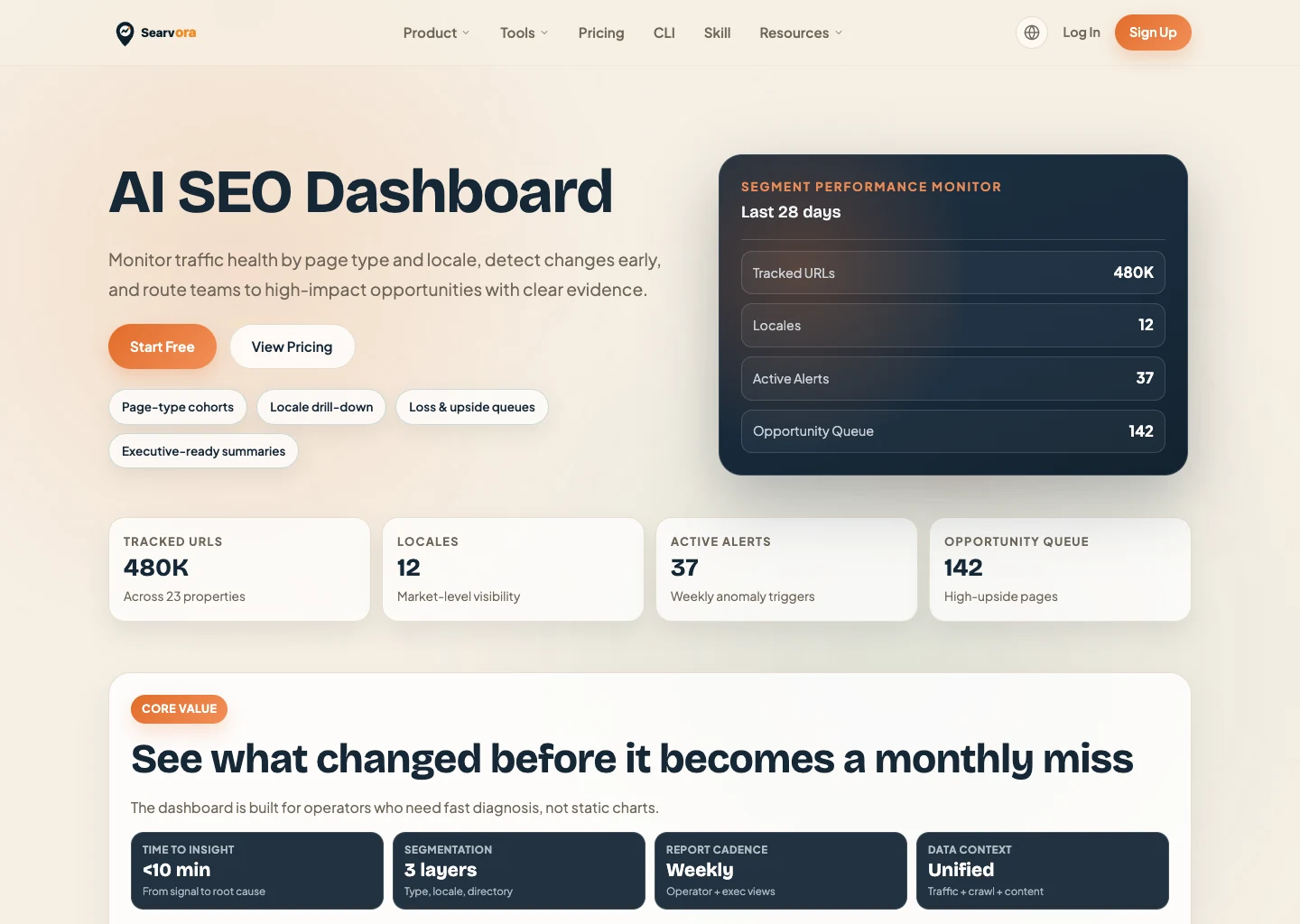
Keep the product role honest: the prompt portfolio and the review rules still need human judgment. The dashboard is where a team can organize the monitoring discussion, compare changes by page group, and decide what should ship next. The actual proof remains the same: a clear source page, a recorded change, and a repeatable validation check.
Weekly AI Search Prompt Tracking Checklist
- Review one prompt group at a time instead of checking an unbounded list.
- Reuse the same wording, market, language, and platform where possible.
- Record mentions, source URLs, framing, and answer stability separately.
- Map each meaningful prompt to the owned page that should answer it.
- Move one-off fluctuations to a watchlist instead of creating immediate work.
- Turn repeatable patterns into one specific page, technical, or positioning action.
- Name an owner and a recheck condition before calling the item prioritized.
- Reuse the same prompt portfolio after the change ships so the team can learn from the result.
AI search prompt tracking works when it narrows the work. A compact portfolio gives your team a repeatable way to spot a source-page gap, decide whether it deserves action, and validate the same question later without chasing every changing answer.