

The best Amazon affiliate websites are useful before they are promotional. They focus on a clear audience, help readers make a real decision, disclose how links may earn money, organize pages so both people and crawlers can find them, and keep recommendations current.
This roundup studies seven sites named in the Ahrefs collection of Amazon affiliate website examples. Instead of repeating historical traffic estimates or revenue claims, it reviews what is visible on the current public sites: their niche, page model, trust signals, architecture, and maintenance risk. That makes the examples more useful for an operator building a durable content system now.
Seven Examples at a Glance
Use the table as a pattern library, not a leaderboard. A site can teach one strong lesson while still having gaps you should not copy.
| Website | Current public model | Pattern worth studying | Verify before copying |
|---|---|---|---|
| The Prepared | Preparedness guides, reviews, checklists, courses, and community | Tight audience promise with guide and review paths | Which pages use affiliate links and how commercial relationships are disclosed |
| Homegrounds | Coffee site named in the source roundup | A focused enthusiast niche can support guides and product decisions | The current public root presented a login surface during review, so recheck accessible content and disclosures |
| Dog Food Advisor | Dog food reviews, ratings, recalls, and advice | Category-led decision support with prominent editorial positioning | Rating methods, ownership, update policy, and affiliate disclosure on the page being cited |
| PCPartPicker | Compatibility tool, product catalog, build guides, trends, and community | A useful tool can create repeat visits and naturally support merchant links | Price freshness, merchant coverage, disclosure placement, and regional differences |
| Equipboard | Artist gear discovery and equipment pages | Entity-led pages can connect people, products, and use cases | Current pages sit behind an access challenge for automated review, so verify claims and disclosure manually |
| Territory Supply | Outdoor destination and hiking editorial | Strong niche imagery and destination-led content clusters | Whether current monetization paths match the page type and remain clearly disclosed |
| Wirecutter | Product reviews, buying advice, deals, and a store | Explicit editorial promise plus visible monetization disclosure | Testing methodology, update dates, retailer relationships, and whether your team can support comparable rigor |

The five-part evidence framework is simple:
- Niche focus. Can a new visitor tell who the site serves and what decisions it helps with?
- Decision usefulness. Does the page compare criteria, tradeoffs, compatibility, or use cases instead of repeating merchant copy?
- Trust and disclosure. Are editorial standards, commercial relationships, and recommendation methods visible enough to evaluate?
- Crawlable architecture. Can important guides, categories, products, and supporting pages be reached through stable internal paths?
- Refresh discipline. Is there an owner and trigger for updating prices, availability, recommendations, links, policies, and evidence?
If you are still choosing the program rather than the site model, start with the beginner affiliate program comparison. This article begins after that choice and asks what the website itself must do well.
1. The Prepared Builds Around a Specific Audience
The Prepared immediately states the audience and job: practical emergency preparedness without sensational framing. Its public homepage routes readers into beginner guidance, checklists, gear reviews, courses, a forum, and topic hubs.
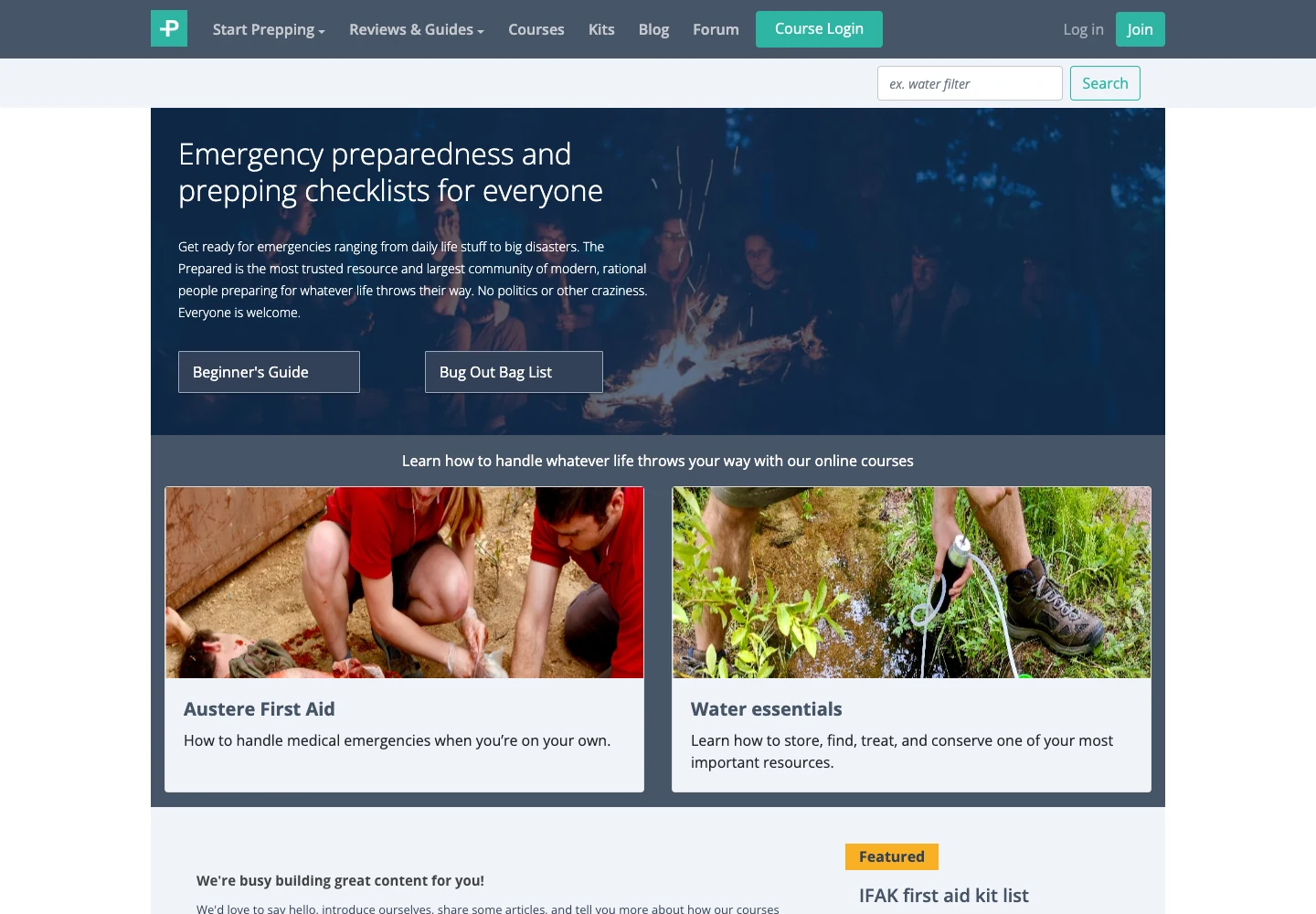
The strongest lesson is not “publish more gear roundups.” It is to own a coherent reader problem. The site can support product-led pages because it also publishes skills, planning, and scenario content. Those non-commercial pages create context for a recommendation and give the architecture more depth than a collection of isolated “best” posts.
What to adapt:
- write a one-sentence audience and problem promise before choosing keywords;
- connect commercial reviews to non-commercial guides that help readers use or evaluate the product;
- create stable category paths instead of publishing every article into one flat feed;
- make expertise and editorial standards easy to find from the pages that ask for trust.
The maintenance risk is breadth. Preparedness spans medical, food, water, communications, vehicles, weather, and gear. A smaller publisher should start with one subtopic it can verify well rather than imitating the entire taxonomy.
2. Homegrounds Shows Why Old Examples Need Rechecking
Homegrounds appears in the source roundup as a focused coffee affiliate site. That historical classification is useful, but it is not enough evidence for a current recommendation. During this review, the public root resolved to a login surface rather than the expected editorial homepage.
That makes Homegrounds a valuable maintenance lesson. Affiliate case studies age. Domains change owners, templates move, content becomes gated, redirects shift, and disclosure or review pages disappear. A strategist who copies an old roundup without reopening the examples can build a brief around a site model that no longer exists publicly.
What to adapt:
- treat competitor roundups as leads, not permanent truth;
- record the URL, visible title, page type, owner, review date, and evidence source;
- recheck the live site before citing its tactics, traffic, tools, or commercial relationships;
- remove or qualify examples when the current public surface no longer supports the claim.
Do not replace the missing evidence with guesses. If the site becomes publicly accessible again, review its category structure, article templates, disclosure, and update dates before using it as a model.
3. Dog Food Advisor Makes the Decision Job Obvious
Dog Food Advisor presents reviews and ratings as the main product, then supports that promise with category paths, recalls, breed information, and advice. The homepage tells a visitor what decision the site helps with before asking them to browse individual products.
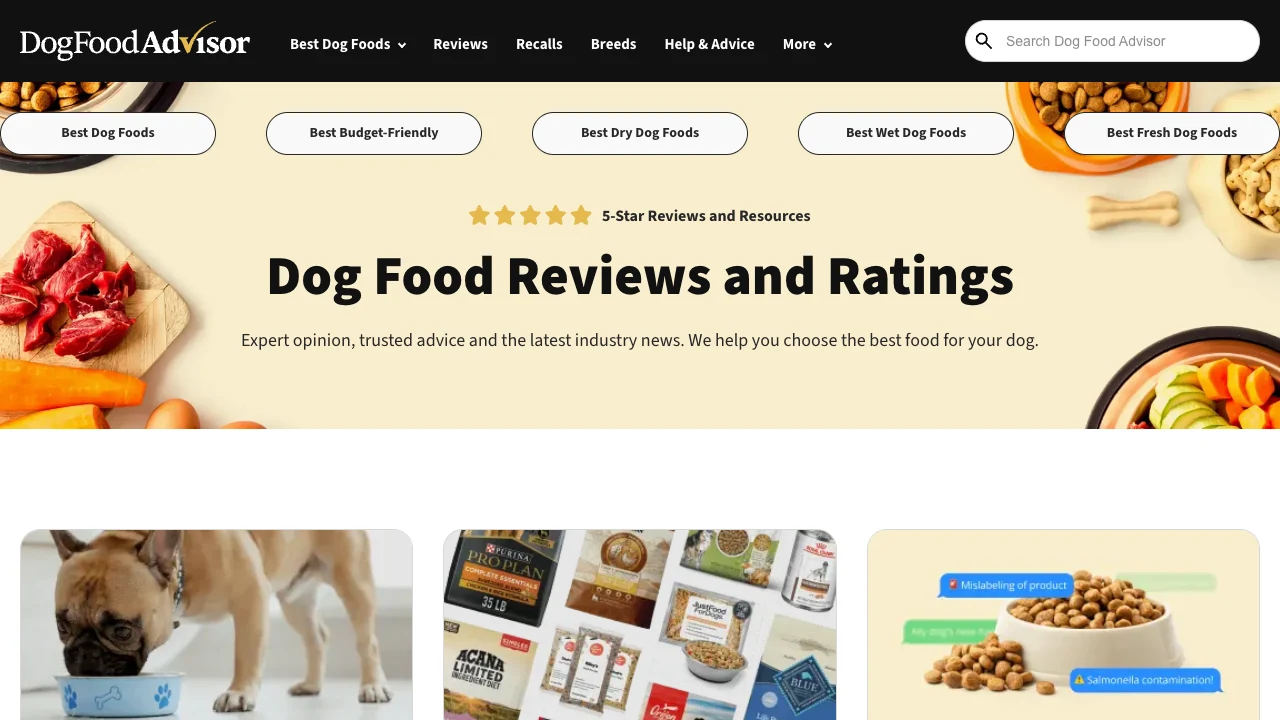
The site also exposes an About path and a disclosure page in its public navigation. That does not prove every recommendation is correct, but it gives a reader places to inspect the methodology and commercial relationship.
What to adapt:
- lead with the decision the reader needs to make, not the affiliate program you joined;
- organize content by meaningful buyer criteria such as budget, format, use case, or constraint;
- publish the review method and explain what can change the recommendation;
- connect fast-changing safety or recall information to the relevant evergreen pages.
The caution is the cost of a ratings model. If you cannot document criteria, evidence, conflicts, and update ownership, use a decision guide or comparison table instead of inventing a score.
4. PCPartPicker Wins With Utility Before Editorial Volume
PCPartPicker helps people choose compatible components, compare prices, save builds, and learn from completed systems. Its builder, product catalog, guides, trends, benchmarks, and forums all support the same job: planning a PC build.
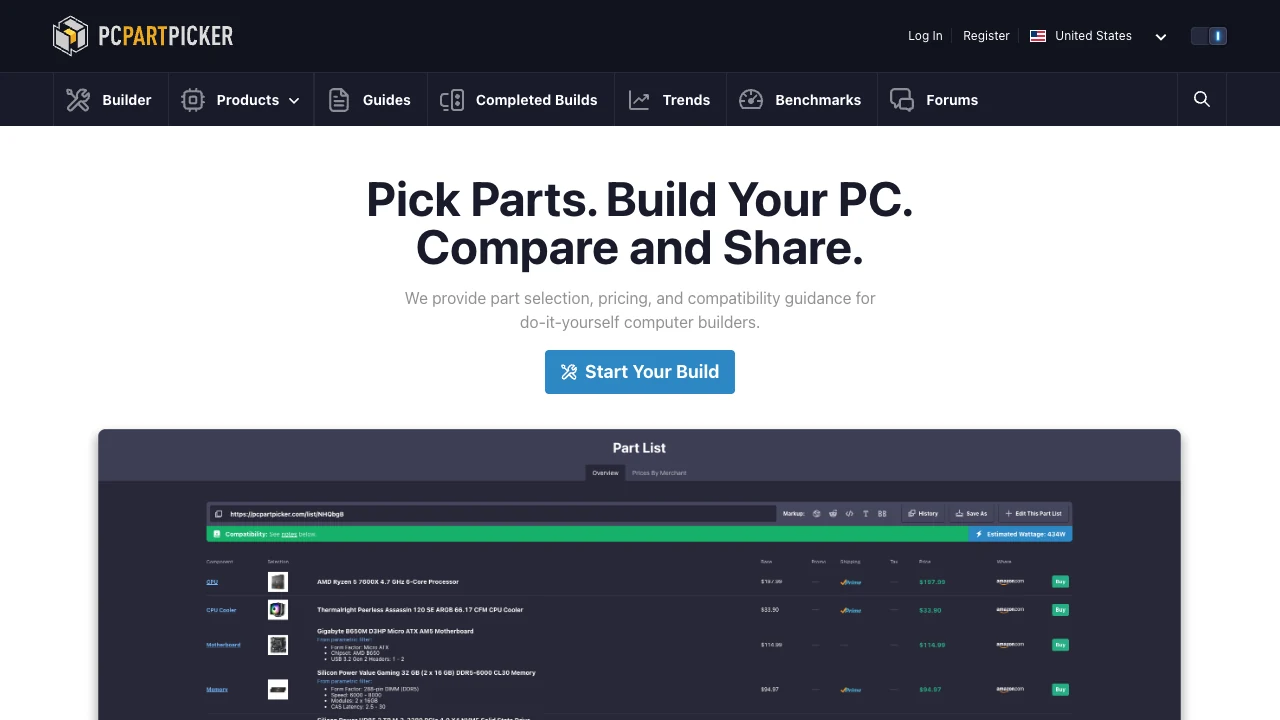
This is the clearest example of a non-article surface doing the hardest work. The tool creates repeat value, while guides and community pages explain choices that a compatibility result alone cannot answer. The site also provides a public affiliate disclosure and an industry code of conduct path.
What to adapt:
- build a calculator, checker, configuration aid, or structured comparison when the search task is interactive;
- let articles answer the judgment questions around the tool rather than duplicating the tool output;
- design internal paths from a result to a guide, category, and next action;
- treat merchant availability and price freshness as data-governance problems, not copywriting tasks.
This pattern should not be forced into a blog. If the winning user job needs saved configurations, live compatibility, or changing inventory, recommend a tool or product surface and use articles as support.
5. Equipboard Demonstrates the Verification Boundary
Equipboard is named in the source roundup for connecting artists, equipment, and product discovery. That entity-led model can be powerful: a person page, equipment page, and category page can reinforce one another through specific relationships rather than generic product lists.
The current public edge presented an access challenge to automated review. That is not a judgment about the site, its content, or its business. It is a verification boundary. A client brief should not claim current rankings, product coverage, disclosure placement, or user features from an old case study when the live evidence could not be inspected.
What to adapt after human verification:
- connect products to real people, use cases, genres, workflows, or compatible items;
- keep the underlying relationship in searchable page content, not only in cards or images;
- give entity pages stable canonical ownership and crawlable internal links;
- record the source and last-verified date for claims about who uses what.
Entity-led affiliate sites can create strong long-tail coverage, but only when the relationships are sourced and maintained. Unsupported associations turn the same architecture into a trust liability.
6. Territory Supply Uses Editorial Clusters, Not a Storefront Clone
Territory Supply currently presents outdoor destination and hiking editorial with strong visual hierarchy. Its homepage groups content around trails, places, and activities rather than looking like a merchant catalog.
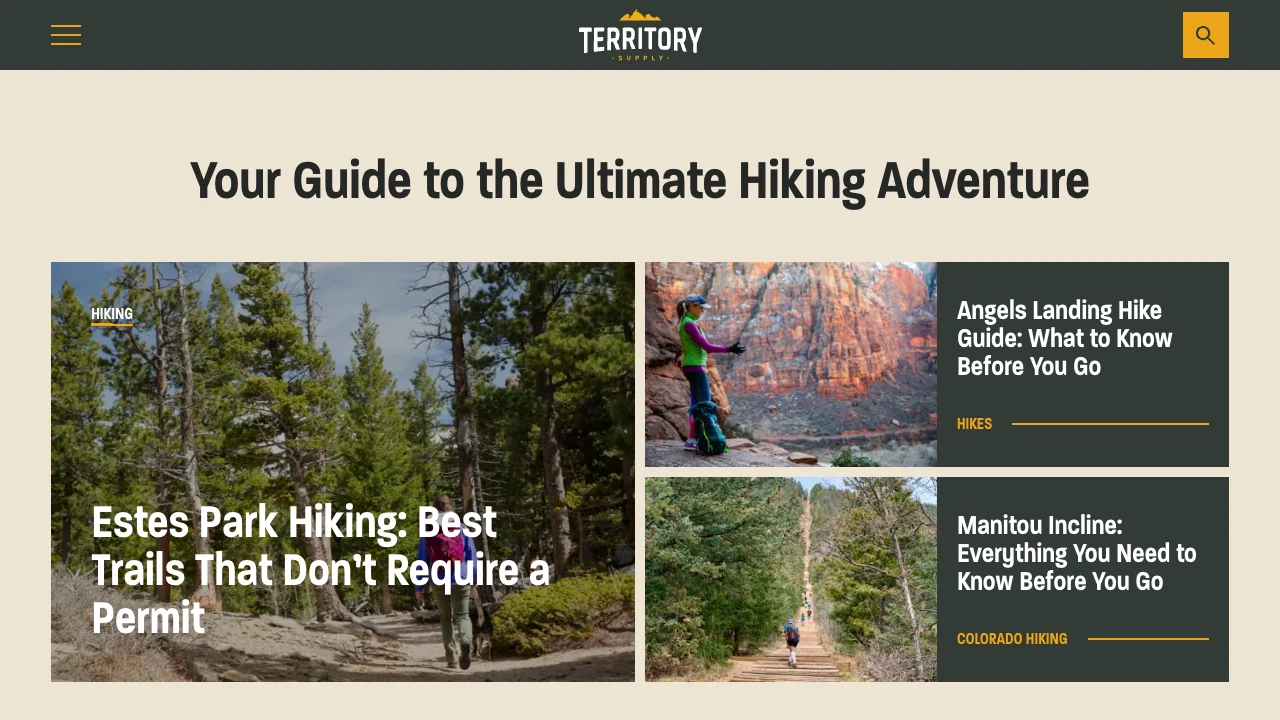
The public site also links to editorial policies. That is useful because outdoor content can blend destination guidance, gear, safety, and commerce. A visible policy gives the publisher somewhere to explain how recommendations are selected and how commercial relationships are handled.
What to adapt:
- make the destination or activity the primary editorial promise;
- place product recommendations inside a real planning or safety task;
- use topic hubs to connect places, seasons, skills, and equipment naturally;
- separate editorial policies from marketing copy and keep them reachable from recommendation pages.
The visual strength should not hide the technical layer. Large images still need stable URLs, useful alt text, responsive delivery, internal links, canonicals, and a sitemap that prioritizes the pages readers can act on.
7. Wirecutter Makes Monetization Visible
Wirecutter opens with product reviews, buying advice, deals, and a clear statement that it may make money from links on the site. That disclosure appears near the top of the public experience rather than being left only in a distant legal page.
The useful lesson is not to copy Wirecutter's scale. It is to align the editorial promise, evidence process, update cadence, and monetization disclosure. A small team can still explain how options were selected, what was checked, who the recommendation is for, what limitations remain, and when the page should be reviewed again.
What to adapt:
- disclose the commercial relationship where readers encounter recommendations;
- explain the criteria and evidence behind a pick;
- preserve real tradeoffs instead of declaring one universal winner;
- show publication and update dates for time-sensitive recommendations;
- keep deals and store surfaces from replacing the durable decision content.
Amazon's current Associates Program Operating Agreement requires participating sites to identify themselves with the specified Amazon Associate disclosure. Treat that as a minimum program requirement, not the entire trust strategy. The page still needs clear placement, accurate claims, and any additional disclosure required by applicable law.
Turn the Patterns Into a Build Plan
The seven examples point to one practical sequence. Build the evidence system before scaling the page count.
| Stage | Operator decision | Required evidence | Stop condition |
|---|---|---|---|
| Choose the niche | Is the audience and buying job narrow enough to own? | Reader problems, product depth, non-commercial support topics | The niche is only a commission category with no useful editorial angle |
| Choose the page model | Article, roundup, comparison, entity page, tool, or hub? | Search task, current examples, maintenance capacity | A blog post is being used to imitate a tool or live database |
| Define trust | Why should the reader believe the recommendation? | Criteria, sources, author/reviewer role, disclosure, update policy | The page relies on copied claims, fake scores, or unsourced associations |
| Design architecture | How will readers and crawlers reach the important pages? | Categories, hubs, contextual links, canonicals, sitemap rules | Pages are orphaned, duplicated, or generated without ownership |
| Publish a small cluster | What is the minimum set that proves the model? | One hub or category plus a few distinct decision pages | The team is scaling before any page earns qualified demand |
| Validate and refresh | What signal triggers expansion, update, merge, or removal? | Crawl status, impressions, clicks, conversion context, broken links, policy changes | Nobody owns freshness or can explain why the page remains live |
The broader affiliate marketing workflow covers niche choice, page types, evidence, disclosure, crawl validation, and measurement. Use it as the guardrail around this example library. Use the website structure workflow when the build plan starts creating categories, tools, entity pages, or deep review clusters.
Blogify fits the publishing stage for Shopify content teams. It can turn an approved topic, product context, SEO structure, internal-link plan, and editorial controls into a Shopify draft workflow. It does not replace the source review, disclosure decision, or final editorial approval.
Amazon Affiliate Website Checklist
Before publishing or expanding an Amazon affiliate website, confirm:
- The site has a specific audience and decision job.
- Each important keyword maps to the right page type.
- Roundups contain real options, criteria, tradeoffs, and update triggers.
- Reviews separate public facts, testing, expert judgment, and opinion.
- Affiliate and legal disclosures appear where readers need them.
- Product, price, availability, safety, and policy claims have current sources.
- Categories, hubs, guides, tools, and commercial pages have clear URL ownership.
- Important pages are internally linked, canonical, indexable, and included in the correct sitemap.
- Images are factual, licensed, local where required, and useful beyond decoration.
- A named owner monitors broken links, stale products, changed policies, and decayed content.
- Performance evidence determines whether to expand, refresh, merge, or remove a page.
- The site still helps the reader if every affiliate link is removed.
The durable pattern is not a particular theme, niche, or article count. It is a system that earns trust before the click and keeps the page useful after the merchant, policy, product, or search result changes.