

Content pillars for SEO are broad, durable pages that own one important reader task and route visitors to genuinely different child pages. They are not a list of related keywords, a publishing calendar, or a longer version of every article already on the site.
The practical test is simple: a pillar earns its URL only when the parent page, each child page, and each internal link have different work to do. Start with the reader's broad question, define the jobs that belong beneath it, then validate that the resulting structure is crawlable, useful, and worth maintaining.
Treat A Content Pillar As A Reader Path
A content pillar often targets a broad, durable topic. Its job is to help someone understand the landscape, make an initial decision, and find the right next task. Child pages should then solve narrower jobs without repeating the parent.
That makes a content pillar different from both a calendar theme and a generic content hub. A calendar groups ideas by campaign. A hub can be a navigational collection. A pillar is a page with a defined promise, a distinct entry point, and accountable routes into child pages.
| Page role | Reader job | What it should contain | What it should not do |
|---|---|---|---|
| Pillar | Understand the full decision space | Definitions, boundaries, a route map, and a first decision | Repeat every how-to in full |
| Child article | Finish one narrow task | Steps, examples, validation, and a next action | Re-explain the entire parent topic |
| Product page | Evaluate or take action | Product fit, capabilities, and a conversion path | Pretend to be a neutral explainer |
| Tool or template | Produce an output | Inputs, rules, and a usable result | Become a thin article with a form attached |
If a proposed child page cannot name a job that differs from the parent, it is usually an update, a section, or an internal link—not a new URL.
Decide Whether The Topic Deserves Its Own Pillar
Do not begin with a keyword list. Begin with a decision: does this topic have a durable broad question, enough distinct child tasks, and evidence that the site can offer more than a shallow overview?
Use this scorecard before commissioning a pillar page:
| Check | A strong signal | A warning sign |
|---|---|---|
| Broad reader question | The topic has an enduring decision such as choosing an approach, understanding a system, or planning a workflow | The topic is only a temporary campaign label |
| Distinct child jobs | Each child answers a different task, comparison, fix, or use case | Children differ only by keyword wording |
| Existing coverage | The pillar can route to useful pages that already exist or deserve a genuinely distinct brief | The plan needs several near-identical posts to feel complete |
| Proof gap | The parent can add a useful framework, examples, or decision table | The parent would summarize competitors without adding judgment |
| Ownership | A team can review links, child coverage, and refresh needs over time | Nobody owns the cluster after launch |
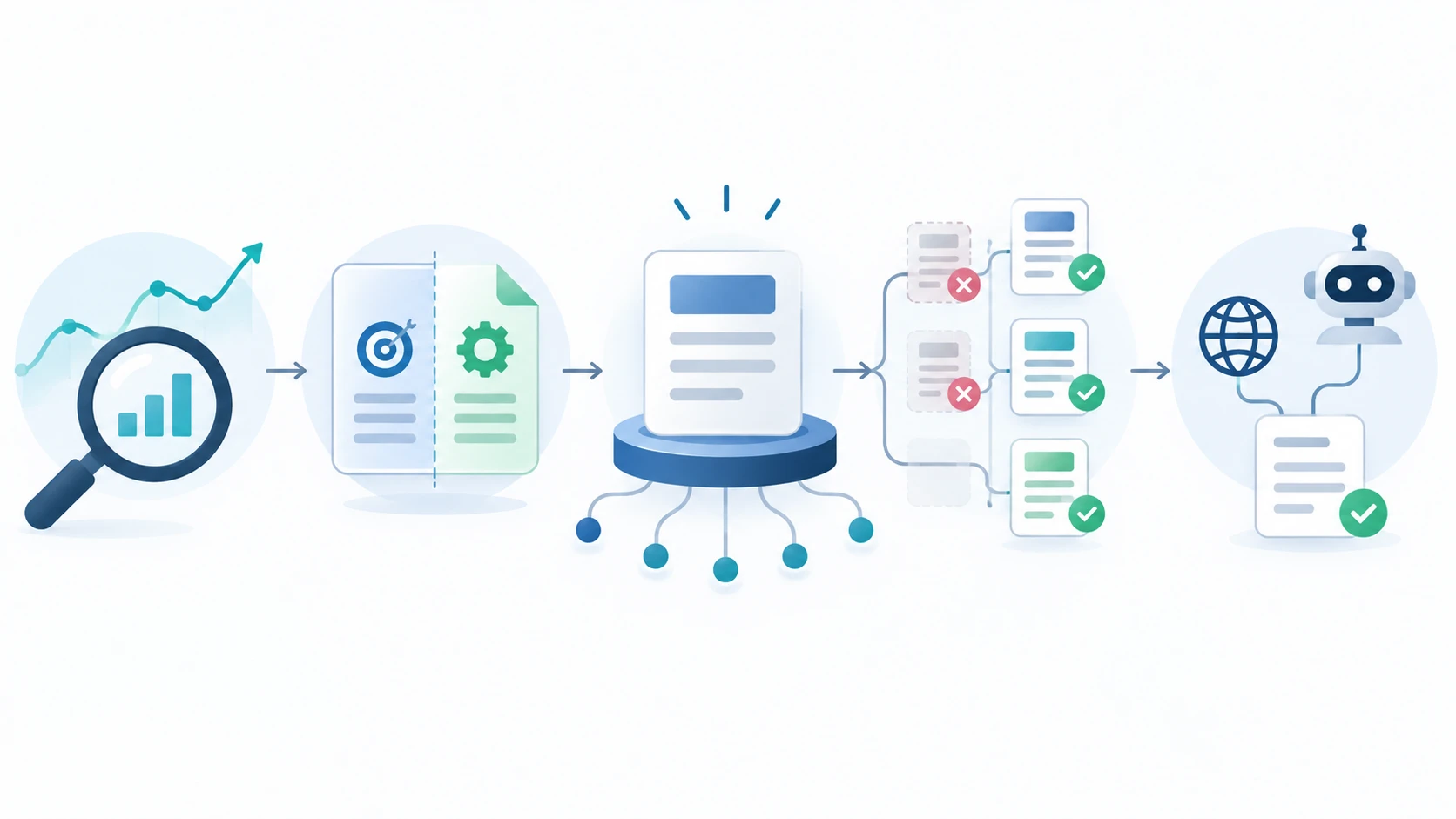
For a useful comparison of competitor pages and existing URLs before drafting, use a content gap analysis. The goal is not to publish every apparent gap. It is to identify whether a new parent page gives users a better route than an existing page already does.
Give The Parent And Child Pages Different Jobs
Content pillars for SEO can sit beside a content hub, but they should not duplicate it. The distinction becomes clear when each URL has a named job.
For example, a content-pillar page can explain how to select the core topic, define the parent promise, and govern a cluster. Its child pages might explain how to write a brief, audit internal links, refresh stale evidence, or compare two publishing routes. The child articles add depth; they do not make the parent page longer by repetition.
Build a page-job map before writing:
| Proposed URL | Core question | Better role | Keep, merge, or skip? |
|---|---|---|---|
| Content pillar | What does this topic include, and how should the cluster work? | Parent explainer and route map | Keep when the topic has a durable broad job |
| Internal-link audit | Which links are missing, weak, or misrouted? | Technical how-to | Keep as a child task |
| Content refresh workflow | Which pages need an update, merge, or retirement? | Operational guide | Keep as a child task |
| Another pillar definition | What are content pillars? | Likely duplicate section | Merge into the canonical parent |
| Keyword list download | Which phrases should we target? | Tool or template, if an output is needed | Do not force into a generic article |
This is also a practical way to build topical authority. Authority grows when a site can answer a broad question, then prove depth through coherent specialist pages. It does not grow because several URLs repeat the same definition with slightly different headings.
Write A Pillar Brief Before You Write The Page
The pillar brief prevents a useful concept from becoming an oversized catch-all page. Keep it focused on five decisions:
- Parent promise: Write the broad reader outcome in plain language.
- Boundary: State what the pillar covers and what belongs elsewhere.
- Child roles: Name the narrow tasks that deserve their own pages.
- Evidence plan: Decide which examples, definitions, tables, and source checks make the parent trustworthy.
- Validation plan: Define how the team will check internal links, crawlability, canonical URLs, and stale content after launch.
| Brief field | Example for a content-pillar page |
|---|---|
| Parent promise | Help an SEO team choose and govern one content pillar without URL sprawl |
| Primary reader | Content lead planning an organic-growth cluster |
| Exclusions | Detailed internal-link fixes, content briefs, and product comparisons |
| Child-page rule | Create a child only when it owns a different task and validation step |
| Success evidence | Clear routes, distinct pages, descriptive anchors, crawlable links, and an assigned review cadence |
The information gain is in the governance. Many explanations stop after defining a pillar and drawing a hub-and-spoke diagram. An operator still needs to decide which page is canonical, which idea belongs inside an existing article, who owns refreshes, and how to catch structural drift after new pages are added.
Make Internal Links Prove The Relationship
Internal links are not decorative. They tell readers where to go next and make a cluster easier to navigate and maintain. Use descriptive anchors that name the destination task, rather than repeating the pillar keyword on every link.
Google's link guidance explains why crawlable a elements, real destinations, and descriptive anchor text matter. Apply that principle to the cluster with a small set of intentional routes:
| Link route | Why it exists | Example anchor |
|---|---|---|
| Pillar to child | Move readers from orientation to execution | internal-link audit workflow |
| Child to pillar | Restore broad context when a reader needs the system view | content pillar strategy |
| Child to sibling | Connect adjacent tasks only when the next task is useful | content refresh decision framework |
| Pillar to product | Let a ready reader turn a decision into work | AI SEO consultant |
Once the links are in place, audit the cluster rather than assuming the diagram survived publication. The internal links for SEO workflow is a useful companion for checking orphan pages, weak anchors, and crawl paths after structural edits.
Govern The Pillar After Launch
A content pillar needs a review loop. New child pages may make the parent promise stale, old links may point to the wrong canonical, and a previously distinct article can drift toward overlap as it is updated.

Use a lightweight recurring review:
- Re-read the pillar promise and confirm the page still answers the broad question.
- Inventory child URLs by their actual reader job, not just their keyword.
- Merge, redirect, refresh, or decline new drafts that duplicate an existing task.
- Check parent-to-child and child-to-parent links for descriptive anchors and real destinations.
- Crawl the cluster after structural changes to review status codes, canonicals, internal links, and depth.
- Review whether the topic has new proof gaps, outdated examples, or weak AI-search-ready explanations.
- Assign the next owner and due date before the review ends.
This keeps the pillar useful for people first. Google's people-first content guidance emphasizes original value and a satisfying reader outcome, not pages made mainly to manipulate rankings. A pillar should make the site easier to understand and use; it should not become a container for every related keyword.
Turn A Pillar Plan Into Assigned Work
The planning work only matters if it produces clear next actions. Searvora AI SEO Consultant is the natural next step when a team needs to turn content signals, topic gaps, and structural questions into prioritized SEO work. Use it to decide whether the next move is a new child brief, a content refresh, an internal-link change, or a technical crawl check.
Content Pillars For SEO Checklist
Before publishing or expanding a pillar, confirm all of the following:
- The parent page owns one broad reader question.
- Every child page has a different task, page type, or validation need.
- The parent adds a route map and decision framework instead of copied summaries.
- Existing URLs were checked before approving a new child brief.
- Internal links use descriptive anchors and real destinations.
- The parent, children, and product routes each have a clear job.
- A crawl and canonical check is part of the post-launch review.
- Someone owns the next refresh decision.
Build content pillars for SEO when they make a cluster easier to understand, easier to navigate, and easier to maintain. If the new page cannot do that better than an existing URL, strengthen the existing route instead of creating another hub.