

The great decoupling SEO diagnosis starts with a pattern where search visibility and search clicks stop moving together. A page, query group, or site can show rising impressions while clicks and CTR flatten or fall. The pattern is getting more attention because AI answers, richer SERP features, and changing search behavior can expose a brand more often without sending the same number of visits.
That does not mean every clicks-down chart is an AI-search emergency. It means the old habit of reading impressions, rank, and clicks as one simple funnel is weaker than it used to be. The useful response is to diagnose the signal, separate causes, and choose the page action that can be validated.
The Short Answer
In SEO, the great decoupling usually means users are seeing your pages, your brand, or your topic footprint more often, but fewer of those impressions turn into clicks. The most common visible pattern is impressions up, clicks down, and CTR down.
Use this first split:
| Pattern | Likely reading | First response |
|---|---|---|
| Impressions up, clicks down, position stable | SERP layout, answer satisfaction, or intent shift may be reducing CTR | Inspect query groups and current SERP features |
| Impressions up, clicks down, position down | Visibility expanded into weaker positions or lower-intent queries | Segment by query and page type before acting |
| Impressions up, clicks stable | Search footprint grew, but click demand did not expand at the same pace | Improve title promise, source depth, and next-step value |
| Impressions down, clicks down | This is not the classic decoupling pattern | Diagnose rankings, demand, crawl, and indexability first |
| Clicks down while AI answers cite competitors | Source ownership may be weak | Improve answer-ready sections and evidence pages |
This is close to the question answered in whether AI search reduces organic traffic, but the job is narrower. You are not asking whether AI search changed traffic in general. You are asking why visibility and clicks diverged for a specific search footprint.
Confirm The Signal Before Explaining It
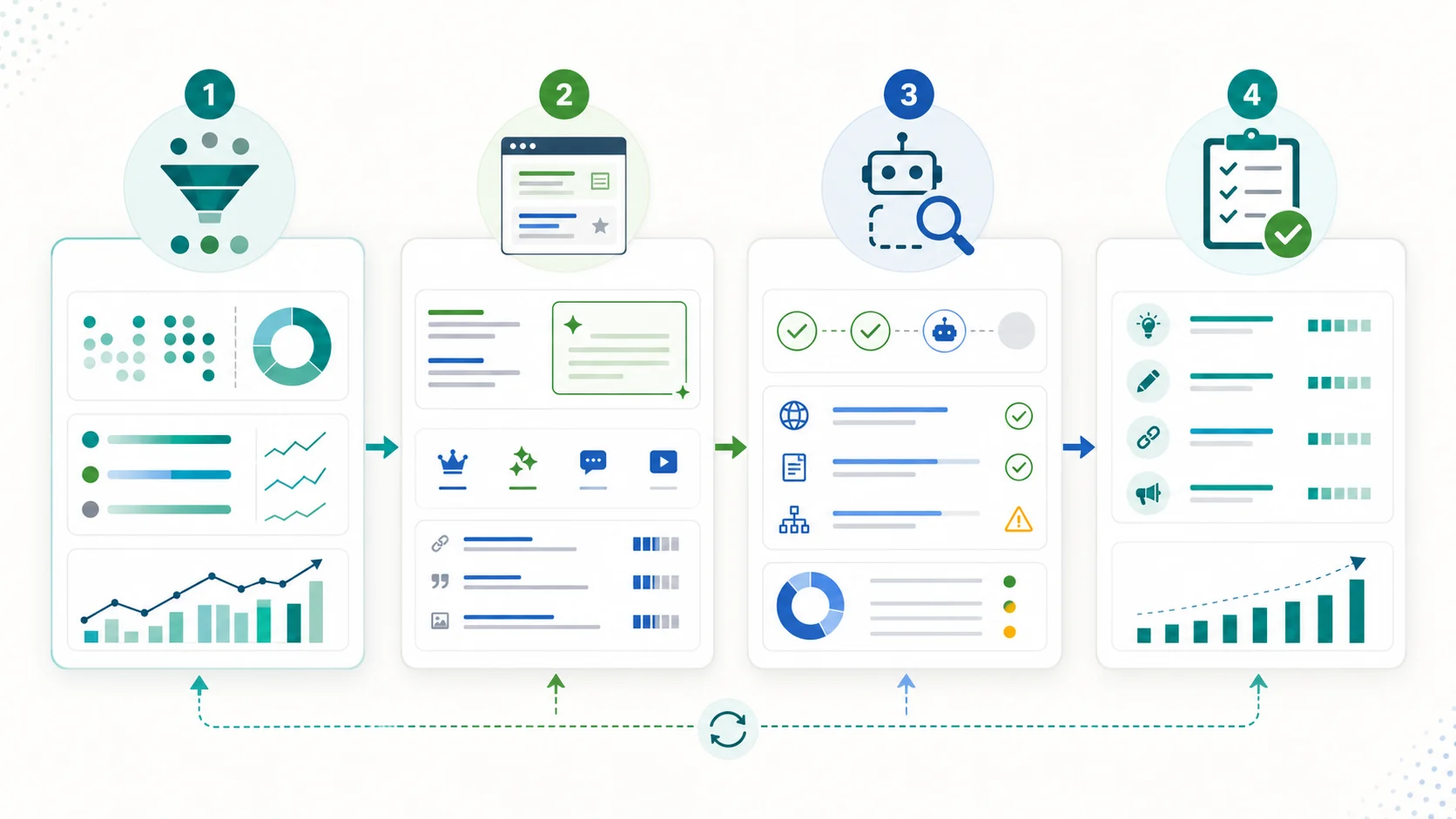
Start in Google Search Console, not in a general analytics dashboard. The Search results performance report gives the page, query, country, device, clicks, impressions, CTR, and average position you need for the first read.
Then check the metric definitions. Google's documentation for impressions, position, and clicks is worth reviewing because an impression is not a simple "ranked once at position one" event. Result grouping, page elements, and the topmost position can all affect how the data should be interpreted.
Use a fixed baseline:
- Choose one page group, directory, or topic cluster.
- Compare the same number of days before and after the visible change.
- Separate desktop and mobile if the SERP layout differs.
- Export query-level data for the affected pages.
- Sort by impression gain, click loss, CTR loss, and position change.
- Mark the queries where the old click pattern broke.
If the pattern only appears after mixing the whole site together, it is not ready for a diagnosis. Decoupling becomes useful when it can be tied to a query group and a page set.
Segment Queries Before Blaming AI Search
AI answers are one possible cause, but they are rarely the only one. A site can gain impressions from broader matching, new query variants, ranking in lower positions, brand discovery, or search result elements that satisfy the task before a click.
Segment the changed queries this way:
| Query group | What to look for | Better next action |
|---|---|---|
| Definition queries | Impressions up, CTR down, answer-heavy SERP | Add concise answers plus deeper examples worth clicking |
| Troubleshooting queries | Featured snippets, AI answers, or forum results absorbing clicks | Make symptoms, causes, fixes, and validation clearer |
| Comparison queries | Competitor pages cited or framed in AI answers | Add decision tables, public evidence, and stronger source pages |
| Branded queries | Brand impressions up but clicks flat | Check entity visibility, sitelinks, and owned-source clarity |
| Long-tail variants | More impressions from weaker related queries | Decide whether the page should target them or link to a child page |
| Lower-position expansion | Impressions up while average position worsens | Improve page fit or create a more precise page for the new query set |
This is where the great decoupling becomes operational. The same chart can lead to different work: a title rewrite, a source-page refresh, an internal-link fix, a new child article, or no action beyond monitoring.
Check The SERP And AI Answer Evidence
Once the query group is clear, inspect the live search experience. Do not rely only on the chart. Search the priority queries by market and device, then record what changed.
For AI-specific interpretation, Google's AI features guidance is a useful boundary. It reinforces that pages still need normal search eligibility, useful content, and indexability. There is no special shortcut that guarantees an AI answer citation.
Create a small evidence log:
| Evidence field | Why it matters |
|---|---|
| Query | Keeps the observation tied to one search job |
| Country and device | AI and SERP features can vary by layout |
| AI answer present | Separates answer-surface pressure from ordinary ranking movement |
| Brand mentioned | Captures entity visibility even without a URL click |
| URL cited | Shows whether the page is being used as a source |
| Competitor cited | Reveals which format or source Google appears to trust |
| CTR and position movement | Connects the SERP observation back to Search Console |
| Page action | Prevents the log from becoming passive research |
For Google-specific query tracking, use the AI Overview tracking workflow as a companion. The great decoupling diagnosis is broader: it includes AI answers, classic snippets, changed result layouts, and lower-intent impression expansion.
Rule Out Crawl And Page Eligibility Problems
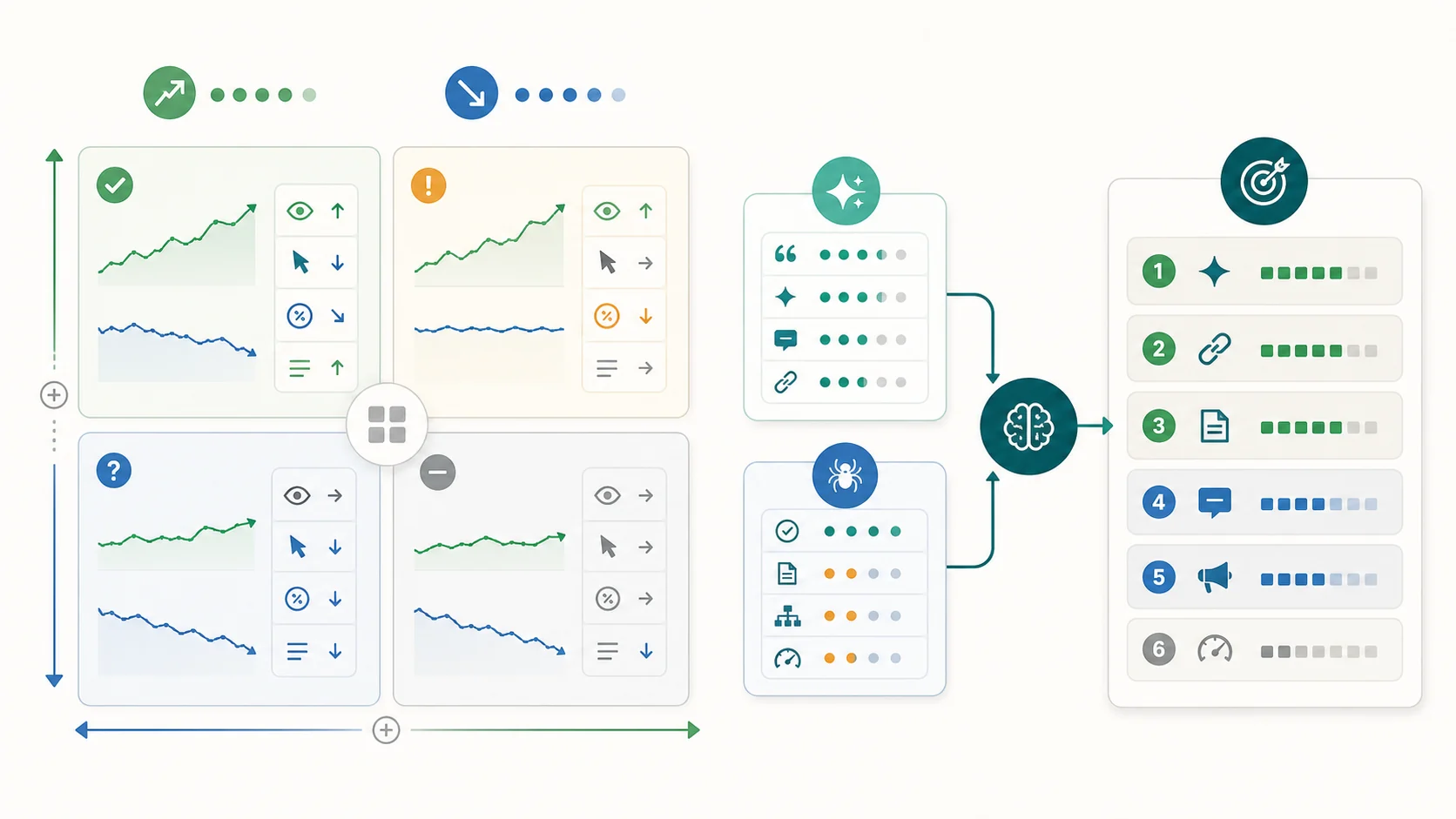
A decoupling chart can tempt teams into content changes, but technical eligibility still matters. Before rewriting the page, check whether search engines can still reach, render, select, and trust the URL set.
Prioritize these checks:
| Check | What it can explain | Validation |
|---|---|---|
| Robots and server status | Search can discover the page but not reliably fetch it | Re-crawl affected URLs and confirm HTTP access |
| Canonical selection | Impressions may spread across variants while clicks concentrate elsewhere | Confirm selected canonical and indexed URL |
| Noindex and redirects | Pages can lose click potential even if related URLs still show | Inspect source HTML, rendered HTML, and redirect chains |
| Internal links | A page can remain visible but become weaker inside the site graph | Rebuild links from relevant parent and sibling pages |
| Title and meta promise | Users may see the result but choose another source | Compare title links, snippets, and intent promise |
| Structured and visible evidence | AI answers may prefer clearer source pages | Add facts, examples, definitions, and comparison support |
Use the organic traffic drop triage path if impressions and clicks both fall. Use a crawler or site audit when the affected pages share a template, directory, locale, or recent release.
Choose The Fix By Signal Pattern
Do not respond to the great decoupling with one generic rewrite. Choose the fix from the evidence.
| Finding | Better response |
|---|---|
| CTR fell, position stable, AI answer present | Add a stronger opening answer, source evidence, examples, and a reason to click beyond the summary |
| Your URL is cited but clicks are low | Keep the source value, then improve mid-page depth, comparison tables, tools, and conversion paths |
| Competitors are cited instead | Strengthen owned source pages, internal links, examples, and factual clarity |
| Impressions rose from low-intent variants | Split child tasks or tighten the page title and intro around the real user job |
| Average position dropped while impressions rose | Treat it as ranking dilution, not pure AI pressure |
| Crawl/index signals changed | Fix technical eligibility before assigning editorial work |
| Branded impressions rose but clicks did not | Review sitelinks, title links, entity pages, and brand evidence |
The information-gain opportunity is not to repeat that clicks and impressions diverged. It is to show the team which action should ship next, what signal will validate it, and when to stop reacting.
Where Searvora Fits
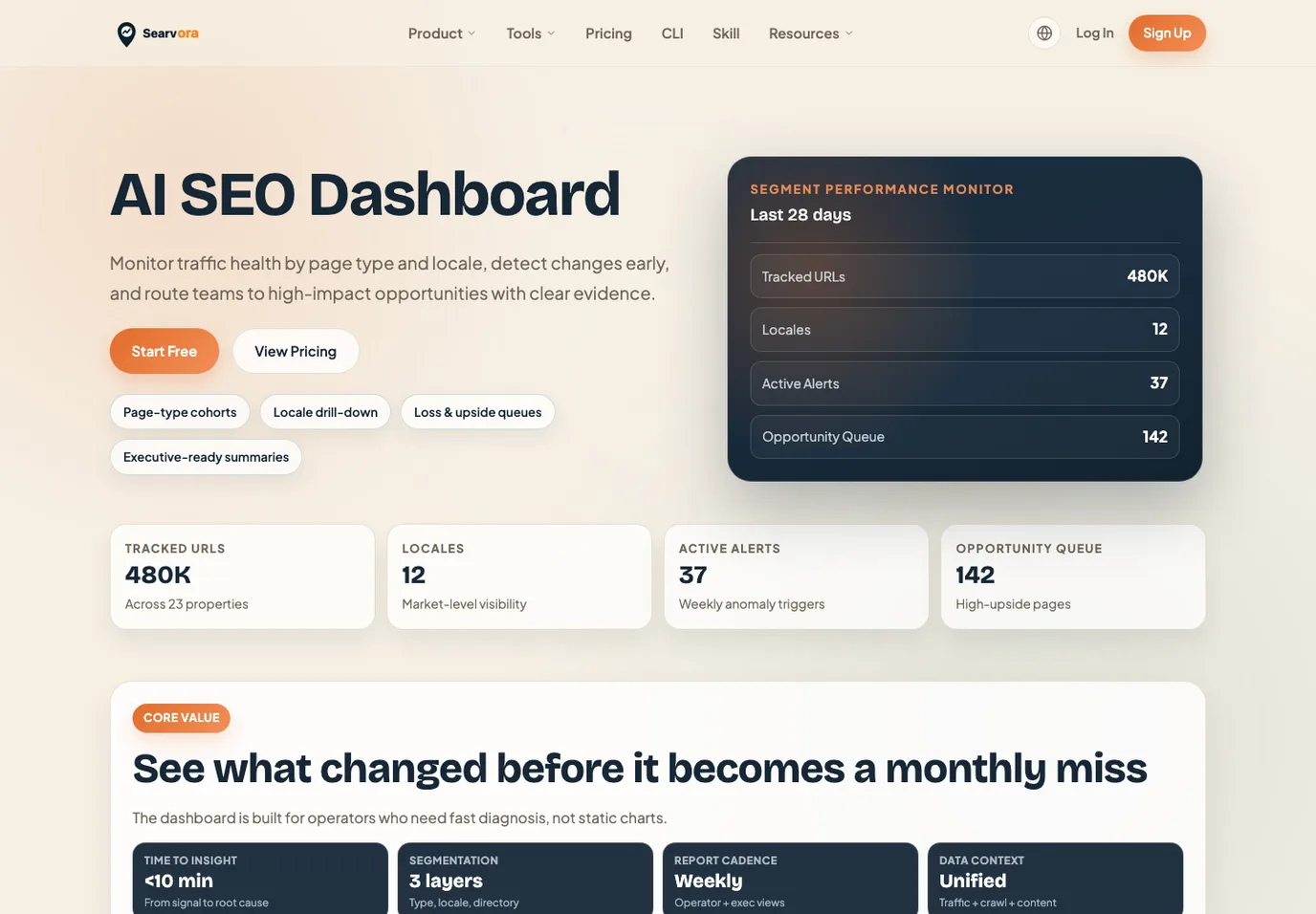
Searvora's AI SEO dashboard fits the monitoring layer of this workflow. The product page positions it around page-type cohorts, locale drill-down, anomaly alerts, opportunity queues, and executive-ready summaries. Those are the controls a team needs when clicks and impressions stop telling the same story.
Use the dashboard to group the affected pages by topic cluster, page type, and market. Then add AI-answer observations and crawl checks beside normal Search Console movement. When the issue is technical, pair the dashboard with a crawl pass from the SEO spider crawler. When the issue is strategic, turn the diagnosis into a prioritized action queue instead of another standalone report.
Decision Checklist
Use this checklist before you explain the great decoupling to a stakeholder:
- Which page group, directory, or topic cluster changed?
- Did impressions rise while clicks fell, or did both metrics fall?
- Did average position stay stable enough that CTR loss is plausible?
- Which query groups gained impressions?
- Are the affected queries informational, troubleshooting, comparison, branded, or long-tail variants?
- Does the current SERP show an AI answer, featured snippet, forum result, or other answer-heavy layout?
- Is your brand mentioned or URL cited in AI-style answers?
- Did crawl, indexability, canonical, sitemap, internal-link, title, or rendered-content signals change?
- Which page action should ship first?
- What metric will you recheck after the validation window?
The great decoupling is not a reason to panic. It is a reason to stop treating impressions, clicks, and rank as one neat story. Diagnose the query group, prove the likely cause, and turn the finding into one action your team can validate.