

Getting on the first page of Google is not a tactic you can switch on. It is the result of making the right page useful for a specific query, accessible to search systems, easy to understand, and worth choosing over the other results. The practical question is not “what ranking trick should I try?” It is “which constraint is holding this page back right now?”
If you are asking how to get on the first page of Google, start with one page and one query. Then work through intent, coverage, on-page clarity, crawl and indexability, internal links, and authority in that order. That gives your team a diagnosis it can act on instead of a long, unranked checklist.
Start With a Page-One Diagnosis
Do not treat every weak page as a generic SEO problem. A page that is invisible because it answers the wrong task needs a different fix from a page that cannot be crawled, or one that is buried in the site architecture.
Use this decision map to identify the one workstream that deserves attention first.

| Signal | What to inspect | What a useful next move looks like |
|---|---|---|
| Search intent | What page type and outcome the leading results serve | Change the page's format, scope, or promise before adding more copy |
| Content coverage | Whether the page answers the decisive sub-questions | Fill specific evidence or decision gaps, not a vague word-count target |
| On-page clarity | Title, H1, opening answer, headings, and internal anchors | Make the visible page promise match the query and the body |
| Crawl and indexability | Status, canonical, robots, rendering, sitemap, and discoverability | Fix the access or canonical signal before judging the content |
| Internal links and authority | Contextual paths into the page and relevant external references | Strengthen useful routes and earn links to the page that should rank |
Match the Query Before You Optimize the Page
Search results are evidence about the job a query creates. For an informational query, the leading pages may be tutorials, checklists, explanations, or comparison guides. For a purchase-oriented query, a product or category page may be the better answer. A well-written article can still miss page one if it is the wrong kind of page.
Check the results manually and capture four details:
- The dominant page type: article, tool, product page, category, video, or forum.
- The dominant format: step-by-step guide, list, explainer, comparison, or template.
- The angle that recurs: beginner setup, troubleshooting, local context, current data, or a specialist workflow.
- The sub-questions that appear in headings, snippets, and related result formats.
Google's SEO Starter Guide is a useful baseline: make pages helpful, crawlable, and clearly connected to the rest of the site. The operational step is to translate that baseline into a page-specific job before changing the page.
If you are deciding whether a new query deserves an article, a tool, or a landing page, use the SEO checklist as the broader planning companion. This article starts later in the process: a page and query already exist, and you need to identify the blocker.
Check Whether the Page Covers the Needed Decision
Coverage is not the same as length. A page can be comprehensive in words yet omit the decision a searcher needs to make. For example, a page about “how to get on the first page of Google” should explain how to recognize an intent mismatch, when a technical defect takes precedence, and when links are actually the next constraint.
Ask these questions before expanding the content:
- Does the introduction answer the query in the first screen?
- Does each H2 move the reader toward a decision or an action?
- Are the examples and proof points specific enough to apply to a real page?
- Does the page explain when not to use a tactic?
- Does the page link to the deeper workflow that follows the diagnosis?
That last check protects the parent hub. A page-one diagnosis should not repeat a full technical audit, an on-page rewrite process, and a link campaign in one article. It should explain how to choose between them, then hand the reader to the relevant child workflow.
Separate Technical Eligibility From Content Quality
Before deciding that a page needs more content, confirm that search systems can reach, render, index, and select it. A blocked, canonicalized-away, redirected, or weakly linked URL is not a content-quality verdict.
For the affected page and its closest template peers, inspect:
- Final status and redirect behavior.
- Robots directives,
noindex, and canonical target. - Rendered title, H1, main content, and meaningful links.
- Sitemap inclusion and internal-link paths from relevant hubs.
- Whether the same issue appears across a page type instead of one URL.
The technical SEO site audit workflow is the deeper playbook when those checks reveal a template or sitewide problem. Keep the first-page diagnosis smaller: prove whether technical eligibility is the constraint, assign the correct owner, and set a recrawl criterion before expanding the scope.
Turn Evidence Into a Short Fix Queue
The best outcome is not a list of possible ranking factors. It is one priority decision with a named owner and a way to check it later.
| If the strongest evidence says… | Prioritize this workstream | Validate with |
|---|---|---|
| The result format does not match the query | Page-type and intent correction | A revised page promise and a fresh intent review |
| The page is relevant but incomplete | Content coverage and on-page improvement | Updated headings, examples, and a focused content QA pass |
| The page is inaccessible or contradictory | Technical SEO remediation | Live status, canonical, rendered HTML, sitemap, and recrawl checks |
| The page is hard to discover internally | Architecture and contextual internal links | Crawl depth, inlinks, and the path from relevant hubs |
| The page is competitive but under-referenced | Evidence-led link work | Relevant referring-page opportunities and qualified placements |
For the last path, link building for SEO is the right deeper guide. It keeps the work grounded in relevance and page value instead of treating every new referring domain as automatically useful.
Use Crawl Evidence Before You Rewrite Everything
Searvora SEO Spider Crawler is useful when the diagnosis points to technical eligibility or page clarity. It is designed to crawl public site signals, group indexability, architecture, metadata, and rendering risks, and turn the evidence into a ranked fix queue rather than an unprioritized issue dump.
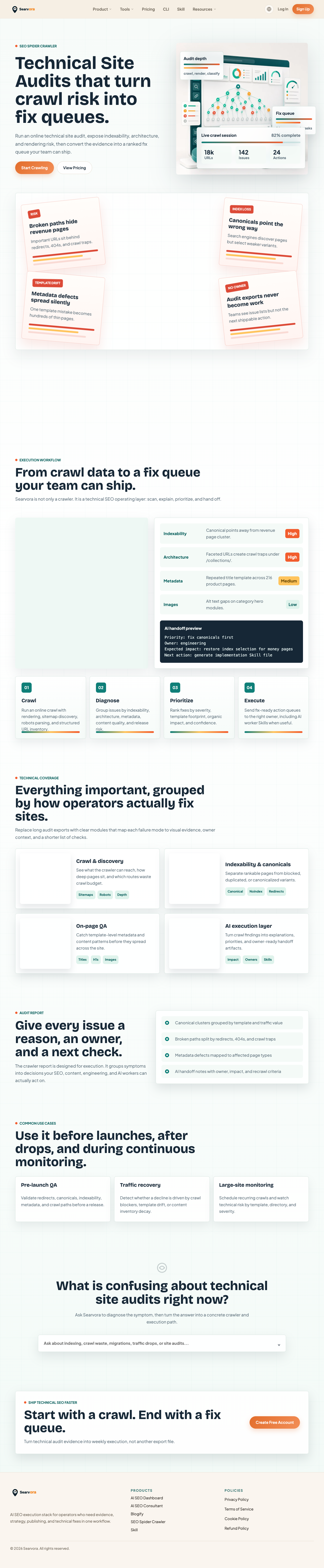
Use the crawler to establish a baseline, compare the affected URL with its template peers, and record what should be different after the fix. A clean post-change crawl is stronger evidence than an assumption that a deployed change solved the ranking constraint.
Validate Directional Progress Instead of Promising a Rank
No workflow can guarantee a first-page position. It can make the next action defensible and show whether the page is becoming eligible, clearer, and easier to evaluate.
Set the validation condition when you assign the work:
- Save the baseline query, page URL, page type, crawl state, and primary hypothesis.
- Ship the smallest change that tests that hypothesis.
- Re-check rendered HTML, indexability, internal links, and sitemap behavior if the change touched technical signals.
- Revisit search-result fit and page coverage after the update.
- Monitor page-level impressions, clicks, and ranking movement after the relevant recrawl window.
- If the page does not move, choose the next constraint from evidence instead of repeating the same tactic.
The point is to build a repeatable loop: diagnose the page, choose one leverage point, ship the change, validate the live output, and learn from the result. That is the most reliable way to work toward Google's first page without pretending that rankings are guaranteed.