

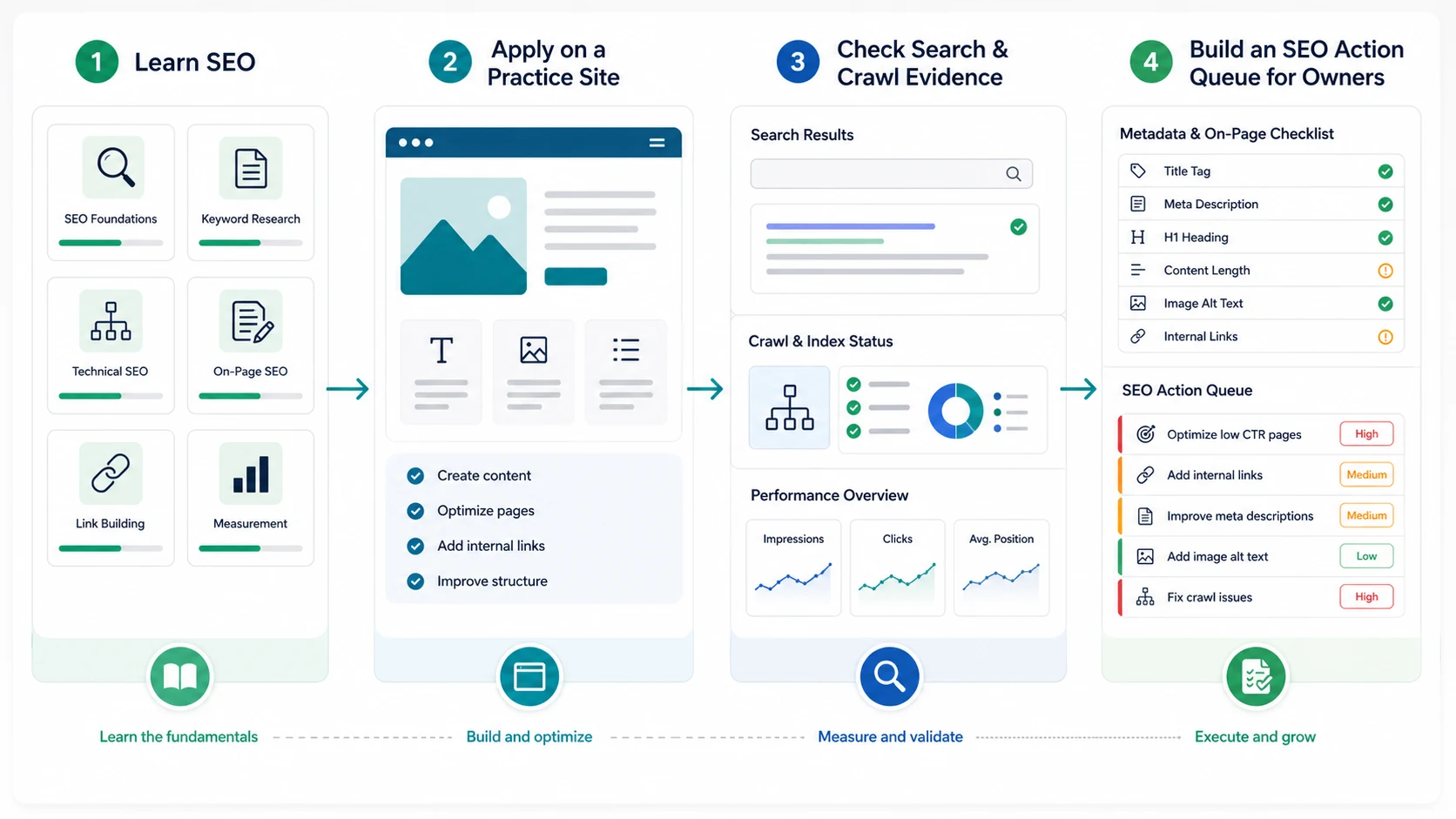
Free SEO courses are most useful when they change what you do next. A beginner course should not end with a certificate tab left open. It should end with a practice site, a crawl check, a content brief, a Search Console review, or a fix queue your team can actually ship.
The Ahrefs roundup that surfaced this competitor opportunity proves the search intent is a real list of free SEO learning options. Searvora's information gain is the operating layer: compare free SEO courses by learner job, practice task, and validation path so training becomes applied SEO work.
Choose Free SEO Courses By The Work You Need To Ship
Start with the work, not the platform. A course on keyword research is helpful if it leads to a page-type decision. A course on technical SEO is helpful if it leads to crawl validation. A course on AI optimization is helpful if it leads to source-page evidence instead of vague prompt experiments.
| Learner job | Course type to start with | Practice task after the lesson |
|---|---|---|
| New marketer learning SEO basics | Beginner SEO fundamentals | Pick one existing page and explain its search intent, target query, title, and next improvement |
| Content marketer planning articles | Keyword research and content SEO | Turn one topic into a page brief, internal link target, and validation window |
| Technical marketer fixing site issues | Technical SEO and crawlability | Crawl a small URL set, group issues by template, and write the first fix ticket |
| Growth operator reporting results | Measurement and SEO process | Build a weekly review with Search Console data, page cohorts, owners, and next actions |
| Team lead building a repeatable process | SEO roadmap or certification path | Convert lessons into a checklist the team can repeat every month |
The Free SEO Courses Shortlist
This is not a universal ranking. These free courses and training paths are useful for different jobs, and you should verify each provider's current enrollment rules before committing a team.
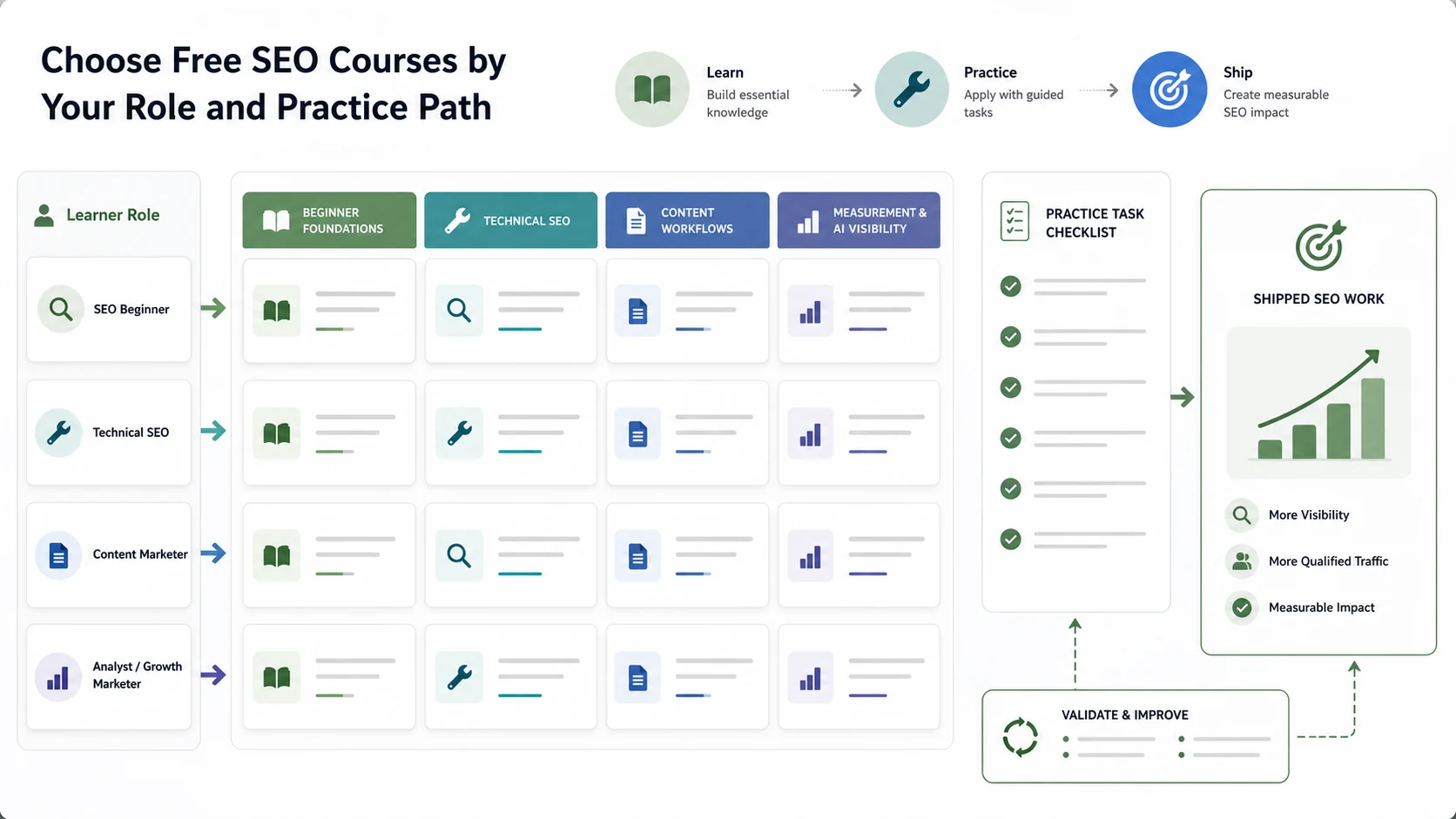
| Resource | Best fit | What to practice right after |
|---|---|---|
| Ahrefs SEO Course for Beginners | Complete beginner SEO foundation | Choose one keyword, map intent, and outline a page that deserves to exist |
| HubSpot SEO Certification Course | Marketers who want a structured strategy course and certificate path | Turn the course into an audit, keyword research, backlink, SERP, and reporting checklist |
| Semrush SEO Essentials with Semrush | Beginners who want tool-led SEO and AI optimization basics | Use one lesson to connect keyword research, technical SEO, content optimization, backlinks, and AI visibility |
| Yoast SEO for Beginners | WordPress and content teams that need quick wins | Apply content, site structure, and crawlability checks to one publish-ready page |
| Google Search Central SEO Starter Guide | Anyone who needs the official Search baseline | Validate crawl, indexing, helpful content, metadata, and structured data assumptions against Google documentation |
| LearningSEO.io | Operators who want a broader roadmap after the first course | Build a learning path across fundamentals, SEO process, CMS implementation, technical SEO, content, links, and AI-search topics |
Ahrefs SEO Course for Beginners
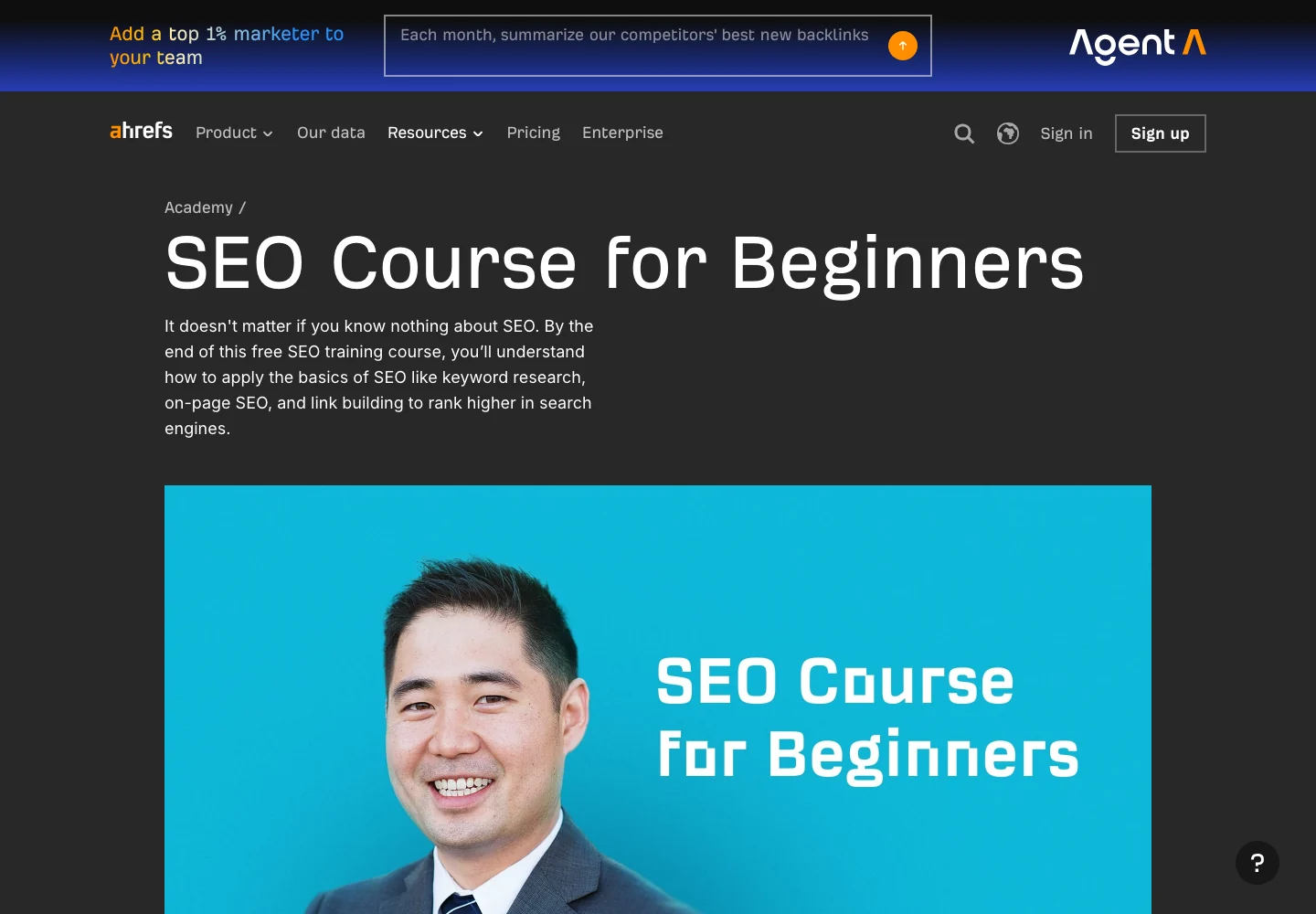
The official Ahrefs SEO Course for Beginners is a strong first stop when someone needs a broad SEO foundation. The public course page presents a free course with modules on SEO basics, keyword research, on-page SEO, link building, and technical SEO.
Use it when the learner still needs a clean mental model of how search demand becomes page work. Do not stop after watching. Pair the course with one practice page:
- Pick a page that should earn organic traffic.
- Write the primary query and search intent.
- Check whether the title, H1, copy, internal links, and technical signals support that job.
- Decide whether the next action is a rewrite, new article, internal link update, crawl fix, or no change.
This course is best for fundamentals. It is not the only workflow a team needs once they are managing many URLs, templates, and owners.
HubSpot SEO Certification Course
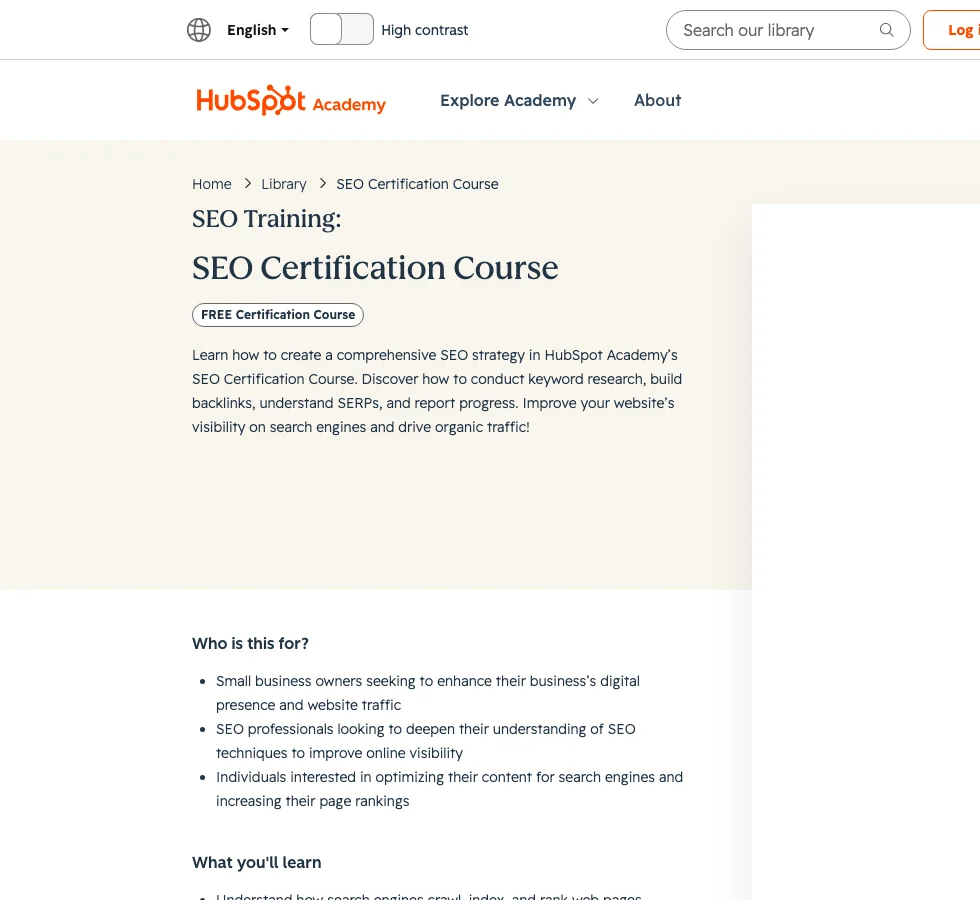
The official HubSpot SEO Certification Course fits marketers who want structure, quizzes, and a certificate path. The public page frames the course around SEO strategy, keyword research, backlinks, SERPs, and progress reporting.
Use it when the team needs a shared vocabulary across content, marketing, and reporting. The most useful follow-up is a one-page operating checklist:
| Course theme | Convert it into this team artifact |
|---|---|
| SEO strategy | A page-type rule for when to create an article, landing page, tool page, or hub |
| Keyword research | A brief template with query, intent, SERP type, existing overlap, and internal links |
| Backlinks | A qualification rule for which link opportunities are worth outreach |
| SERPs | A review habit that checks page type, feature ownership, and competitor angle before drafting |
| Reporting | A weekly owner view with changed pages, evidence, and next actions |
HubSpot is useful when a marketer needs a course path. Searvora becomes useful after the course when the same team needs to turn signals into assigned work.
Semrush SEO Essentials With Semrush
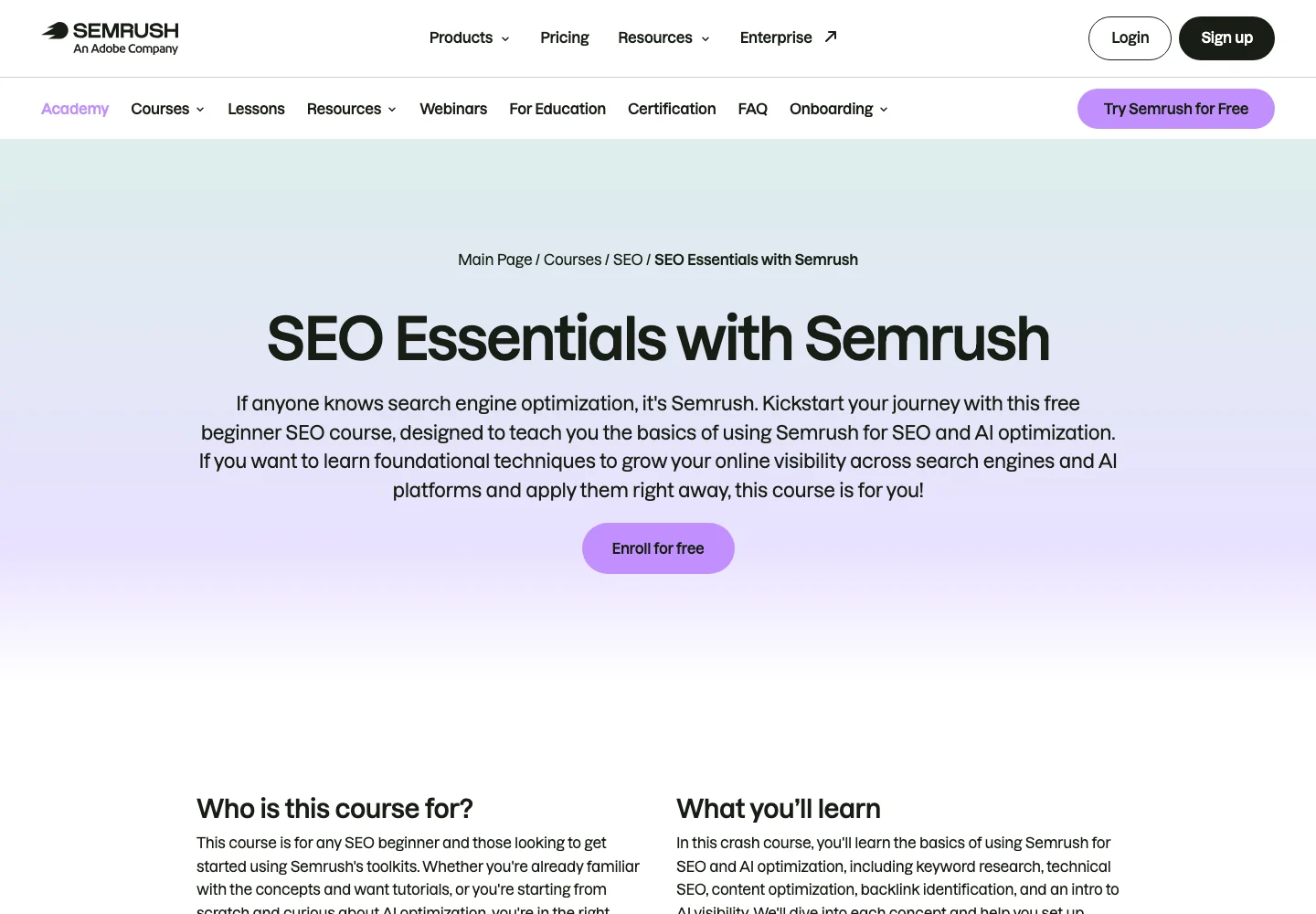
The official Semrush SEO Essentials with Semrush course is useful when the learner wants SEO fundamentals through a tool-led workflow. The public page describes a free beginner course covering Semrush for SEO and AI optimization, including keyword research, technical SEO, content optimization, backlink identification, and an introduction to AI visibility.
Use it when the learner already expects to work inside an SEO suite. The practice task should not be "open every report." It should be:
- Pick one topic or URL.
- Pull keyword, content, technical, and backlink clues from the course workflow.
- Write one action from each clue.
- Rank those actions by impact, confidence, and effort.
- Decide what to ship this week and what to monitor.
The information gain for Searvora readers is the handoff. Tool training teaches where signals live. An operating workflow decides which signal deserves work.
Yoast SEO For Beginners
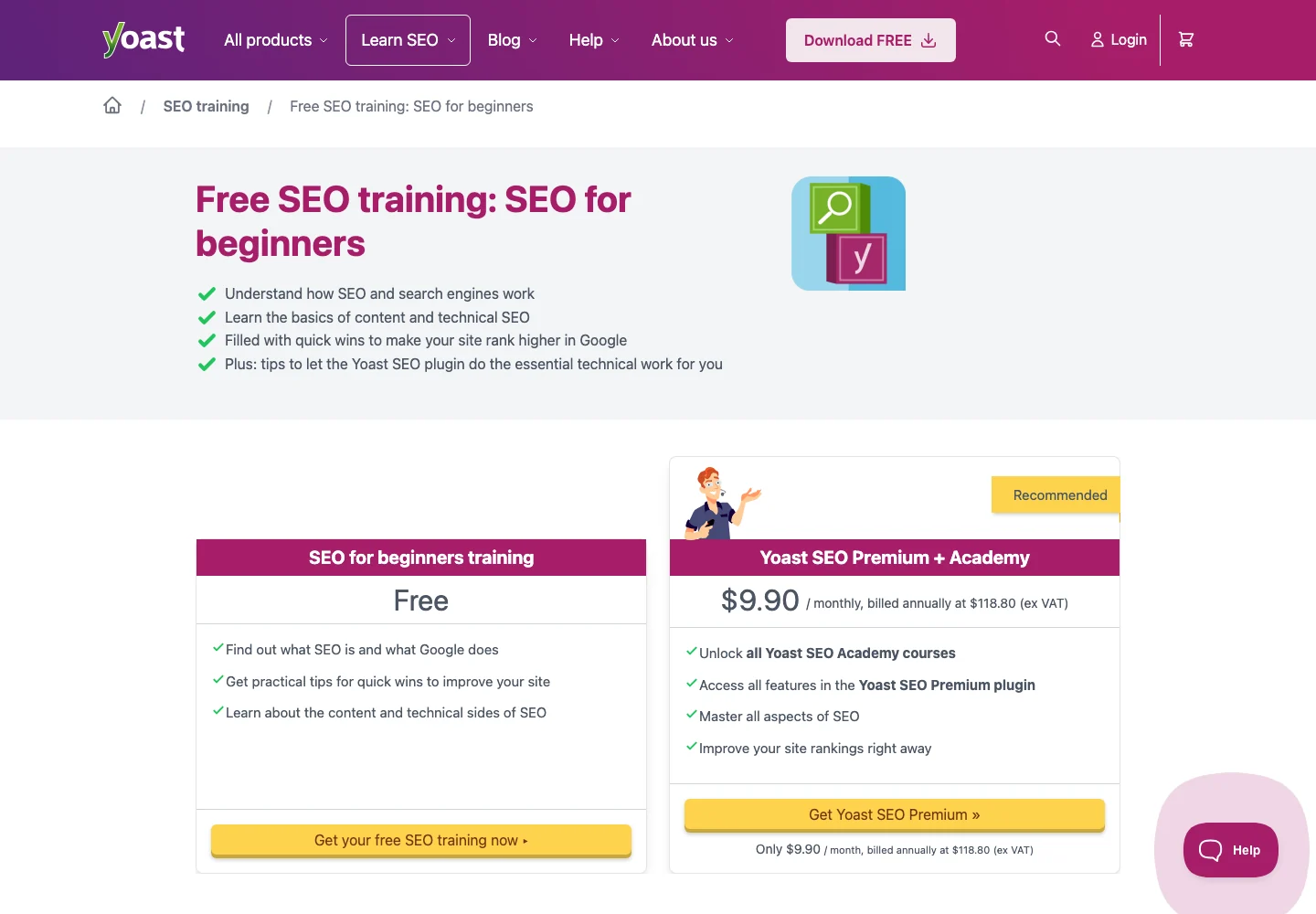
The official Yoast free SEO training for beginners is strongest for content teams and WordPress users who want practical basics. The public page highlights how SEO and search engines work, content and technical SEO basics, quick wins, site structure, crawlability, and rich results.
Use it when the team writes or edits pages directly. The best practice task is a publish-readiness pass:
| Check | What the learner should decide |
|---|---|
| Search intent | Does this page answer the job the query implies? |
| Title and intro | Does the page make its promise quickly? |
| Content structure | Are headings useful for readers and search engines? |
| Internal links | Does the page belong in a cluster with supporting links? |
| Crawlability | Can search engines reach and understand the URL? |
| Rich result fit | Does structured data match visible content and page type? |
Yoast is useful for page-level improvement. Pair it with a crawler or dashboard when the same issues repeat across many pages.
Google Search Central SEO Starter Guide
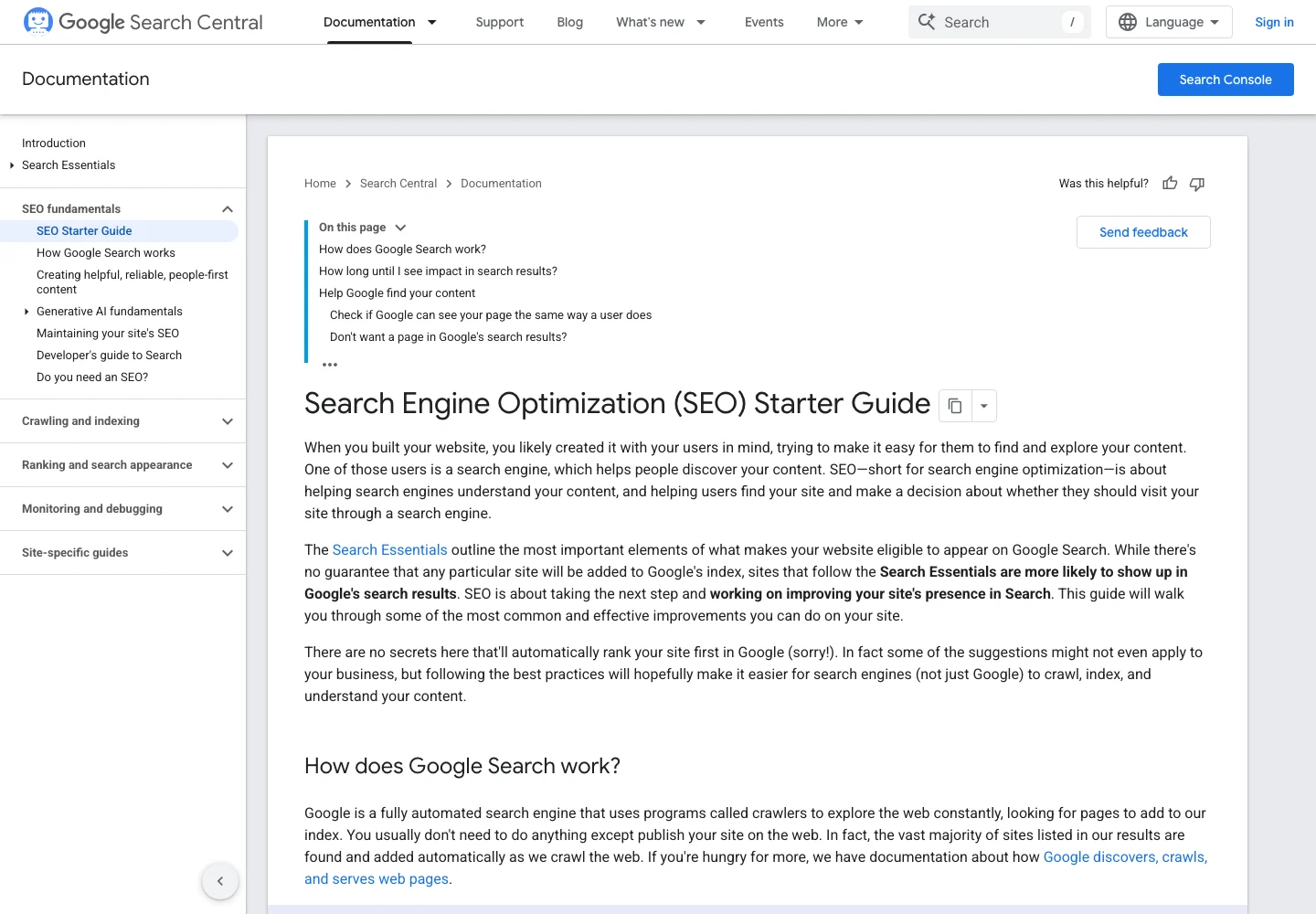
The official Google Search Central SEO Starter Guide is not a course in the classroom sense, but it belongs in every free SEO training path. It gives the official baseline for how Google frames crawling, indexing, helpful content, metadata, links, structured data, search appearance, Search Console, and site-specific guidance.
Use it as the source-of-truth check after any course. If a lesson, template, or tool advice conflicts with Google's documentation, slow down and verify the assumption before turning it into policy.
The practice task is simple:
- Choose one page.
- Check whether Google can discover, crawl, index, and understand it.
- Review the title, snippets, links, structured data, and helpful content signals.
- Document what is verified, what is inferred, and what still needs a crawl or Search Console check.
This is also where AI-search work starts to stay grounded. If the page is not crawlable, indexable, clear, and useful for classic search, it is a weak source for AI-answer systems too.
LearningSEO.io
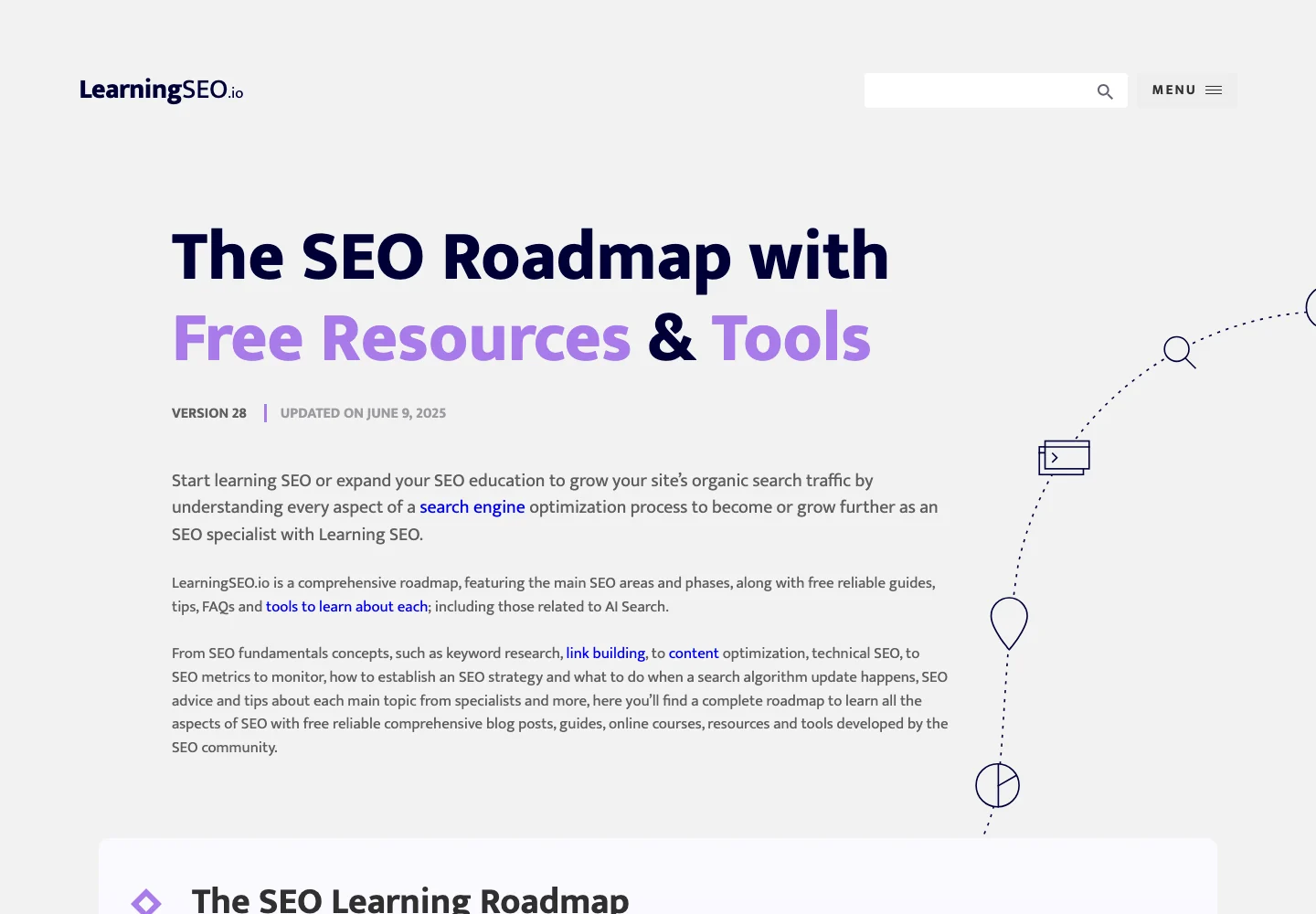
The official LearningSEO.io roadmap is useful after the first beginner course because it organizes the broader learning path. The public roadmap covers fundamentals, SEO process, CMS implementation, deeper technical and content topics, link building, management, automation, AI-search topics, and ongoing learning resources.
Use it when someone has finished one course and asks, "what should I learn next?" The answer should depend on the work queue:
| If the queue is full of | Learn next |
|---|---|
| Pages with weak intent fit | Keyword research, competition analysis, content optimization, and keyword mapping |
| Crawl or indexability problems | Technical optimization, JavaScript SEO, sitemaps, robots.txt, canonicalization, and crawl budget |
| Unclear reporting | SEO measurement, reporting, forecasting, and stakeholder communication |
| CMS publishing issues | Shopify, WordPress, Webflow, Wix, or platform-specific SEO implementation |
| AI-search visibility questions | AI Mode, LLM optimization, brand visibility, source pages, and citability checks |
LearningSEO.io is a roadmap, not a substitute for execution. Use it to choose the next learning module after your real work queue tells you where the skill gap is.
Turn Course Notes Into An SEO Practice Queue
The difference between learning and execution is evidence. After any free SEO course, require one small proof-of-work artifact.
| Course note | Proof-of-work artifact |
|---|---|
| "Keyword research matters" | A brief with query, intent, page type, overlap check, and internal links |
| "Technical SEO matters" | A crawl sample grouped by issue, template, severity, and owner |
| "Content quality matters" | A refresh brief with missing sections, source evidence, and validation criteria |
| "Links matter" | A relevance-first outreach or internal-link opportunity list |
| "Reporting matters" | A weekly dashboard view with changed pages, reason, owner, and next check date |
| "AI visibility matters" | A source-page checklist for crawlability, entity clarity, citations, and answer-readiness |
This is where existing Searvora workflows help. Use free SEO tools when the next step is a focused check. Use free keyword research tools when the next lesson needs demand evidence. Use the technical SEO workflow when the course points to crawl, indexability, metadata, sitemap, or internal-link issues.
Where Searvora Fits After The Course
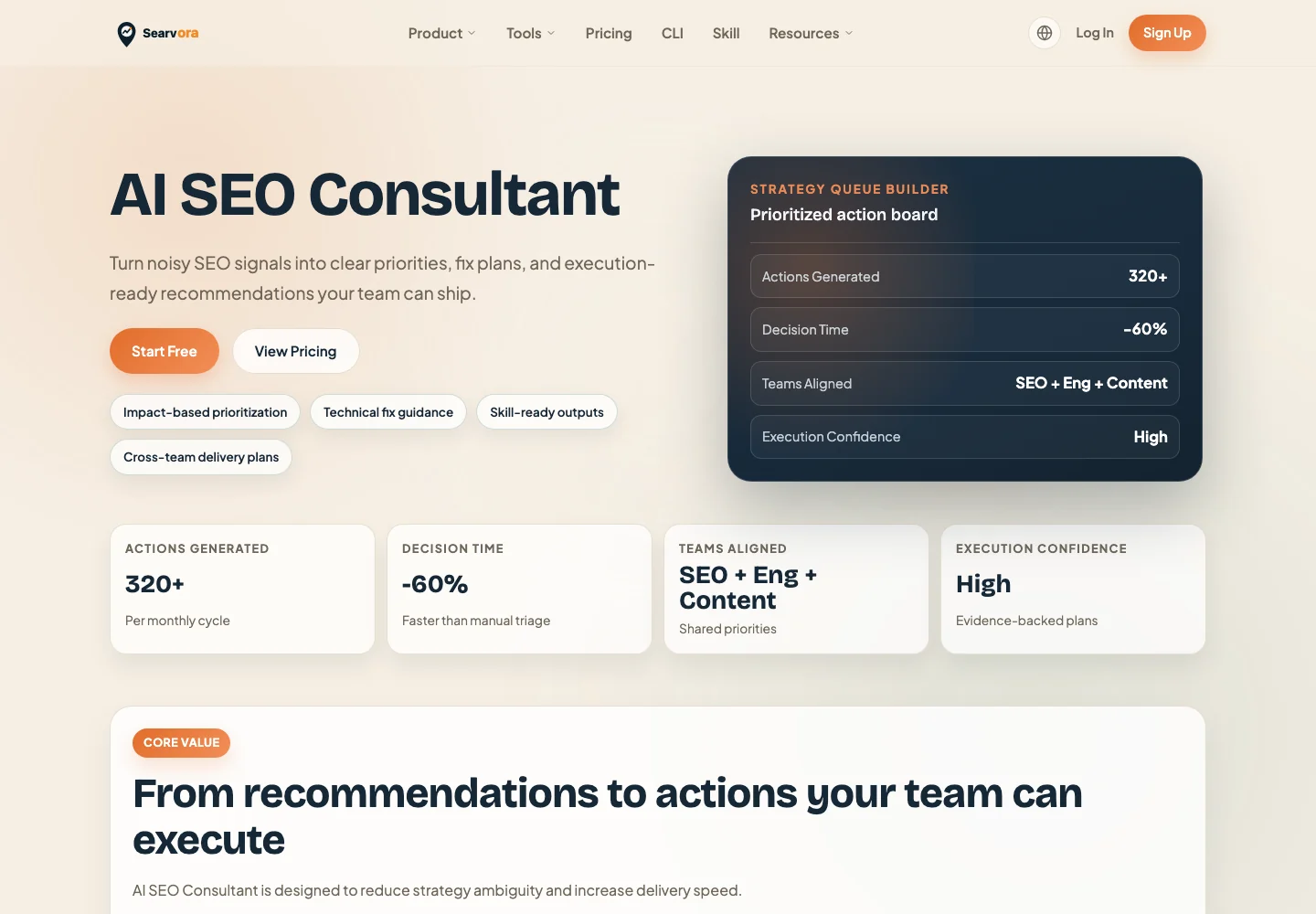
A free SEO course teaches the concept. Searvora helps after the concept creates too many possible actions.
Use the AI SEO consultant when course notes, crawl findings, keyword ideas, content gaps, and AI-search evidence need to become a ranked action queue. The local product page positions it around pattern-based diagnosis, impact and effort prioritization, fix-ready guidance, and execution alignment. That is the layer a learner needs after training turns into real site work.
Run This Course Selection Checklist
Before sending a teammate through another free SEO course, answer these questions:
- What job should the learner be able to do after the course?
- Which page, template, topic, or report will they practice on?
- What evidence will prove they understood the lesson?
- Which Searvora or external tool will validate the work?
- Who reviews the output before it becomes a live page change?
- What is the next course only if this practice task is complete?
The best free SEO courses are not just easier ways to learn definitions. They are low-risk ways to build judgment. Choose the course that closes the current workflow gap, then turn the lesson into a page, crawl, brief, dashboard, or action your team can recheck.