

If you are asking what is a good organic traffic percentage, the useful answer is not one fixed number. It is the share of traffic that makes sense for the page type, the business model, the channel mix, and the job that organic search is supposed to do.
For a content-heavy SEO program, organic search may be the main discovery channel. For a product page, a support tool, a local service page, or a paid-led launch, a lower organic percentage can still be healthy if the page earns qualified visits and supports the right next action. The useful question is not "is our percentage high?" It is "does this share prove the page is discoverable, trusted, and useful enough for its role?"
Start With The Page Job
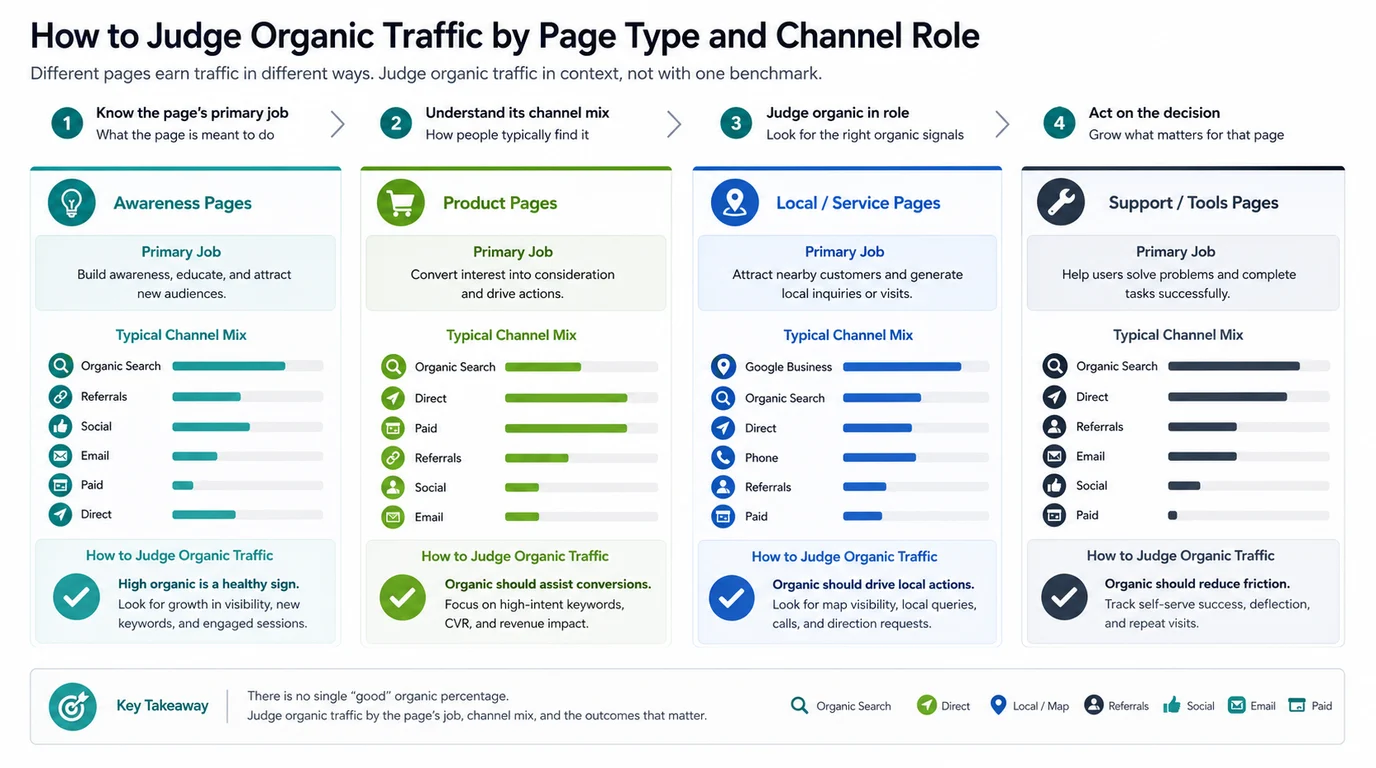
Organic traffic percentage means different things on different pages. A blog explainer, product comparison page, ecommerce collection, support page, and free tool should not be judged by the same threshold.
Use this page-job table first:
| Page type | Healthy organic role | Watch out for |
|---|---|---|
| Awareness article | Bring new qualified searchers into the site | High visits with weak engagement or no next step |
| Product or landing page | Capture commercial and comparison intent | Organic share falling while paid traffic masks weak visibility |
| Tool or support page | Solve a task and earn repeat discovery | Direct traffic hiding misclassified organic or branded demand |
| Ecommerce category | Match product demand and collection intent | Organic share rising on low-converting queries |
| Local or service page | Convert nearby or high-intent searches | Map/local discovery missing from the review |
If you need the baseline definition first, use what organic traffic means in SEO work. Once the source is clear, the benchmark question becomes much easier.
Clean The Channel Mix Before Benchmarking
Organic percentage is only useful when the channel mix is clean enough to trust. Misclassified direct traffic, untagged campaigns, paid search leakage, referral noise, consent changes, and bot filtering can all distort the percentage.
Before deciding whether the percentage is good, check:
- Organic search is separated from paid search, referral, email, social, and direct.
- Branded and non-branded demand are not being treated as the same job.
- Landing pages are grouped by page type, directory, locale, or template.
- Search Console clicks and impressions roughly support the analytics trend.
- Conversions or key events are attached to the same page group.
If organic and direct are being confused, review direct versus organic traffic before changing SEO priorities. Attribution cleanup is often the fastest way to avoid the wrong benchmark.
Use Percentages As Questions, Not Targets
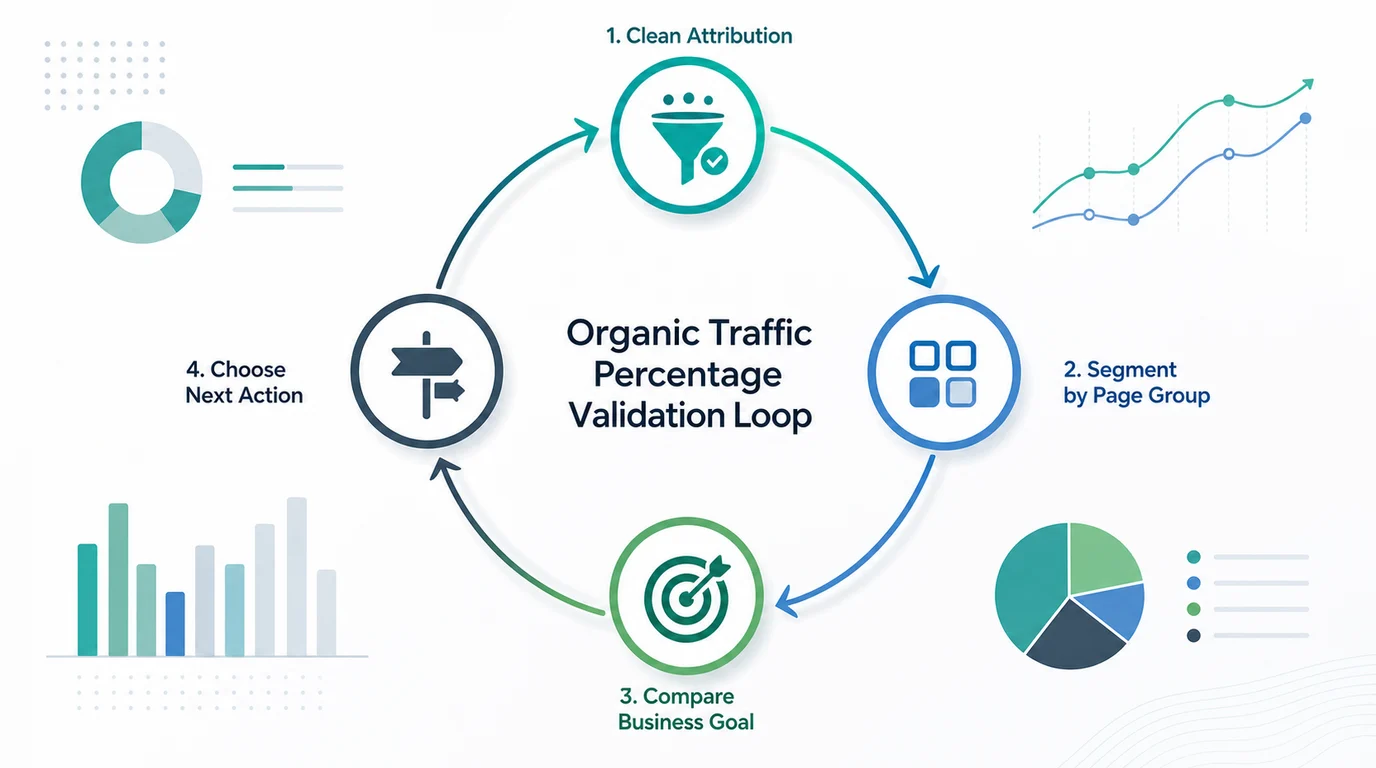
A percentage should trigger a better question. It should not become a quota by itself.
| Organic traffic percentage pattern | Better question | Likely next action |
|---|---|---|
| Very low on an awareness article | Is the page indexable, linked, and matching real search intent? | Check crawl eligibility, queries, and internal links |
| High on a low-converting article | Is the query too broad for the CTA? | Adjust next step, page promise, or supporting links |
| Falling on a product page | Did commercial visibility drop or did paid/direct mix change? | Compare Search Console, paid campaigns, and conversion rate |
| Rising on support/tool pages | Are searchers solving the task successfully? | Track task completion, repeat visits, and deflection quality |
| Stable sitewide but moving by template | Which page group is hiding the real change? | Segment by directory, page type, locale, or owner |
This framing is safer because organic percentage can rise for bad reasons. Paid traffic may fall. Email may be under-tagged. Direct traffic may be misclassified. A viral referral source may disappear. The percentage is useful only when it points to a page-level decision.
Compare Percentage With Business Outcome
The best organic share is the one that supports the page's business role. Pair the percentage with engagement, conversion, and search-demand evidence before celebrating or worrying.
Use this compact review:
| Evidence | What it tells you | Decision it supports |
|---|---|---|
| Organic share | How dependent the page group is on unpaid search | Whether SEO is a major acquisition lever |
| Search Console clicks and impressions | Whether search visibility exists behind the traffic | Whether to improve snippets, content, or eligibility |
| Engagement or key events | Whether the visits are useful after the click | Whether the traffic is qualified |
| Conversion or assisted conversion | Whether the page supports business goals | Whether the page deserves more SEO investment |
| Crawl and index checks | Whether organic growth is being blocked | Whether to fix technical eligibility before content |
This is where a dashboard beats a one-time benchmark. The team needs to see whether organic percentage, search demand, engagement, and crawl eligibility are moving together.
For a broader metrics review, pair this with SEO metrics to track instead of using organic percentage as the only health signal.
Where Searvora Fits
Searvora's AI SEO dashboard fits when the benchmark needs to become an operating cadence. The product page positions it around page-type cohorts, locale drill-down, anomaly detection, opportunity queues, and cross-team reporting. That makes it useful for judging organic percentage by segment instead of one blended sitewide number.
Use Searvora to ask better benchmark questions:
| Dashboard view | Benchmark question |
|---|---|
| Page-type cohorts | Is this organic share healthy for the page job? |
| Locale or directory drill-down | Is one market or template hiding the real issue? |
| Loss and upside queues | Which percentage shift deserves work first? |
| Cross-team reports | Who owns the next action and validation window? |
Organic Traffic Percentage Checklist
Use this checklist when someone asks whether the percentage is good:
- Define the page group before reading the percentage.
- Confirm organic search is not mixed with direct, paid, referral, or untagged campaigns.
- Separate branded and non-branded demand when the site has enough data.
- Compare Search Console clicks and impressions against the analytics trend.
- Review engagement and conversion quality, not just visit share.
- Check crawl, indexability, canonical, sitemap, and internal-link signals for underperforming page groups.
- Decide whether the next action is technical, content, internal linking, CTA fit, reporting cleanup, or watch.
- Recheck the same segment after the validation window.
That is the practical answer to what is a good organic traffic percentage: it is good when the right pages earn qualified unpaid visits, the attribution is clean, and the resulting decision helps the team improve search performance without chasing an arbitrary number.