

If you want to know how to rank in AI Overviews, start with the constraint most shortcuts ignore: you do not directly submit a page into an AI Overview. You improve the odds that Google can crawl, index, understand, and cite the right source page when an AI answer needs support.
The Ahrefs article that surfaced this opportunity gives practical AI Overview ranking advice. Searvora's information gain is the operator workflow around that advice: choose the source page, cover query fan-out, make the answer extractable, validate crawl and snippet eligibility, and turn the evidence into weekly actions.
What Ranking In AI Overviews Really Means
Google's AI features guidance says the same search fundamentals apply to AI Overviews and AI Mode. There are no extra technical requirements, no special schema requirement, and no separate machine-readable file that guarantees inclusion. A page must be eligible for Google Search and eligible to show a snippet before it can appear as a supporting link.
That changes the job. The goal is not to "optimize for the AI box" as if it were a normal rank position. The goal is to make the best owned source page eligible, useful, specific, and easy to reuse when Google's systems build an answer.
Use this decision frame before rewriting anything:
| Question | Strong answer | Weak answer |
|---|---|---|
| Which URL should support this AI answer? | One canonical source page is named | Several similar pages compete for the same job |
| Is the page eligible for Search? | It is crawlable, indexable, canonical, and snippet-eligible | Robots, noindex, canonical, or preview controls are unclear |
| Does the page answer the task directly? | The answer, caveats, examples, and proof are visible in HTML | The page is generic or hides important detail |
| Can Google explore related subtopics? | The page covers fan-out questions with clear sections | The page only repeats the head keyword |
| Can the team validate movement? | Query, page, citation, and action evidence are tracked | The team relies on one manual SERP check |
Pick The Source Page Before Editing Copy
AI Overview work goes sideways when teams start by adding paragraphs to every adjacent article. Start with source ownership instead.
For each target query group, choose the URL that should be cited if Google needs a supporting source. It might be a parent explainer, a product page, a comparison page, a technical tutorial, a dataset, or a support page. The page type should match the user task, not the content calendar.
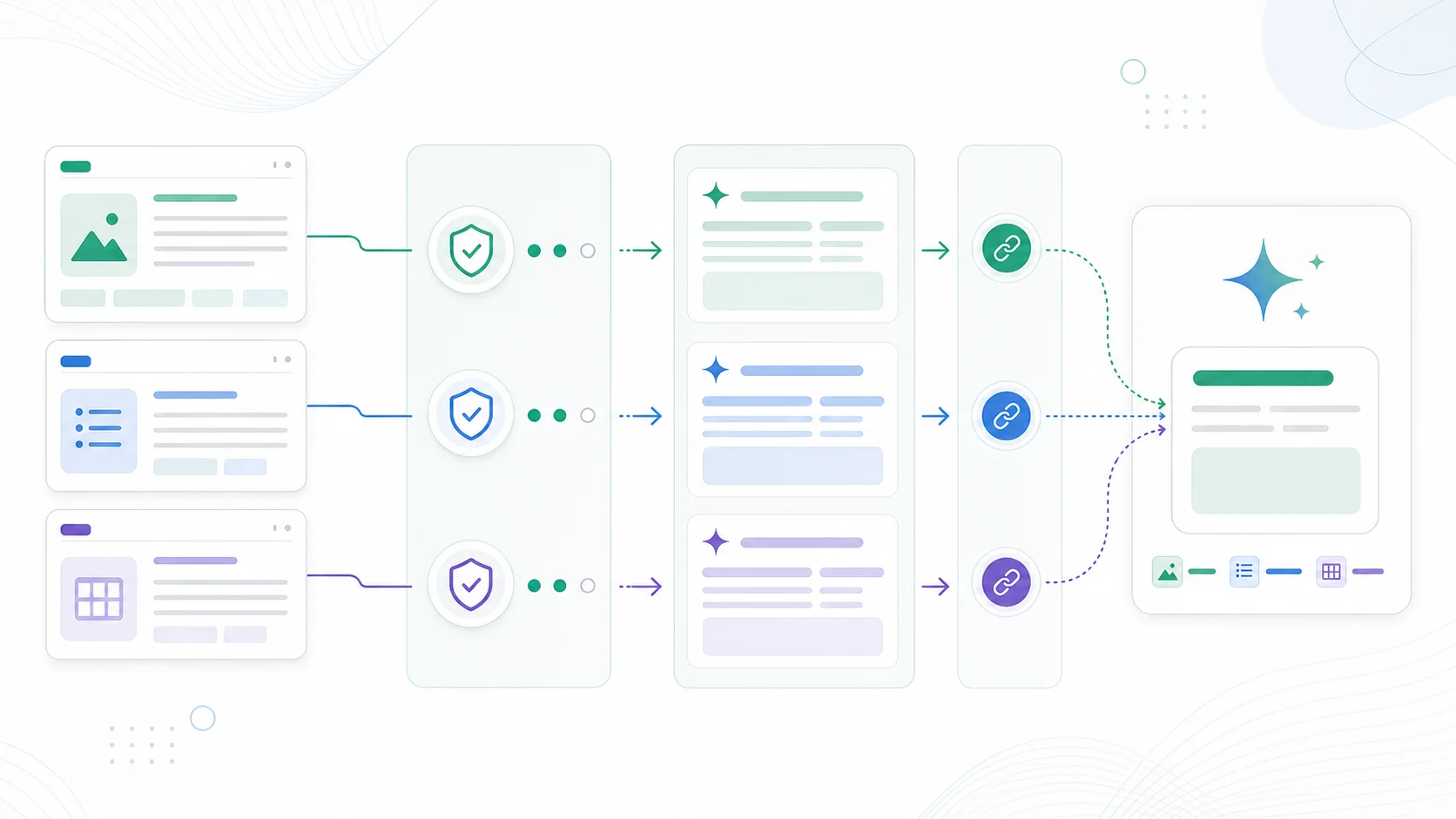
Use this source map:
| Query job | Best source type | What the page must prove |
|---|---|---|
| "What is..." or definition query | Parent explainer or glossary-style article | The topic is defined clearly with scope, examples, and related concepts |
| "How to..." workflow query | Step-by-step article or technical guide | The reader can follow the process and validate the result |
| Comparison query | Comparison article or alternatives page | Tradeoffs, fit, limitations, and decision criteria are visible |
| Troubleshooting query | Diagnostic article, support page, or tool page | Symptoms, causes, fixes, and verification steps are separated |
| Product-category query | Product page plus supporting article | The product fit and use case are specific enough to trust |
This article is a child of the broader Google AI Overviews workflow. That parent explains what AI Overviews mean for SEO. This page owns the narrower "how to rank in AI Overviews" job: choosing and improving the source page most likely to support an AI answer.
Cover Query Fan-Out Without Making One Giant Page
Google says AI Overviews and AI Mode may use query fan-out, meaning related searches across subtopics and sources can help build a response. That does not mean every article should become a 12,000-word catch-all. It means the source page should answer the main job and cover the subquestions a searcher would naturally ask next.
For a page targeting how to rank in AI Overviews, the fan-out set usually includes:
- What makes a page eligible for AI Overviews?
- Whether special schema or markup is required.
- How Google chooses supporting links.
- How to make content easier to cite or summarize.
- How to measure AI Overview visibility.
- How to avoid cannibalizing existing SEO pages.
- What to fix first when a competitor is cited instead.
Build sections around these tasks. Keep the intro direct, then use tables, steps, examples, and validation checks to make the answer easy to extract. Google's guidance on succeeding in AI search keeps the same baseline: unique, valuable content for people, good page experience, accessible content, matching structured data, and useful supporting media.
The information gain is in the operating detail. A generic page says "create helpful content." A stronger page names the source page, shows the evidence it needs, explains which related query jobs belong on the page, and defines what the team will check after publishing.
Make The Answer Extractable And Citable
AI Overview visibility depends on whether the page can support a useful answer without losing meaning. That is why answer structure matters.
Use this build pattern:
| Page element | Why it helps | How to write it |
|---|---|---|
| Direct answer block | Makes the page's core claim easy to understand | Give the practical answer in the first few paragraphs |
| Eligibility section | Separates technical access from editorial quality | Cover crawl, indexability, snippet eligibility, canonical, and preview controls |
| Fan-out sections | Shows depth without keyword stuffing | Answer related subquestions as H2 or H3 sections |
| Evidence table | Gives systems and people structured proof | Compare checks, pass conditions, and next actions |
| Caveats | Reduces overclaiming | Explain what Google does not guarantee |
| Validation loop | Turns the article into an operating workflow | Track queries, pages, citations, Search Console data, and update dates |
Do not hide important facts inside decorative images. Google's AI features guidance specifically points back to textual content, crawl access, internal links, page experience, and structured data that matches what users can see. Images can support the page, but the claim itself should be in crawlable text.
If you already have a strong parent page, avoid creating a second parent with the same task. For example, the track AI Overviews workflow owns measurement. This page should link to it when measurement becomes the next job, not duplicate every tracking detail.
Validate Eligibility Before You Chase Citations
Before asking why a competitor is cited, prove that your candidate page is eligible enough to be considered.
Run these checks in order:
- Confirm the page returns a successful status for users and Googlebot.
- Confirm robots.txt, meta robots, X-Robots-Tag, canonical, and redirects do not remove the page from consideration.
- Confirm the page is included in the right XML sitemap and internally linked from relevant hubs.
- Confirm title, H1, intro, and canonical URL all describe the same source job.
- Confirm important definitions, examples, tables, and caveats render as HTML text.
- Confirm structured data, if used, matches visible content.
- Confirm preview controls such as nosnippet or max-snippet do not accidentally limit the useful answer.

Google's Search Console performance report remains the baseline for clicks, impressions, CTR, average position, queries, pages, countries, devices, dates, and search appearances. As of June 3, 2026, Google has also announced Search Generative AI performance reports for a subset of sites, with dedicated generative-AI visibility views. Use those reports when available, but keep a fallback ledger for teams that do not have them yet.
Your fallback ledger should track:
| Evidence | What to record | Why it matters |
|---|---|---|
| Query set | Target query, country, device, intent, and source URL | Keeps checks comparable over time |
| AI Overview state | Present, absent, brand mentioned, URL cited, competitor cited | Separates visibility evidence from normal ranking movement |
| Search Console movement | Clicks, impressions, CTR, position, page, and query group | Shows whether demand or click behavior changed |
| Eligibility changes | Crawl, indexability, canonical, sitemap, internal links, and metadata | Prevents content rewrites when the blocker is technical |
| Content updates | What changed, why, owner, and recheck date | Connects actions to later evidence |
Turn The Evidence Into A Weekly Action Queue
A source-ready page still needs maintenance. AI Overview surfaces change, Google tests new reporting, competitors refresh content, and your own site can create source confusion when several pages drift toward the same query.
Use this weekly sequence:
- Choose one topic cluster where AI Overview visibility would matter.
- Pick the source page that should support the target answer.
- Map the fan-out subquestions and remove overlap with parent or sibling pages.
- Run crawl, indexability, canonical, snippet, sitemap, and internal-link checks.
- Add missing definitions, examples, tables, caveats, and official sources.
- Record the update date and expected evidence window.
- Recheck AI Overview presence, citations, query movement, and page movement.
- Assign one next action: refresh, merge, internal link, technical fix, new child page, or watchlist.
Searvora AI SEO Dashboard fits this operating layer. Use the AI SEO Dashboard to monitor page groups, locale performance, anomaly signals, opportunity scores, and action queues. That keeps AI Overview work from becoming a one-off rewrite that nobody revisits.
For a broader answer-engine framework, pair this workflow with answer engine optimization. Keep the roles clear: this page owns Google AI Overview source-page readiness; the parent hub owns the larger AI-search strategy.
AI Overview Ranking Checklist
Use this checklist before approving a page as your AI Overview source:
- One URL is responsible for the query job.
- The page is crawlable, indexable, canonical, snippet-eligible, and internally linked.
- The intro answers the task directly before adding nuance.
- Fan-out subquestions are covered with useful sections, not keyword repetition.
- Claims are supported by official sources, examples, tables, screenshots, or operational evidence.
- Important facts are visible in HTML text.
- Parent and sibling pages have clear roles to avoid cannibalization.
- Search Console, generative-AI report data when available, citation checks, and content updates are tracked separately.
- Every recheck produces one action or a deliberate watchlist decision.
Ranking in AI Overviews is not a separate trick layered on top of SEO. It is the discipline of making the right page eligible, specific, extractable, useful, and easy to improve when the evidence changes.