

Learning how search engines work starts with the path from URL discovery to served result. Search engines discover URLs, crawl or render pages, store useful information in an index, rank eligible pages for a query, and serve the result format that best answers the searcher. AI answer systems add another surface, but they still depend on source pages that can be found, understood, trusted, and validated.
For SEO teams, the useful question is not only "how does Google work?" It is "which part of the workflow is failing for this page, and what evidence proves the fix worked?"
Start With The Search Engine Pipeline
Search is easier to debug when you separate the system into stages. A ranking problem can start as a discovery problem, a crawl problem, an indexing problem, a relevance problem, or a result-format problem.
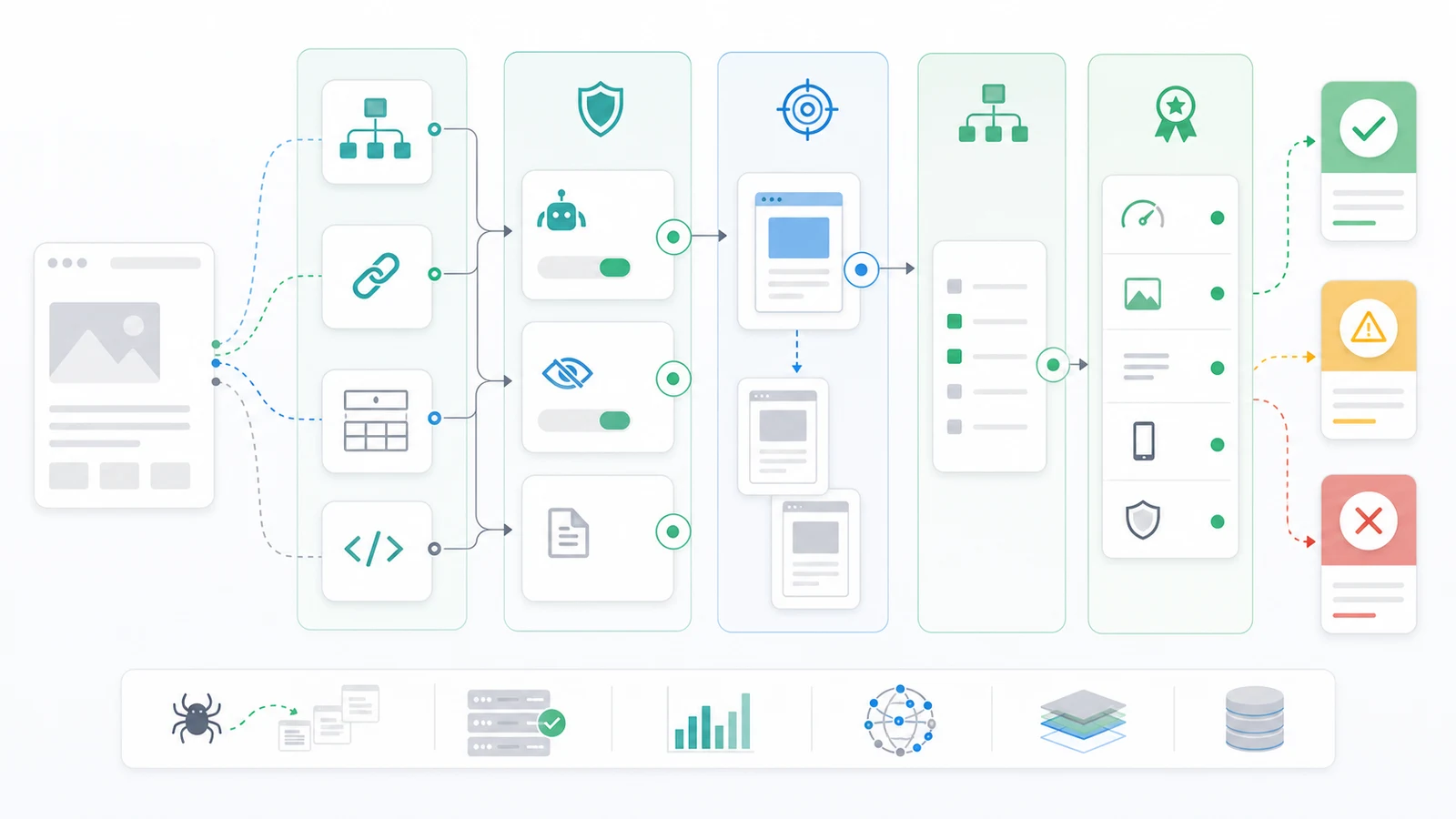
Use this map before you rewrite copy or chase another keyword:
| Stage | What search systems need | What SEO teams should validate |
|---|---|---|
| Discovery | A URL that can be found through links, sitemaps, redirects, or other references | Internal links, XML sitemap inclusion, crawl depth, orphan risk |
| Crawl | A fetchable URL with a stable response | Status code, redirects, robots.txt, server errors, blocked resources |
| Render | The important content and links after JavaScript runs | Rendered HTML, title, H1, body copy, navigation, structured data |
| Index | A canonical page that deserves to be stored | Noindex, canonical target, duplicate variants, content value |
| Rank | A page that fits the query better than alternatives | Intent fit, topic coverage, internal links, authority, freshness |
| Serve | A result that can appear as a blue link, feature, snippet, or AI source | Title, description, structured evidence, extractable definitions, source clarity |
| Validate | Evidence that the live state changed | Recrawl, sitemap checks, Search Console data, AI citation review when relevant |
Google's How Search Works documentation is the official baseline for crawling, indexing, and serving results. The operator layer is turning that model into repeatable checks.
Discovery Decides Whether The Page Enters The System
Search engines cannot evaluate a page they never find. Discovery usually comes from crawlable internal links, XML sitemaps, redirects from known URLs, external links, and already known page relationships.
Start with the site itself:
- Confirm the canonical URL appears in the right sitemap.
- Check that useful pages link to it with crawlable
hreflinks. - Measure crawl depth from important hubs, navigation, or parent pages.
- Find orphan pages that exist in the CMS but have no internal path.
- Remove stale sitemap URLs that redirect, error, noindex, or canonicalize elsewhere.
Discovery work is often where parent hubs matter. A strong parent explainer can route search systems and readers to child workflows such as Googlebot checks, indexing diagnostics, or technical audits. A buried page has a weaker starting point even when the content itself is good.
Crawling And Rendering Decide What Search Can Inspect
After discovery, a crawler has to fetch the page. For modern websites, the rendered output matters too. A browser can show a page while search systems see blocked resources, missing links, delayed content, or contradictory metadata.
Google's crawler overview and JavaScript SEO basics are useful references here because they separate fetchability from rendered-page usefulness.
Run these checks before changing the article body:
| Crawl or render check | Healthy pattern | Failure pattern |
|---|---|---|
| Status code | Final canonical URL returns a clean 200 | Redirect chain, 404, 5xx, soft failure, timeout |
| Robots access | Important content and resources can be requested | Robots.txt blocks the page or critical assets |
| Rendered content | Main answer, H1, links, images, and schema appear in rendered HTML | Content depends on fragile client-side state |
| Internal links | Related pages use crawlable links | Navigation is click-only or hidden behind scripts |
| Metadata | Title, description, robots, canonical, and hreflang are visible and consistent | Source and rendered output disagree |
The deeper technical SEO workflow is useful when these checks turn into a wider site audit. For this article, the key point is simple: search engines work from the live signals they can fetch and render, not from what the CMS preview promised.
Indexing Is A Selection Decision, Not A Button
Indexing means a search system chooses to store information about a page. It is not guaranteed just because the URL exists or was submitted.
A page may fail indexing because it is blocked, noindexed, duplicated, canonicalized away, thin, too similar to another page, not internally supported, or simply waiting for recrawl. Those are different jobs.
Use this triage:
| Indexing symptom | Likely question | Better next step |
|---|---|---|
| URL is not discovered | Can search systems find it? | Add internal links and clean sitemap inclusion |
| Crawled but not indexed | Is the page eligible and useful enough? | Check noindex, canonical, duplicate content, and page value |
| Wrong URL is indexed | Which URL has stronger consolidation signals? | Align canonicals, redirects, internal links, and sitemap entries |
| Many variants are indexed | Is the URL pattern creating duplicates? | Control facets, parameters, pagination, and canonical rules |
| Fixed page still excluded | Has the live fix been recrawled? | Re-crawl, inspect, and monitor before making unrelated changes |
The Google indexing workflow goes deeper on this stage. It is the right companion when a specific page is missing from Google or when a template group has inconsistent canonical and indexability signals.
Ranking Depends On Query Fit And Page Evidence
Ranking starts after eligibility. At that point, search systems compare many possible answers for a specific query. They evaluate whether the page matches intent, covers the task, demonstrates useful evidence, and belongs in the result set compared with other sources.
Google's ranking systems guide describes multiple systems that help identify useful, reliable results. SEO teams should translate that into practical review fields:
| Ranking field | What to inspect | Practical fix |
|---|---|---|
| Intent fit | Does the page answer the actual query shape? | Rewrite the intro, title, headings, or page type |
| Page type | Is this meant to be an explainer, how-to, tool, comparison, or hub? | Route the topic to the page format searchers expect |
| Evidence | Are definitions, steps, examples, and constraints visible in text? | Add tables, examples, official-source links, and validation checks |
| Internal support | Do related pages reinforce the topic? | Link from parent hubs and child guides with descriptive anchors |
| Technical trust | Can the page be crawled, rendered, indexed, and selected as canonical? | Fix access and consolidation issues before content polish |
| Freshness | Does the topic require current guidance? | Add an update path and refresh when standards or result formats change |
This is where many teams confuse vocabulary overlap with duplicate content. A parent article about how search engines work can link to a child indexing article, a Googlebot article, and a technical audit article without cannibalizing them. Cannibalization needs the same core keyword, same page type, and same user job.
AI Answers Raise The Evidence Bar
AI answer surfaces do not make crawl, index, and ranking fundamentals disappear. They make source-page evidence more important. If a page cannot be discovered, rendered, selected as canonical, or summarized clearly, it is a weaker candidate for AI-assisted results too.
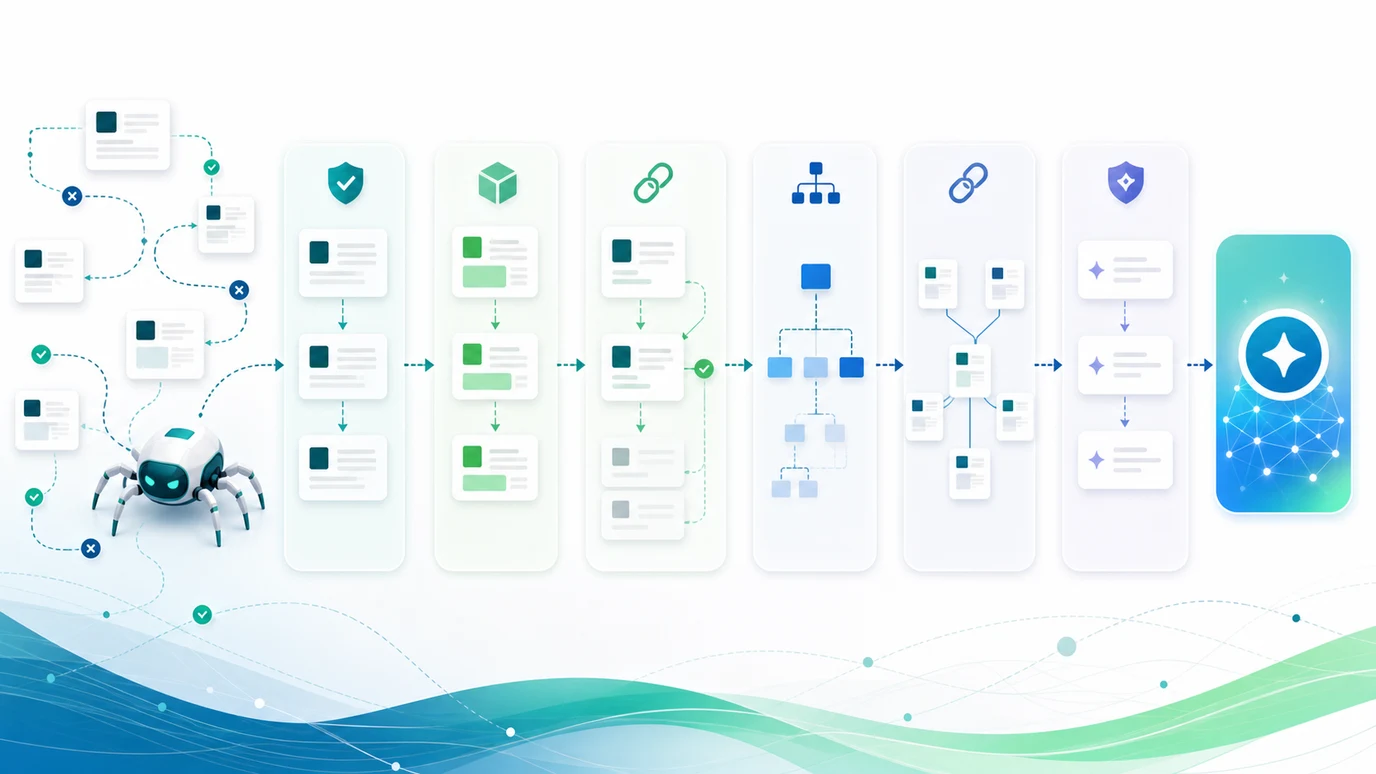
Use this AI-readiness split:
| Classic search evidence | AI-answer readiness question |
|---|---|
| The page is crawlable and indexable | Can answer systems reach the source page reliably? |
| The canonical is stable | Is there one clear URL that represents the answer? |
| The intro defines the topic directly | Can the answer surface extract the core explanation without guessing? |
| Tables and examples are visible in text | Is the useful evidence reusable outside the page layout? |
| Internal links show topic relationships | Does the site expose parent, child, and proof pages clearly? |
| The page is monitored after changes | Can the team see whether visibility or citation behavior changed? |
This is why AI-search work should still begin with source-page quality. If the crawl layer is weak, fix the crawl layer. If the source evidence is thin, improve the answer. If the site has good pages but poor internal support, strengthen the cluster before writing another disconnected article.
Turn The Model Into An SEO Fix Queue
When a page underperforms, assign the issue to the first failing stage. That prevents vague tickets like "improve rankings" and creates work that can be validated.
Use this queue format:
| Failure stage | Example issue | Owner | Validation check |
|---|---|---|---|
| Discovery | Important guide is orphaned from the topic hub | Content or SEO | Crawl shows new inlinks and lower depth |
| Crawl | Product collection returns intermittent 5xx errors | Engineering | Recrawl shows stable 200 responses |
| Render | JavaScript hides key comparison links | Frontend | Rendered HTML contains crawlable links |
| Index | Canonical points to an outdated URL | Engineering or CMS owner | Canonical, sitemap, and internal links agree |
| Rank | Intro answers the wrong page type | Content | Updated title, intro, H2s, and search intent review |
| Serve | Page lacks extractable definitions and examples | Content or SEO | Snippet, AI-source, and query monitoring after recrawl |
The sequence matters. Do not ask a content writer to fix a page that is blocked. Do not ask engineering to "improve rankings" when the real issue is a weak answer. Name the system stage, attach evidence, assign the owner, and define the recheck.
Where Searvora Fits
Searvora SEO Spider Crawler fits the evidence layer of this workflow. The product page positions it around online crawling, rendering, sitemap discovery, robots parsing, indexability, canonicals, hreflang, metadata checks, issue clustering, recurring crawls, exports, and owner-ready fix queues.
Use the SEO spider crawler when the team needs to move from "search engines might not understand this page" to a reviewable set of crawl findings and validation rules.
| Workflow step | Searvora role | Output |
|---|---|---|
| Crawl the URL set | Collect status, links, canonicals, robots, metadata, and sitemap signals | Baseline evidence |
| Group issues | Cluster failures by template, directory, severity, and page type | Shorter owner queue |
| Prioritize fixes | Rank work by search access, organic impact, template footprint, and confidence | A fix order the team can defend |
| Validate changes | Re-crawl and compare the same fields after release | Proof that the search-engine stage changed |
| Escalate strategy | Route ambiguous page-value questions to AI SEO Consultant | A prioritized action queue instead of scattered notes |
Search Engine Workflow Checklist
Use this checklist when a page is not getting the visibility it should:
- Confirm the page has a distinct search job and deserves a URL.
- Check whether the URL is internally linked and included in the right sitemap.
- Crawl the URL and template group for status, redirects, robots, and resources.
- Inspect rendered HTML for the title, H1, body answer, links, schema, and images.
- Confirm canonical, sitemap, hreflang, and internal links point to the same preferred URL.
- Decide whether the page deserves indexing or should merge, redirect, noindex, or stay private.
- Compare the page type and intro against the actual query intent.
- Add extractable evidence: definitions, examples, tables, steps, and constraints.
- Link parent and child pages naturally so the cluster is easy to follow.
- Re-crawl after fixes and monitor search and AI-source behavior after recrawl windows.
How search engines work is not trivia. It is the operating model behind good SEO triage. Find the first failing stage, fix the signal that belongs to that stage, and validate the live page before moving to the next theory.