

In-house SEO works when one team owns the operating system, not when one person owns every task. The useful model gives SEO a weekly cadence for evidence, priorities, content decisions, technical fixes, stakeholder updates, and validation.
The Ahrefs in-house SEO article that surfaced this opportunity is useful for the role reality: company size, politics, collaboration, and long-term investment matter. Searvora's information gain is the operating layer after that decision. Once SEO moves inside the company, the team needs a way to turn search signals into shipped work without becoming an internal help desk.
What In-House SEO Actually Owns
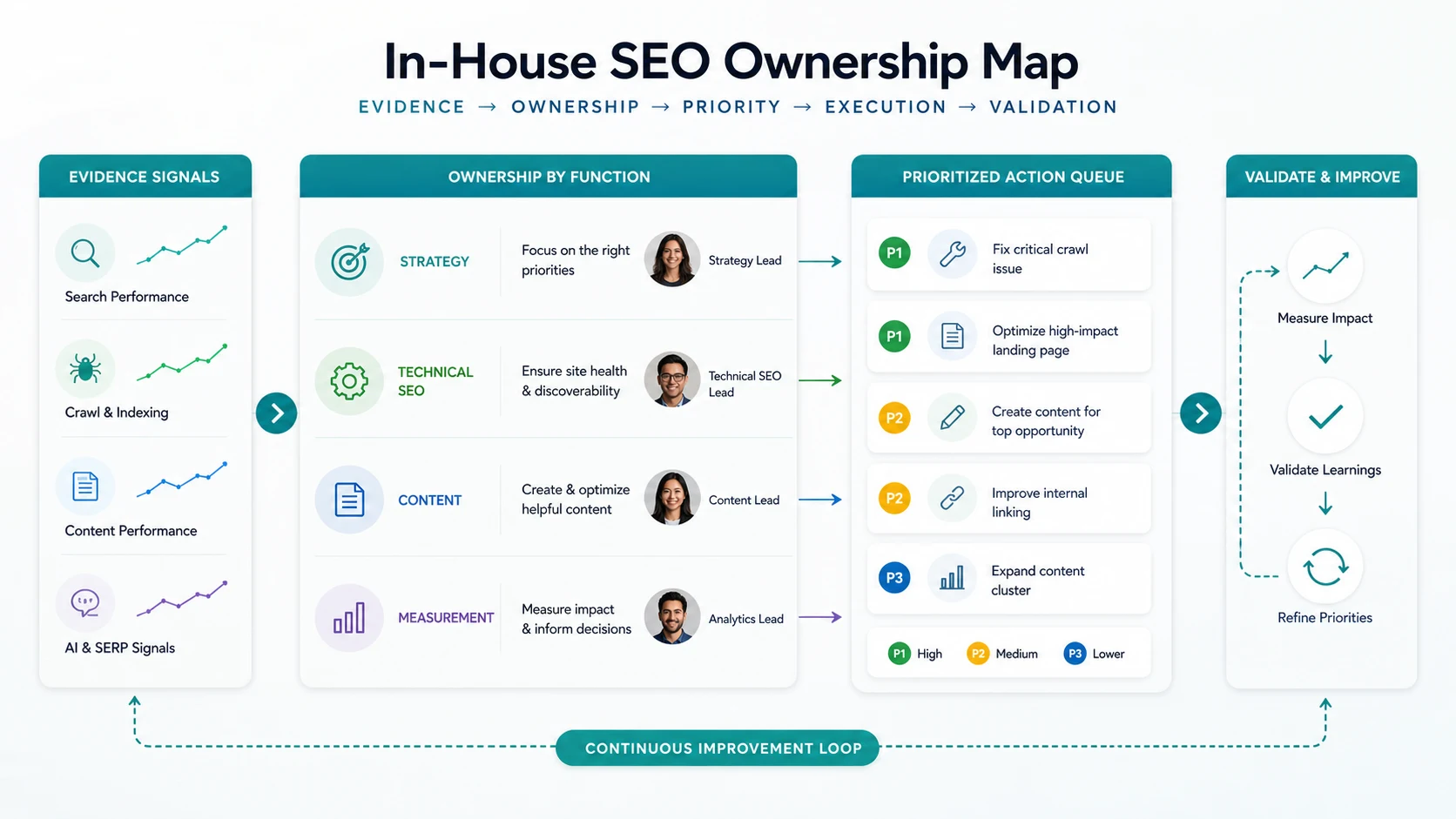
An in-house SEO function should own the system that decides what gets fixed, refreshed, created, consolidated, measured, and escalated. That does not mean the SEO lead writes every brief, implements every redirect, or edits every title tag.
Use this ownership split before hiring, buying tools, or briefing an agency:
| Workstream | In-house owner should decide | Execution partner can help with |
|---|---|---|
| Strategy | Which markets, page types, topics, and technical risks matter this quarter | Research support, competitive review, and planning inputs |
| Technical SEO | Which crawl issues block important pages and which releases need validation | Engineering tickets, crawl exports, QA notes, and regression checks |
| Content | Which pages need new content, refreshes, consolidation, or internal links | Drafting, editing, SME interviews, and CMS production |
| Measurement | Which segments and validation windows prove the work mattered | Dashboard setup, reporting automation, and anomaly notes |
| AI search visibility | Which topics need source pages, entity clarity, citations, and answer-ready evidence | Prompt sampling, source review, and content recommendations |
This is why in-house SEO is less about job title and more about decision rights. If SEO cannot prioritize the work, it becomes a reporting role. If SEO cannot validate the work, it becomes a suggestion box.
Decide The Operating Model Before The Tool Stack
The first in-house SEO mistake is buying a stack before defining the weekly system. A crawler, dashboard, rank tracker, content workflow, and consultant can all be useful, but only if each one feeds a real decision.
Start with four operating questions:
| Question | Strong answer | Weak answer |
|---|---|---|
| What changed? | Traffic, crawl, content, ranking, and AI-visibility signals are segmented by page type and owner. | A sitewide dashboard moved and nobody knows why. |
| What matters first? | The team ranks work by business page, indexability, search demand, confidence, and effort. | Every issue export becomes urgent. |
| Who can ship it? | SEO routes work to content, engineering, product, merchandising, or leadership with acceptance criteria. | SEO keeps a backlog nobody else sees. |
| How do we know it worked? | Each action has a validation window, baseline, and follow-up signal. | The team publishes fixes and moves on. |
For an in-house team, the tool stack should map to those questions:
| Operating need | Useful Searvora fit |
|---|---|
| Prioritize mixed SEO signals | AI SEO Consultant for strategy, recommendations, and action planning |
| Monitor page groups and movement | AI SEO Dashboard for page-type, locale, and visibility monitoring |
| Validate crawl and release risk | SEO Spider Crawler for technical audits, indexability, metadata, links, and fix queues |
| Produce structured content work | Blogify when Shopify teams need repeatable briefs, drafts, and publishing workflow |
The operating model should come first because it prevents tool sprawl. If a platform does not change the weekly priority call, it is a reference source, not part of the core system.
Build A Weekly Evidence Cadence
In-house SEO has an advantage agencies often lack: faster access to releases, product context, internal SMEs, analytics changes, and publishing plans. The tradeoff is noise. Every team can ask for SEO help, and not every request deserves the same week.
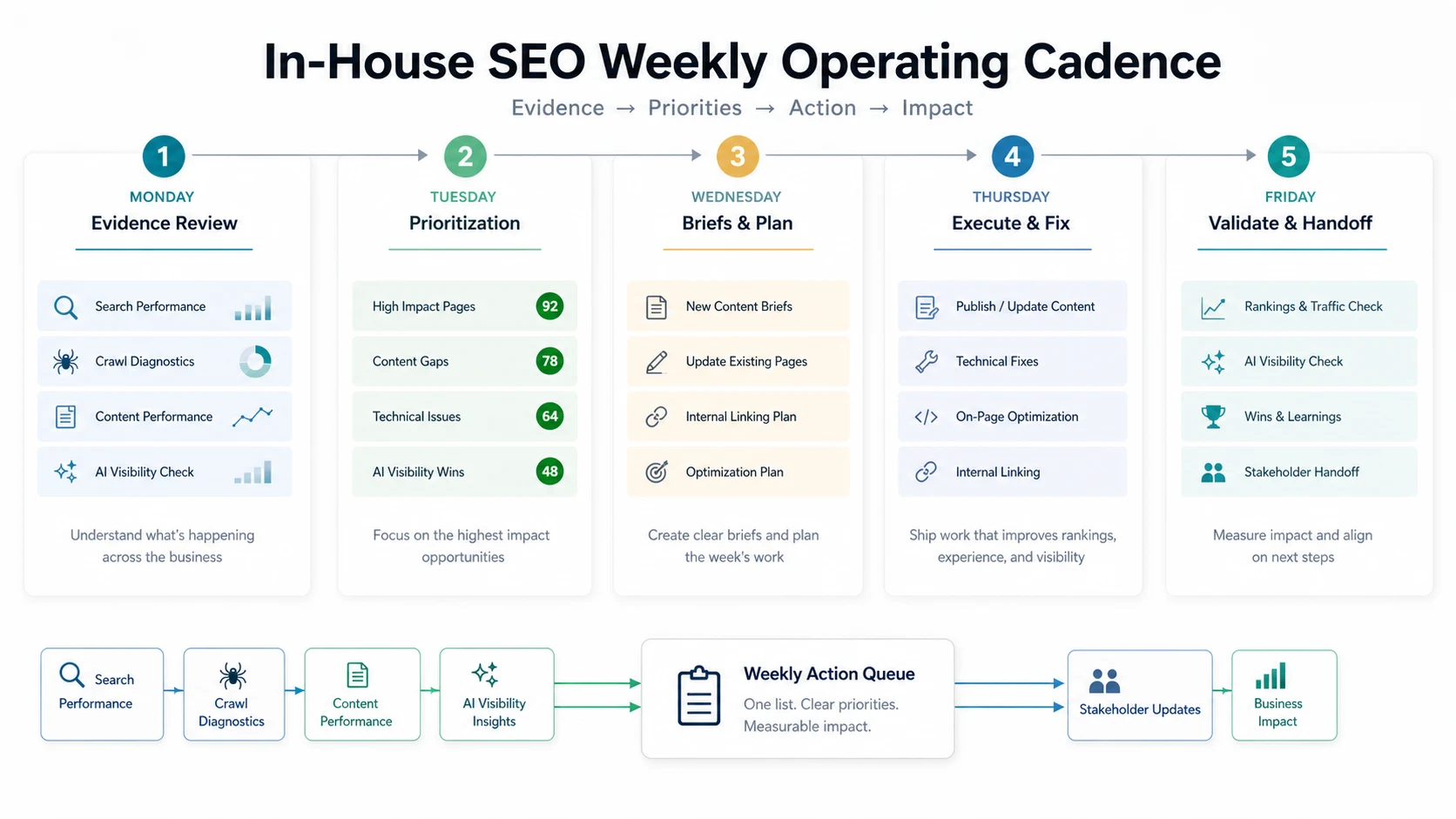
Use a weekly cadence like this:
| Day | SEO job | Output |
|---|---|---|
| Monday | Review search, crawl, content, and AI-visibility signals | A short evidence note with affected page groups |
| Tuesday | Prioritize by business value, risk, confidence, and owner | One ranked action queue |
| Wednesday | Write briefs, tickets, and acceptance criteria | Content briefs, engineering tickets, or page-update specs |
| Thursday | Support implementation and unblock questions | Shipped fixes or approved drafts |
| Friday | Validate, summarize, and adjust next week's queue | Stakeholder update with wins, misses, and follow-up checks |
This cadence is deliberately small. It does not require a large SEO department. It requires one place where the team decides which signals matter this week.
The cadence also makes automated SEO reporting more useful. A report should not just arrive on schedule. It should feed the Monday evidence review, Tuesday priority call, and Friday validation note.
Keep Agencies And Contractors In The Right Lane
In-house SEO does not mean no external help. It means the company owns the strategy, context, and acceptance criteria. Agencies, consultants, freelancers, and contractors can still be valuable when the boundary is explicit.
Use outside support when:
| Situation | Good external role | In-house control point |
|---|---|---|
| The team lacks specialist depth | Technical audit, migration review, international SEO, schema, or marketplace review | Decide which recommendations enter the roadmap |
| The backlog is too large | Content production, internal-link cleanup, QA, or reporting setup | Define briefs, quality gates, and validation windows |
| Leadership needs outside perspective | Strategy review, market benchmark, or competitor analysis | Translate advice into internal tradeoffs |
| A tool requires expert setup | Dashboard segmentation, crawl configuration, or automation workflow | Preserve the segments and owners the business uses |
Avoid outsourcing the final priority list. External teams can bring evidence, frameworks, and execution capacity, but the in-house SEO lead should still decide what gets shipped, paused, or escalated.
Turn SEO Work Into Cross-Functional Tickets
An in-house SEO team wins or loses on handoff quality. "Fix duplicate titles" is not a ticket. "Update the category template title pattern because 216 indexable pages share the same title structure" is closer. A good ticket makes the evidence, scope, owner, and validation clear.
Use this handoff format:
| Field | What to include |
|---|---|
| URL group | The exact pages, template, directory, or locale affected |
| Evidence | Crawl finding, query loss, ranking change, AI citation gap, or content audit note |
| Why it matters | Indexability, relevance, conversion, snippet, AI-search visibility, or user task |
| Owner | Engineering, content, product, design, legal, merchandising, or leadership |
| Acceptance criteria | What must be true after the fix ships |
| Validation window | When SEO will re-crawl, re-check performance, or review visibility |
Pair this with an SEO checklist only when the checklist becomes an assigned queue. A checklist is useful for coverage. It becomes operational when every item has an owner and a validation rule.
For technical work, keep a second level of detail ready. A technical SEO site audit should separate indexability blockers, metadata patterns, internal links, canonical problems, structured data, and release risks so engineering can estimate the work correctly.
Where Searvora Fits
Searvora is most useful when an in-house team needs a repeatable path from signal to assigned work.
| In-house SEO stage | Searvora role | Practical output |
|---|---|---|
| Weekly strategy call | AI SEO Consultant | Prioritized action plan from mixed SEO signals |
| Monitoring | AI SEO Dashboard | Page-type, locale, traffic, and visibility signals for review |
| Technical validation | SEO Spider Crawler | Crawl evidence, issue groups, and fix-ready queues |
| Content execution | Blogify | Structured drafts and publishing workflow for Shopify content teams |
Keep the main handoff focused on strategy and prioritization. If the in-house SEO lead already has data but needs to decide what to do next, AI SEO Consultant is the best primary fit. The dashboard, crawler, and content workflow support the same cadence by feeding evidence and execution back into the queue.
In-House SEO Checklist
Use this checklist before declaring the function "in-house":
- Name the business outcomes SEO is expected to influence.
- Define the page types, markets, or product areas SEO will own first.
- Pick the weekly evidence inputs: search, crawl, content, analytics, AI visibility, and release notes.
- Decide who can approve SEO priorities when teams disagree.
- Create a single action queue with owners and acceptance criteria.
- Separate agency support from final priority ownership.
- Require every content brief to state the search task, page type, internal links, and validation plan.
- Require every technical ticket to state the affected URL group and post-release check.
- Review AI-search visibility as source evidence, not as a guaranteed traffic channel.
- Close each week with what shipped, what changed, and what needs another cycle.
The best in-house SEO teams are not the ones with the longest tool list. They are the ones that can see a signal on Monday, make a priority call on Tuesday, ship the right work by the end of the week, and know what they are checking next.