

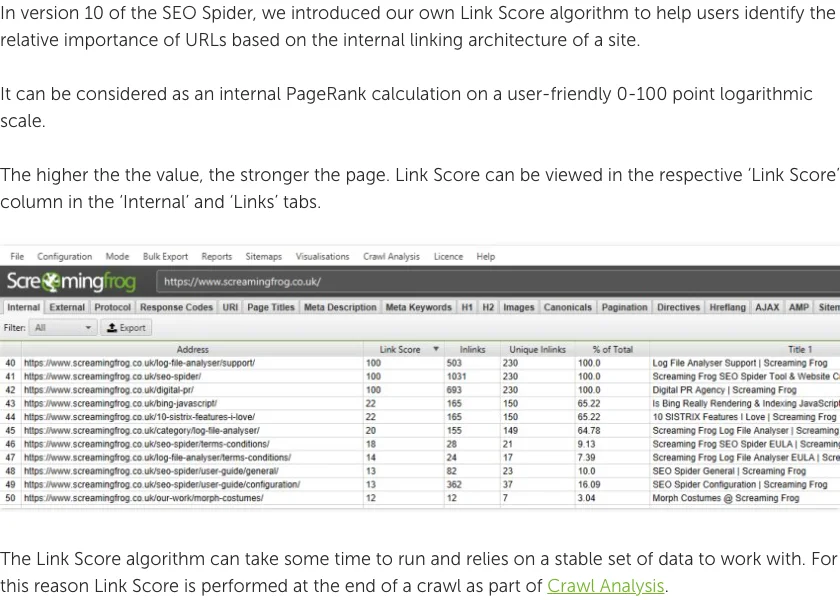
Link Score SEO starts with understanding what the score can actually prove. Screaming Frog Link Score is a crawl-relative measure of how strongly a URL is supported by a site's internal link structure. It maps an internal PageRank-style calculation onto a 1–100 logarithmic scale, making it easier to compare eligible URLs inside the same completed crawl.
The score is useful for finding pages that look too weak or too prominent for the job they perform. It is not a Google metric, a ranking guarantee, or a universal benchmark that can be compared across unrelated crawls. The practical SEO job is to combine Link Score with page purpose, crawl depth, inlinks, indexability, canonical state, performance, and business value before changing a single link.
How Screaming Frog Link Score Works
Screaming Frog's official Link Score documentation says the metric is calculated at the end of a crawl through Crawl Analysis. It uses the internal linking relationships found in the crawl and then scales the resulting values from 1 to 100.
The official process has several important details:
- The crawler first identifies eligible internal URLs.
- Each eligible URL receives an initial share of the score.
- Link Score flows through qualifying link relationships over repeated iterations.
- The raw values are converted into an easier 1–100 scale.
- The strongest eligible URL in that crawl receives 100, while the weakest receives 1.
The algorithm uses a damping coefficient of 0.85 and performs ten iterations. Screaming Frog also documents that qualifying links can include standard anchor links, redirects, and canonicals, with specific rules for self-references, duplicate links, and nofollow links.
| Link Score input | What it represents | What to remember |
|---|---|---|
| Internal link graph | How eligible URLs connect to one another | A partial crawl produces a partial graph |
| Inbound link sources | Which pages pass relative internal importance | Links from stronger pages can matter more than raw link count |
| Outbound link distribution | How a source page spreads its score | Large navigation or template patterns can change the distribution |
| Redirects and canonicals | Signals that may bypass an alternate URL toward a target | Bad canonical or redirect patterns can distort the architecture |
| Nofollow treatment | Links that do not pass Link Score under the documented model | A nofollow choice can change the calculated flow |
You do not need to reproduce the formula to use the metric. You do need to understand the crawl scope and the URL rules that produced it.
Link Score Is Relative, Not a Google Ranking Score
A Link Score of 70 does not mean a page has 70 percent SEO strength. It means the page sits toward the stronger end of the eligible URL set in that specific crawl.
That distinction prevents several bad conclusions:
| Wrong conclusion | Safer interpretation |
|---|---|
| A score of 80 should rank well | The URL receives relatively strong internal support in this crawl |
| A score of 15 is always a problem | The page may be a low-priority utility URL that needs little internal prominence |
| Two sites can compare scores directly | Each score is scaled inside its own crawl and URL set |
| Link Score equals Google's PageRank | It is Screaming Frog's documented internal model, not a value reported by Google |
| Raising the number guarantees traffic | Internal links help discovery and context, but rankings depend on more than link structure |
Google's link best practices confirm the durable part of the workflow: crawlable links help Google discover pages, and descriptive internal anchor text helps people and Google understand them. Google does not publish a page-level Link Score for site owners.
Build the Right Crawl Before Trusting the Score
Link Score relies on a stable, completed crawl. If the crawler cannot see important sections, the calculation cannot represent the real site architecture.
Check these inputs first:
- Crawl scope: Confirm whether the run includes the whole site, one directory, a subdomain, an XML sitemap, or a curated URL list.
- Rendering mode: If JavaScript controls navigation or links, make sure the crawl mode captures the rendered relationships you intend to audit.
- Robots and authentication: Blocked or gated sections can disappear from the graph.
- URL normalization: Parameters, alternate hosts, trailing slashes, and duplicates can split signals across multiple URLs.
- Canonical and redirect behavior: Make sure the preferred destination is the one the audit should prioritize.
- Crawl completion: Run Crawl Analysis after the crawl has finished and the URL set is stable.
The Screaming Frog configuration workflow is the useful companion when the audit scope, rendering mode, or storage rules are still uncertain. A perfect interpretation cannot rescue a badly scoped crawl.
Combine Link Score With the Signals That Explain It
Link Score becomes actionable when it is joined to the evidence that explains why a URL is strong or weak.
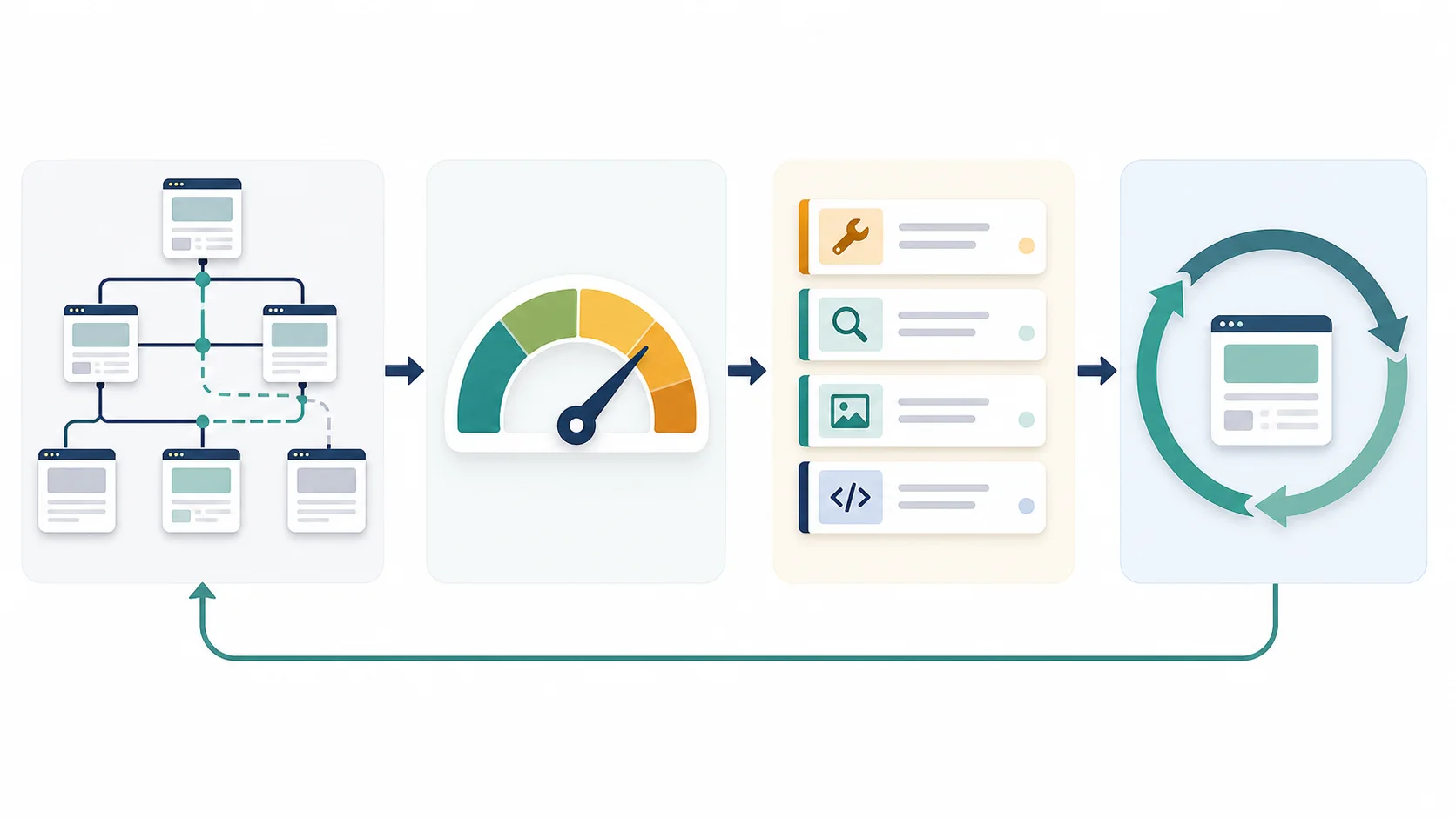
Use this decision table:
| Signal | Question it answers | Example action |
|---|---|---|
| Link Score | Is this URL relatively strong or weak inside the crawled graph? | Flag unexpected outliers for review |
| Unique inlinks | How many distinct pages support the URL? | Find pages with broad support or very few sources |
| Crawl depth | How far is the URL from strong entry points? | Shorten the path to important pages |
| Anchor text | Do source pages explain the destination clearly? | Replace vague or misleading anchors |
| Indexability | Can the destination compete in search? | Do not strengthen a blocked or noindex URL by accident |
| Canonical | Is the link pointing to the preferred version? | Update links to the canonical destination |
| Page job | Should this URL be a product page, hub, guide, support page, or utility page? | Judge prominence against purpose |
| Search and business evidence | Does the page have demand, conversions, strategic value, or a recovery opportunity? | Prioritize fixes that support real outcomes |
The internal links for SEO audit covers the broader link-graph workflow. Link Score is a narrower diagnostic layer inside that audit, not a replacement for it.
Turn Link Score Outliers Into a Fix Queue
Start with mismatches between score and page purpose.
| Pattern | Likely question | Next check | Possible action |
|---|---|---|---|
| Important page, unexpectedly low score | Is the page buried or weakly supported? | Inlinks, depth, anchors, hub coverage | Add contextual links from relevant strong pages |
| Utility page, unexpectedly high score | Is navigation or a template overemphasizing it? | Sitewide links, footer, header, pagination | Reduce unnecessary sitewide prominence |
| Redirected or alternate URL drawing support | Are internal links pointing through a hop or toward the wrong version? | Redirect target, canonical target, source templates | Update links to the preferred final URL |
| Strong score, weak search performance | Is internal support masking an intent, quality, or index-selection problem? | Query fit, content depth, canonical selection, SERP type | Fix the actual page problem rather than adding more links |
| Weak score across a whole directory | Is the section isolated from the main architecture? | Navigation, hubs, breadcrumbs, cross-cluster links | Repair the template or hub pattern |
| New page with low score | Has it entered the site without a launch link plan? | Publishing workflow, related articles, sitemap | Add intentional launch links and validate discovery |
Prioritize by impact and confidence, not by the size of the score gap. A commercial page that is two clicks too deep may deserve action before a low-scoring article with no demand. A thin utility page may be correctly weak.
For each approved fix, record:
- affected URL and page job
- current Link Score, inlinks, and crawl depth
- source pages or templates to change
- intended anchor and placement
- owner
- expected outcome
- recrawl condition that proves the change shipped
Common Link Score SEO Mistakes
Adding links only to raise a number
Links should help a reader reach a useful next page. If the destination is weak, duplicated, blocked, or misaligned with search intent, more internal links amplify the wrong decision.
Comparing scores from different crawl scopes
A directory crawl and a full-site crawl do not contain the same eligible URL set. Keep the crawl configuration and URL scope with the report so later comparisons use the same baseline.
Ignoring navigation and template links
Sitewide components can dominate the graph. Review whether a strong score comes from deliberate editorial support or simply from a footer, menu, filter, or repeated template block.
Treating every low-score URL as an orphan
An orphan page has no crawlable internal link path from the crawled site. A low-score page may still have links, just weaker support. Use the orphan pages workflow when discovery sources need to be reconciled across crawls, sitemaps, analytics, and other URL inventories.
Closing the task without a recrawl
An edited CMS field or navigation template is not proof that the final links render correctly. Re-crawl the affected segment, confirm the destination state, and compare the graph again.
Where Searvora Fits
Searvora SEO Spider Crawler is built around the operational layer after technical evidence is collected: crawl the site, group issues, prioritize affected pages, assign owners, and define validation steps.
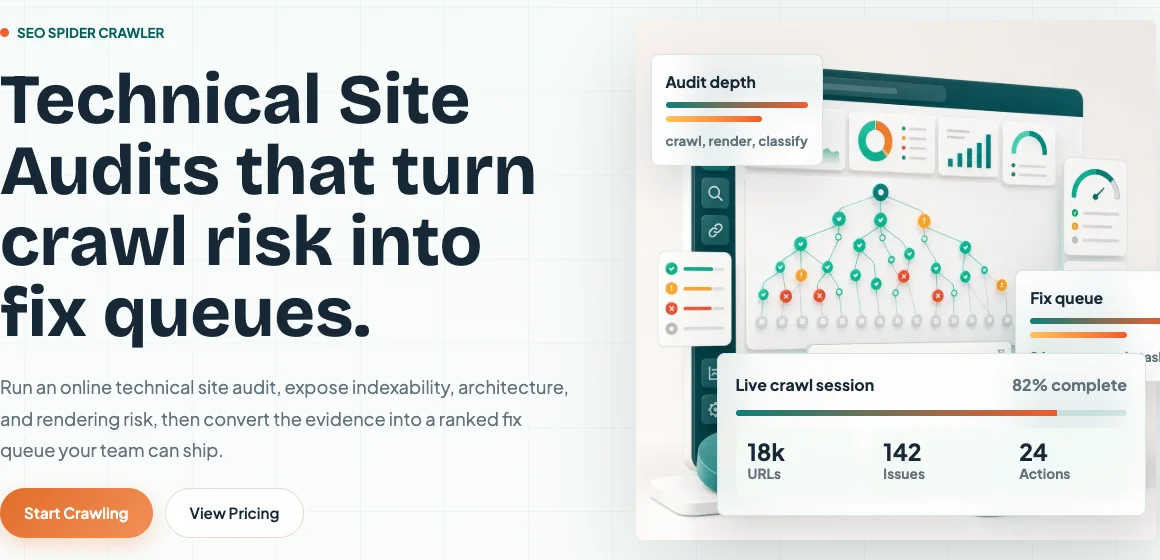
That makes it useful when a Link Score review needs to become team work:
| Team need | Searvora workflow |
|---|---|
| Confirm the architecture | Inspect crawl paths, depth, indexability, canonicals, redirects, and internal-link patterns |
| Explain the outlier | Connect the score to page type, template footprint, and technical state |
| Prioritize changes | Rank work by severity, organic impact, confidence, and effort |
| Hand off the fix | Add owner context and a clear implementation target |
| Prove completion | Re-crawl the affected URL set and verify the intended change |
This is not a claim that Searvora reproduces Screaming Frog's proprietary Link Score. Use Screaming Frog's official documentation and product when you need that metric. Use Searvora when the bigger job is turning crawl and architecture evidence into a fix queue the team can ship and validate.
Link Score SEO Checklist
Use this checklist before acting on a Link Score report:
- Confirm the crawl scope, rendering mode, robots behavior, and URL sources.
- Finish the crawl and run Crawl Analysis on a stable URL set.
- Treat 1–100 as a relative scale inside that crawl.
- Identify score-to-page-job mismatches, not merely low numbers.
- Check unique inlinks, crawl depth, anchor text, indexability, and canonicals.
- Add search demand, performance, and business value to the priority decision.
- Review whether navigation or repeated templates explain unexpected strength.
- Approve only links that help users and reinforce the correct canonical page.
- Assign each change to an owner with a specific source and destination.
- Re-crawl the affected segment and record whether the architecture changed as intended.
Link Score is most valuable when it narrows the investigation. Use it to find surprising architecture patterns, then let crawl evidence and page purpose decide the fix.