

If the question is how marketers use LinkedIn to improve AI search visibility, start with source evidence. LinkedIn can help when public company pages, expert posts, and profile details make a brand easier to understand, reference, and connect back to owned pages.
It does not help when the team treats LinkedIn as a shortcut around SEO. The practical job is to turn public LinkedIn activity into clearer entity signals, stronger source pages, and a validation loop for the AI-search queries where the brand should appear.
Use LinkedIn As A Source Layer
LinkedIn is useful for AI-search visibility because it can expose public signals about people, company categories, expertise, audience conversations, and current positioning. Those signals are strongest when they support a real source page on the brand's own site.
The official LinkedIn Marketing Blog article on AI visibility frames LinkedIn as part of an AI-led discovery shift. Searvora's information gain is the operating layer after that: how to decide which LinkedIn signal should become an owned-page fix, not just another post.
Use this separation before changing anything:
| LinkedIn signal | What it can support | What to improve on your site |
|---|---|---|
| Company page description | Brand entity, category, audience, and use cases | Homepage, product page, about page, and category copy |
| Founder or expert posts | Expertise, examples, and current point of view | Source article, use-case page, proof page, or FAQ section |
| Repeated audience questions | Search tasks and objections worth answering | Intro, H2 structure, decision table, or support article |
| Public engagement patterns | Which ideas are traveling beyond the first audience | Internal links, refreshed examples, and distribution plan |
| Third-party mentions of posts | External proof and citation candidates | Brand mention ledger and source-page evidence map |
Build The LinkedIn Source Map
Do not review LinkedIn activity as one blended visibility score. Map each public signal to the page that should support the same answer in search and AI-search experiences.
Start with four groups:
- Company identity: the public description, product category, official names, and audience language.
- Expert proof: founder, executive, or practitioner posts that explain the work in concrete terms.
- Topic demand: comments, saves, reposts, and questions around a specific problem.
- Source ownership: the owned URL that should answer, prove, or expand the same task.
That map prevents a common mistake. A strong LinkedIn post may show that people care about a topic, but the post alone is not the canonical source page. If AI search should cite or summarize your brand for that task, the owned page needs the clearest answer.
The AI visibility evidence loop is the parent process here. LinkedIn is one evidence layer inside that loop, alongside Search Console movement, citation checks, crawl eligibility, brand mentions, and source-page quality.
Connect Every Signal To An Owned Page
LinkedIn content gets operational when each signal ends with one page and one fix. The fix can be small. It might be a clearer definition, a better comparison table, an example from the post, a stronger internal link, or a recheck note for the next review.
Use this decision table:
| Finding | Likely meaning | Better next action |
|---|---|---|
| LinkedIn post earns useful discussion but no owned page answers the task | Social proof exists before source ownership | Create or strengthen the source page first |
| Company page uses category language that differs from the website | Entity wording is inconsistent | Align homepage, product, and LinkedIn descriptions |
| Expert post explains the use case better than the product page | The public proof is stronger than the owned source | Move the example into a crawlable page section |
| AI answer mentions the brand but cites a third-party page | Entity awareness exists, but source ownership is weak | Improve the page that should earn the citation |
| LinkedIn discussion reveals repeated objections | The page may answer too slowly or too generically | Add a decision table, FAQ, or example near the top |
| Visibility signal is noisy or one-off | The query set may be unstable | Move it to watchlist instead of rewriting immediately |
The AI search citation audit is useful when the gap is source ownership. It asks which URL should support the answer, whether that URL is technically eligible, and which evidence is missing.
Decide What To Fix After Each Check
A LinkedIn AI-search workflow should not end with "post more." It should end with a page, owner, action, and validation date.
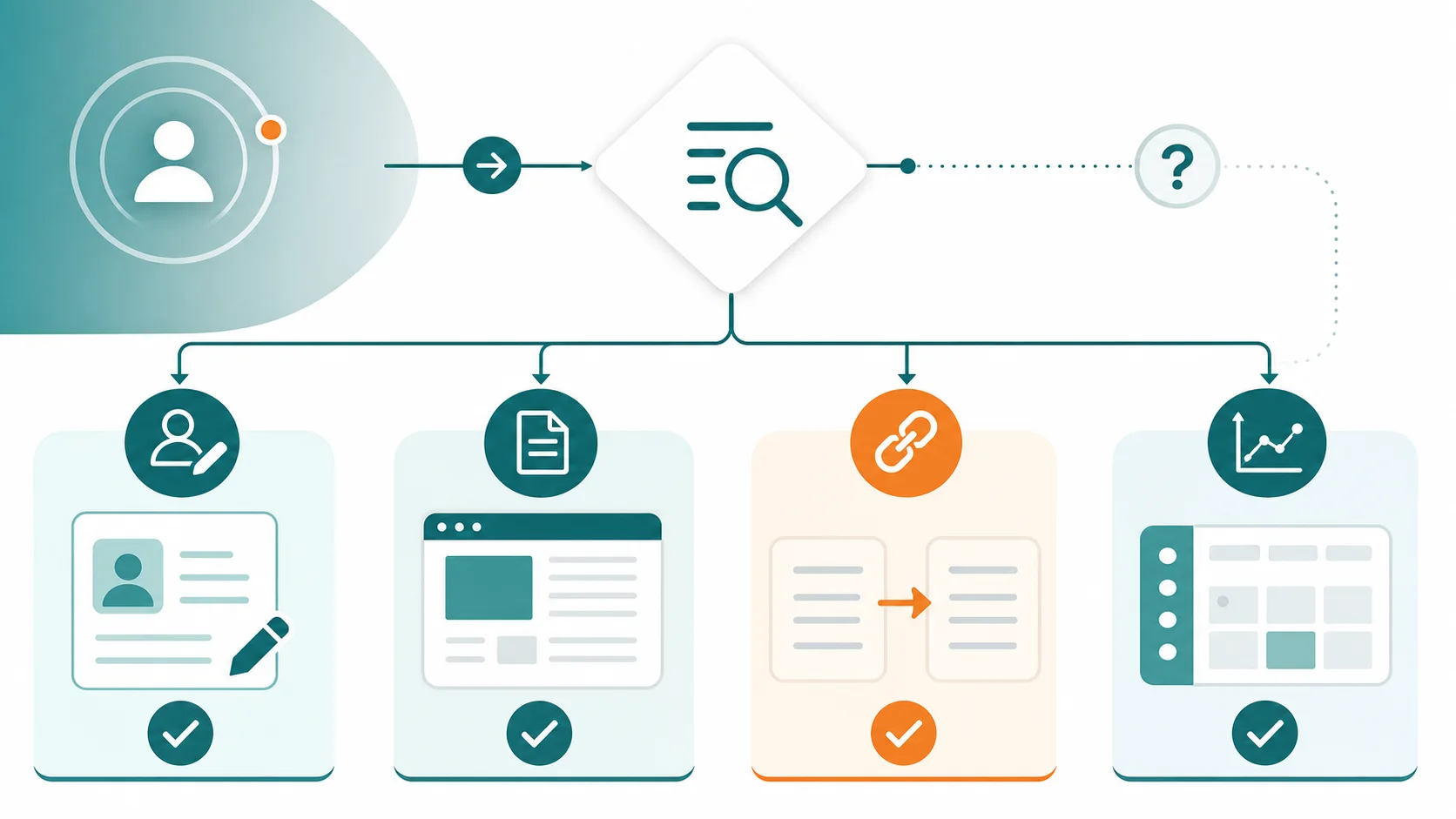
Use this routing logic:
| If the evidence shows | Route the work to | Validation check |
|---|---|---|
| Brand description mismatch | Brand or product marketing | Public profile and website language match |
| Good topic engagement but weak owned answer | Content or SEO | Source page answers the task in visible HTML |
| Strong post but isolated source page | SEO operations | Related pages link to the source with useful anchors |
| AI answer cites a competitor source | Content and technical SEO | Owned page has clearer proof and is crawlable |
| Query is unstable across checks | Watchlist | Same query set is rechecked before edits |
This is also where the social signals for SEO workflow becomes useful. Social distribution can reveal demand, but SEO progress still depends on the destination page, search evidence, links, mentions, and source clarity.
Run A Weekly LinkedIn AI Visibility Loop
Review one topic cluster at a time. If the team tries to inspect every post, query, page, and AI answer in one meeting, the evidence turns into noise.
Run the loop like this:
- Pick one product category, use case, or problem query group.
- List the LinkedIn company page, profile, and post signals that relate to that group.
- Choose the owned page that should support the answer.
- Check whether the page is crawlable, indexable, canonical, internally linked, and clear in rendered HTML.
- Review whether AI-search experiences mention the brand, cite the owned page, cite a competitor, or stay unstable.
- Compare the same page group in Search Console or your SEO dashboard.
- Choose one next action: update LinkedIn wording, improve the source page, add internal links, create a child article, or watch.
- Record the owner and recheck date.
Google's AI features guidance keeps the foundation practical: pages still need eligibility, helpful content, visible text, and normal search quality. LinkedIn evidence is useful only when the page behind the brand can support the answer.
Where Searvora Fits
Searvora AI SEO Dashboard fits the monitoring layer of this workflow. The product page positions it around page-type cohorts, locale drill-down, anomaly detection, opportunity queues, and executive-ready summaries. Those are the views a team needs when LinkedIn activity creates mixed signals across brand demand, source pages, AI mentions, and search performance.
Use the AI SEO dashboard to keep LinkedIn evidence beside normal SEO signals:
| Workflow step | Searvora role | Output |
|---|---|---|
| Group queries | Track the topic cluster, market, page type, and source page | Stable review set |
| Monitor movement | Compare impressions, clicks, visibility shifts, and page cohorts | Evidence before edits |
| Route fixes | Separate profile wording, source-page work, links, and watchlist items | Owner-ready queue |
| Recheck results | Review the same query and page group after changes ship | Validation trail |
LinkedIn AI Search Visibility Checklist
Use this checklist before reporting LinkedIn activity as AI-search progress:
- Name the query group where the brand should appear.
- Identify the owned page that should support the answer.
- Align company page, product page, and source-page category language.
- Move useful expert examples from posts into crawlable owned content when they belong there.
- Add internal links from related articles, product pages, or hubs to the source page.
- Check whether AI-search experiences mention the brand and which URL they cite.
- Compare the same page group in Search Console or the dashboard.
- Assign one fix and one recheck date.
- Leave unstable one-off prompts on watchlist.
- Repeat the same query set before claiming improvement.
LinkedIn can help marketers improve AI search visibility when it makes the brand clearer and the source page stronger. The win is not more posting for its own sake. The win is a public signal that leads to a better owned page, a cleaner citation path, and a decision the team can validate next week.