

Social signals for SEO are useful when you treat them as evidence of distribution, audience interest, brand demand, and source-page reach. They are weak when you treat likes, shares, comments, or saves as a magic ranking switch.
The practical question is not whether a social post can push a page up by itself. The useful question is whether social distribution helps the right page reach the right audience, earn searches, links, mentions, referrals, and AI-search visibility that can be measured and acted on.
The Ahrefs article on social signals that surfaced this opportunity argues for the same caution: social activity matters, but not as a simple ranking-factor shortcut. Searvora's information gain is the operating layer after that distinction: how to turn social activity into a clean weekly evidence loop.
Social Signals Are Distribution Evidence
Social signals usually include engagement on social platforms and community channels: shares, comments, saves, reactions, reposts, discussion threads, and visible mentions. They can tell you whether a piece of content reached people who cared enough to react or pass it along.
That is different from saying the engagement count itself is an SEO ranking lever. Google's SEO Starter Guide frames promotion as a way to help interested people discover useful content, while still grounding SEO in helpful, accessible pages. The safest workflow is to use social distribution to expand discovery, then measure the search evidence that follows.
Use this separation:
| Signal | What it can tell you | What it should not prove alone |
|---|---|---|
| Shares and reposts | The topic or asset traveled beyond the first audience | That the page deserves to rank |
| Comments and replies | Readers had questions, objections, or use cases | That the page satisfies search intent |
| Branded search movement | More people searched for the brand, product, or article topic | That social was the only cause |
| Referral sessions | Social or community links sent visitors to the page | That visitors were qualified |
| Links and mentions | Other pages referenced the asset or brand | That every mention is editorially valuable |
| AI/search mentions | The brand or page appeared in modern search surfaces | That the source page is strong enough yet |
Map Social Activity To Search Outcomes
Social signals become useful for SEO when they are connected to outcomes the team can validate. A post that earns discussion may reveal a better headline. A thread that sends referral traffic may show a topic deserves a stronger source page. A repeated brand mention may point to an AI-search visibility gap.
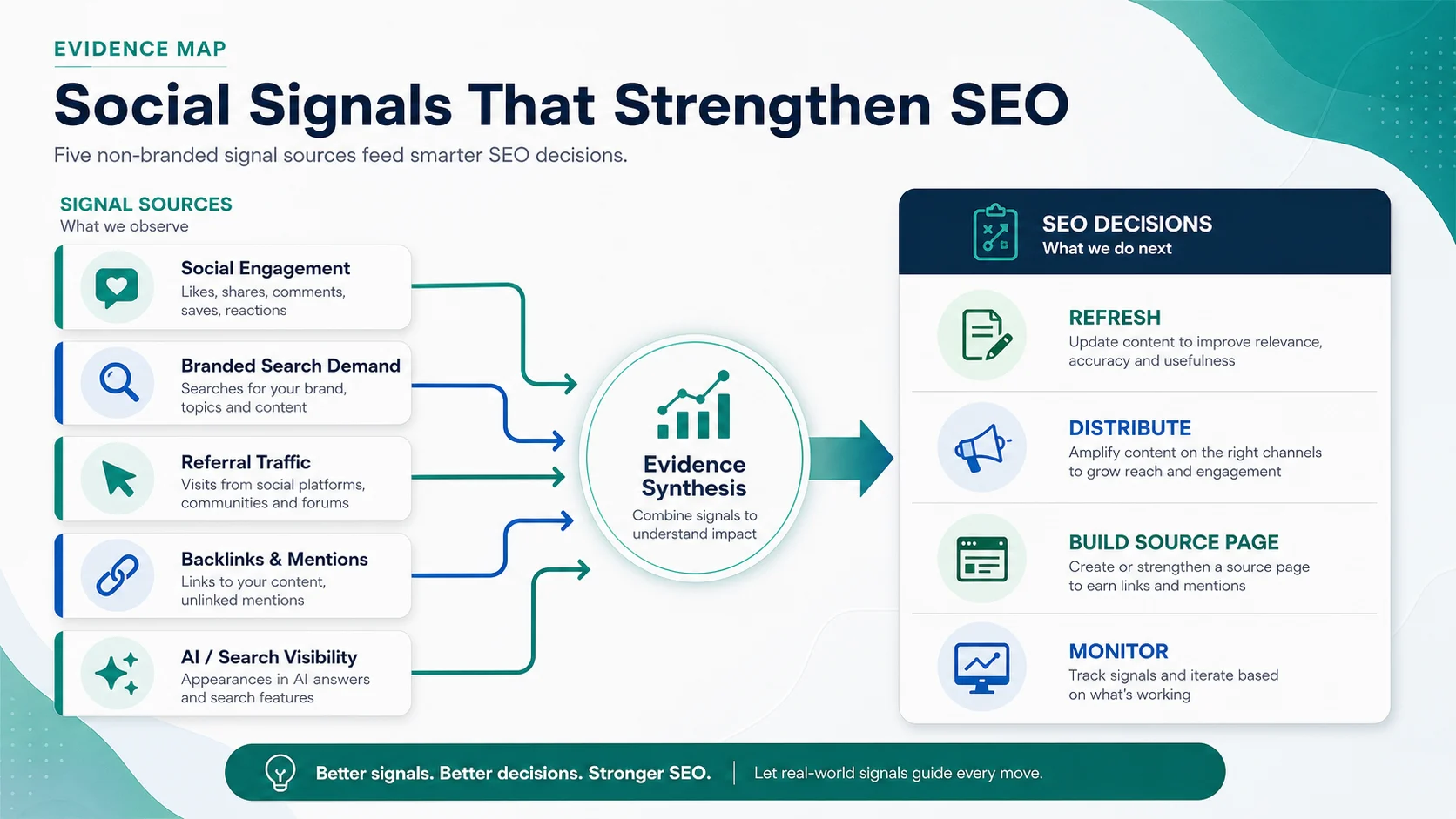
Start with an evidence map rather than a single score:
| Evidence layer | Data to collect | Better SEO action |
|---|---|---|
| Audience resonance | Which topics, hooks, examples, and formats earn real conversation | Update titles, intros, examples, or FAQs around the questions people repeat |
| Branded demand | Branded queries, product-name searches, and topic-plus-brand searches | Strengthen source pages and internal links for the brand/category connection |
| Referral quality | Sessions, landing pages, engagement, and conversions from social and community sources | Keep the channel if it brings qualified readers, not just visits |
| Link and mention lift | New backlinks, unlinked mentions, newsletter citations, and community references | Qualify sources before outreach or asset refresh work |
| Search visibility movement | Search Console clicks, impressions, CTR, and page movement after distribution | Decide whether to refresh, consolidate, or monitor the page |
| AI-search evidence | Mentions, citations, source URLs, and competing answers in AI search experiences | Improve source-page clarity, evidence, crawlability, and citation readiness |
This is where social distribution can help SEO without turning into folklore. The brand SEO workflow is useful when the evidence is mostly about entity clarity and branded demand. The AI search citation audit is useful when social discussion reveals questions where your page should become a better source.
Build A Weekly Social SEO Loop
Do not review social signals once per quarter in a channel report. Review them weekly or monthly beside search data, page health, and content actions.
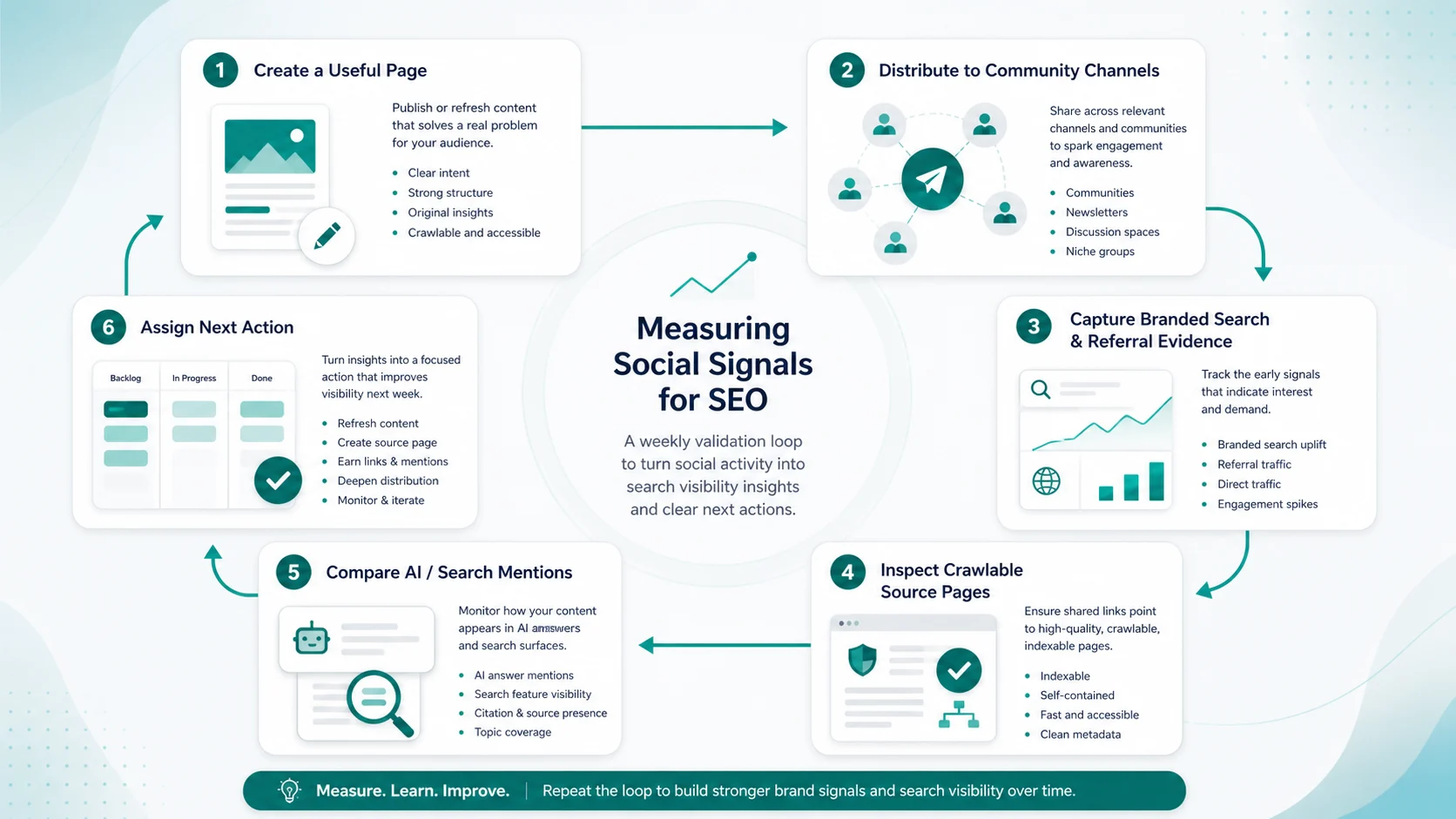
Use this loop:
- Pick the page or cluster you distributed.
- Record the channel, audience, post angle, and date.
- Capture social engagement patterns, not just totals.
- Check referral sessions and landing-page behavior.
- Compare branded and non-branded search movement in Search Console.
- Inspect whether the target page is crawlable, indexable, canonical, and internally linked.
- Look for new links, unlinked mentions, citations, or repeated questions.
- Check whether AI/search experiences mention the brand, source page, or competitors for the same task.
- Assign one next action: refresh the page, add examples, build a stronger source page, deepen distribution, earn mentions, or monitor.
Google's Search Console performance report is the baseline for clicks, impressions, CTR, queries, and pages. Use it to avoid over-crediting social activity when search demand did not move, and to spot early demand when branded or topic queries start rising after distribution.
Check The Source Page Before Chasing More Engagement
More reach does not help much if the destination page is weak. Before the team doubles down on a social campaign, inspect the page that social activity is sending people toward.
Use this source-page checklist:
| Check | Why it matters |
|---|---|
| Search intent match | The page should answer the task that social discussion exposed |
| Crawl access | Search systems need a clean path to discover and render the page |
| Indexability | The page should not be blocked, noindexed, or canonicalized away by mistake |
| Internal links | Related pages should point to the source page with descriptive anchors |
| Evidence quality | Claims, examples, screenshots, and references should be visible on the page |
| Link-worthiness | The page should be useful enough for newsletters, communities, and other sites to cite |
| AI-source clarity | The page should make the entity, answer, and source context easy to understand |
Google's crawlable links guidance is a good technical guardrail: links should be implemented so systems can discover and understand them. Google's AI features guidance also keeps AI-search work tied to the same basic eligibility and helpful-content foundation.
If social distribution exposes a useful question but the page is thin, update the page before chasing more posts. If the page is strong but nobody knows it exists, distribution and outreach may be the right next action. If the page attracts attention but weak sources keep repeating the same claim, the fix may be clearer evidence or a better summary section.
Avoid The Social Signal Traps
The most common mistake is to make a social report look like an SEO report. A social report asks whether content traveled. An SEO report asks whether search visibility, source quality, crawlability, demand, or business outcomes changed.
Avoid these traps:
| Trap | Better approach |
|---|---|
| Counting every like as SEO progress | Separate engagement from search movement and source-page improvement |
| Buying reach to create artificial link pressure | Follow Google's spam policies and keep link acquisition editorial |
| Treating a viral post as a content strategy | Check whether the topic maps to durable search demand and a useful page |
| Ignoring crawl and indexability | Validate the destination page before celebrating distribution |
| Rewriting everything after one post | Wait for repeated signals across query, referral, link, and mention evidence |
| Mixing brand awareness with page performance | Keep separate ledgers for brand demand, page visibility, and conversion quality |
If the campaign is part of a broader content system, pair this with the content marketing workflow. Social distribution works best when the page already has a clear search job, a useful answer, and a validation plan.
Where Searvora Fits
Searvora AI SEO Dashboard fits the monitoring layer of social-signal SEO. The local product page positions it around page-type cohorts, locale drill-down, anomaly detection, opportunity queues, and executive-ready summaries. Those are the views a team needs when social distribution creates mixed evidence across search demand, referrals, page groups, and action owners.

Use the AI SEO dashboard to keep social-driven evidence beside normal SEO signals:
| Job | What to review in Searvora |
|---|---|
| Brand demand review | Branded and topic-plus-brand query movement by page group |
| Page cohort monitoring | Which distributed pages gained or lost visibility after promotion |
| Opportunity queue | Whether the next action is refresh, internal links, source-page work, or monitoring |
| Cross-team handoff | Which content, SEO, PR, or engineering owner should act next |
The dashboard should not pretend a social metric is a ranking factor. It should help the team ask the better question: did distribution reveal a search opportunity, a source-page gap, a link-worthy asset, or a reason to keep watching?
Social Signals for SEO Checklist
Use this checklist before reporting social signals as SEO progress:
- Name the page or cluster that social distribution supported.
- Record the channel, date, audience, and post angle.
- Separate engagement totals from evidence patterns.
- Check referral sessions and landing-page quality.
- Compare branded and non-branded query movement.
- Look for links, unlinked mentions, citations, and repeated questions.
- Crawl the destination page for access, indexability, canonical, internal links, and metadata.
- Review whether the page is clear enough for AI/search systems to use as a source.
- Choose one next action instead of adding every signal to a vague score.
- Recheck the same evidence after the action ships.
Social signals for SEO matter most when they make the next decision clearer. Use them to learn what traveled, which page earned attention, what search evidence changed, and which action deserves the next week of work.