

On-page vs off-page SEO is the decision between improving the page itself and building trust around it. On-page SEO covers the signals you can improve on your own pages: crawl access, indexability, titles, headings, content quality, internal links, schema, media, and page experience. Off-page SEO builds trust around those pages through backlinks, mentions, reputation, expert references, branded demand, and authority signals from the wider web.
The practical answer is not choosing one forever. Fix on-page blockers first when search engines cannot access, understand, or trust the page itself. Invest in off-page SEO when the page already satisfies the search task but lacks authority against stronger competitors. Run both when the page is strategically important and the evidence shows both page quality and authority gaps.
The Ahrefs comparison that surfaced this opportunity frames the two sides clearly. The Searvora angle is the operating decision after that definition: which evidence proves the next action should be a page fix, an authority push, or a measurement reset?
The Short Answer
Use on-page SEO first when the page has access, relevance, structure, or quality problems. Use off-page SEO first when the page is already strong but competing pages have better authority, links, mentions, or trust evidence.
| Decision question | Prioritize on-page SEO when | Prioritize off-page SEO when |
|---|---|---|
| Can search systems access the page? | Status, canonical, noindex, robots, rendering, or sitemap issues exist | The page is crawlable, indexable, and stable |
| Does the page satisfy the query? | Title, H1, intro, sections, media, or page type do not match intent | The page already answers the task clearly |
| Is internal context strong? | Important pages are buried, orphaned, or weakly linked | Internal routing is already clear |
| Is external authority the gap? | Current winners are not much stronger externally | Current winners have better links, mentions, or brand trust |
| Can you measure the result? | Baseline crawl and page metrics are missing | Page baseline is solid enough to evaluate authority work |
What On-Page SEO Controls
On-page SEO controls the signals a team can change directly on the site. It includes the content promise, the technical eligibility of the URL, and the internal paths that help crawlers and users understand where the page belongs.
Typical on-page work includes:
- Confirming the right page type for the search task.
- Fixing status codes, canonicals, noindex rules, robots rules, and rendering gaps.
- Aligning the title, H1, intro, and H2 structure around one page job.
- Improving content depth, examples, tables, screenshots, and answer clarity.
- Cleaning internal links, anchors, crawl depth, and orphan pages.
- Validating schema and media against visible content.
- Re-crawling the page after changes ship.
The deeper On-Page SEO workflow is the companion when the issue is page-level structure, metadata, headings, content fit, or crawl validation. Google's SEO starter guide is also useful because it connects helpful content, site structure, links, and crawlability.
On-page SEO is not just "put the keyword in the title." It is making the page eligible, coherent, useful, and easy to validate.
What Off-Page SEO Controls
Off-page SEO controls the evidence other people and websites create around your pages. It includes backlinks, citations, reviews, brand mentions, expert references, partnerships, PR coverage, social discovery, and the reputation signals that make a page easier to trust.
Typical off-page work includes:
- Earning links from relevant pages.
- Building linkable assets that deserve citation.
- Finding unlinked brand mentions and requesting proper attribution.
- Contributing useful expert commentary where the audience is relevant.
- Strengthening branded search demand and public entity clarity.
- Monitoring toxic or low-quality link patterns before reacting.
- Measuring whether authority work changes visibility, citations, or qualified traffic.
The Link Building for SEO article is the safer companion when the team needs outreach rules, prospect quality checks, and risk boundaries. Google's link spam policy is the hard line: off-page SEO should earn trust, not manufacture it.
Off-page SEO is strongest when the destination page is already worth referencing. Otherwise, outreach simply sends attention to a weak asset.
Decide Which Side Comes First
The fastest way to choose is to gather three groups of evidence before assigning work: page foundation, authority gap, and measurement confidence.
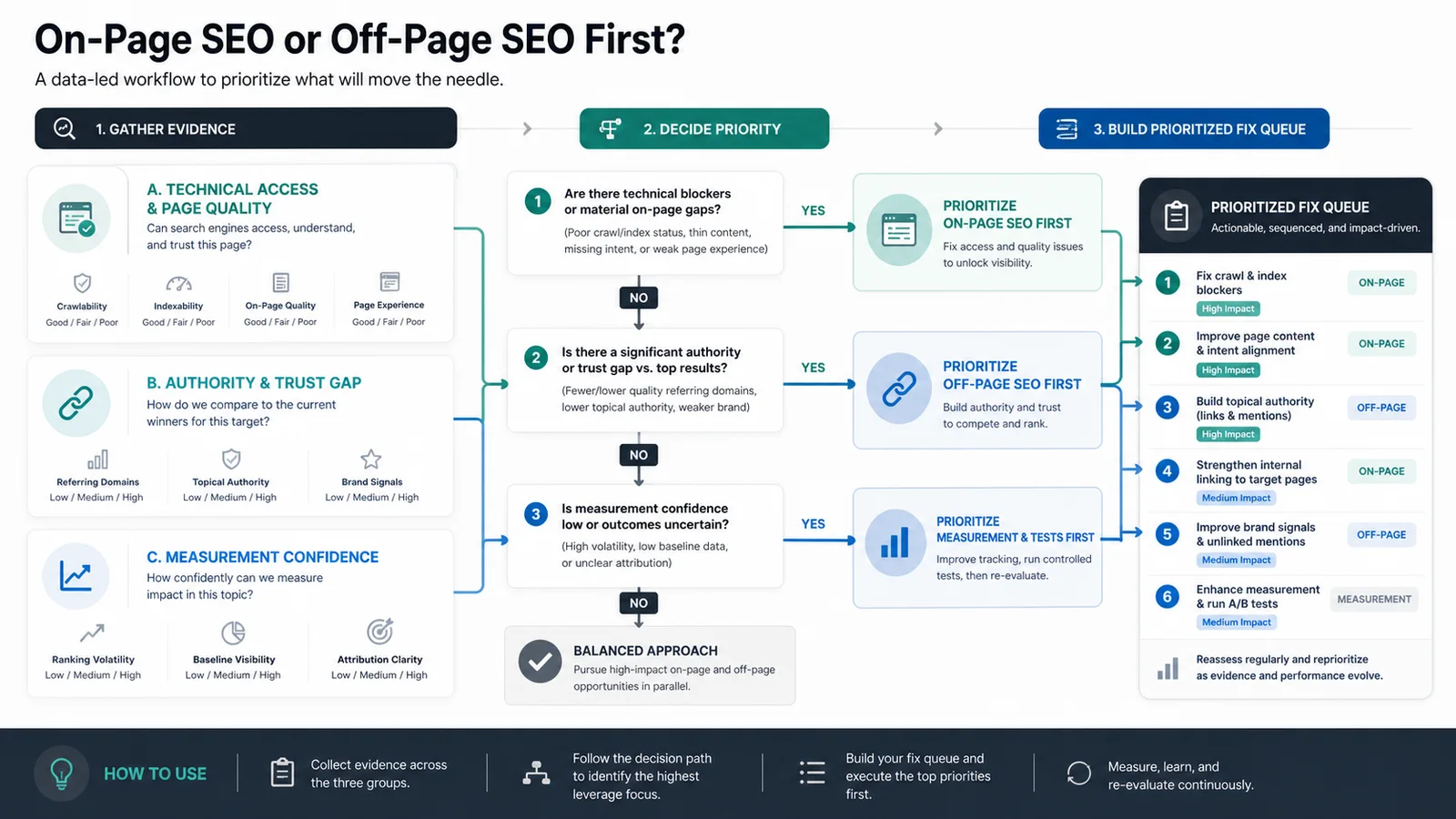
Use this decision map:
| Evidence group | What to inspect | If weak, start here |
|---|---|---|
| Technical access | Status code, canonical, robots, noindex, rendering, sitemap, crawl depth | On-page SEO |
| Page quality | Page type, title, H1, intro, topical coverage, examples, media, internal links | On-page SEO |
| Authority gap | Referring domains, link relevance, brand mentions, expert references, competitor authority | Off-page SEO |
| Trust quality | Whether the page can support claims, cite sources, and earn mentions naturally | Usually on-page first, then off-page |
| Measurement | Baseline rankings, impressions, crawl state, traffic, conversions, AI-search mentions | Measurement reset before major spend |
This prevents the common misdiagnosis. A page sitting on page two does not automatically need backlinks. It may need a better page type, a clearer H1, stronger internal links, or a canonical fix. A page with clean crawl signals and strong content may need authority, but you only know that after the on-page evidence is stable.
Build One Queue, Not Two Campaigns
SEO teams often split on-page and off-page work into separate calendars. That creates busy work because the two sides depend on each other.
Use one queue instead:
| Priority | Evidence | Owner | Example action |
|---|---|---|---|
| Access blocker | Page cannot be indexed or rendered correctly | Technical SEO or engineering | Fix canonical, robots, noindex, status, or rendered content |
| Intent mismatch | Page format does not satisfy the query | Content or SEO | Change article, landing page, hub, tool, or comparison structure |
| Internal context gap | Relevant pages are not connected clearly | SEO or content ops | Improve anchors and destinations with an internal links for SEO pass |
| Authority gap | Page is strong but weaker than current winners externally | PR, partnerships, or SEO | Build linkable assets, earn relevant mentions, reclaim unlinked mentions |
| Measurement gap | Impact cannot be judged cleanly | Analytics or SEO ops | Set baseline crawl, Search Console segment, dashboard view, and review window |
This single queue also helps leadership understand tradeoffs. "We need off-page SEO" is vague. "The page is crawlable and satisfies intent, but three competing pages have stronger topical authority and relevant links" is a decision.
Validate Both Workstreams After Shipping
On-page and off-page SEO both need validation, but the proof windows are different. On-page fixes can often be checked immediately with a recrawl. Off-page work usually needs a longer window because discovery, crawling, attribution, and authority effects take time.
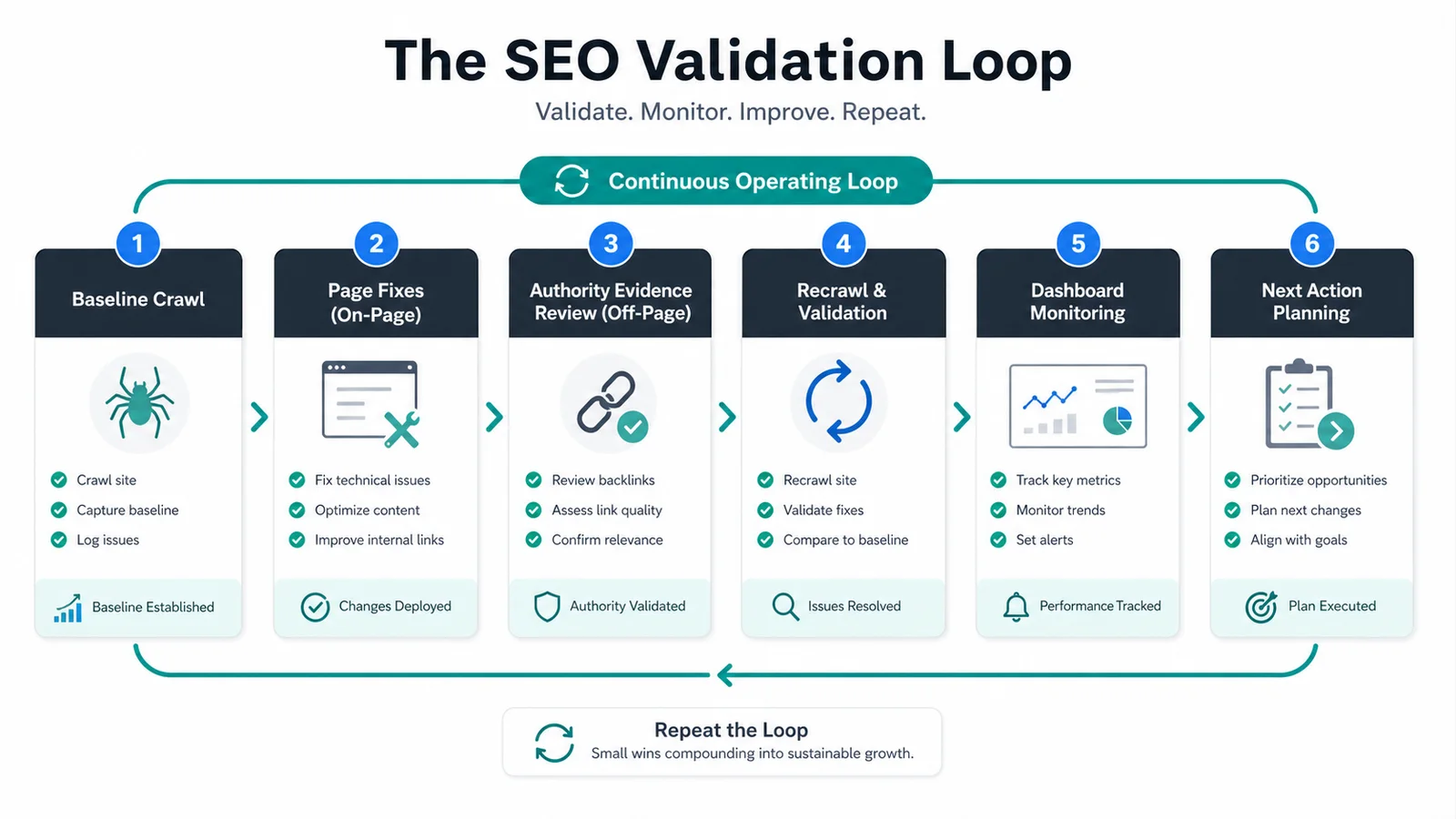
Use this loop after changes ship:
- Save a baseline crawl for the target URLs.
- Record the current title, H1, canonical, indexability, internal links, rankings, impressions, and traffic.
- Ship the on-page fixes in a focused batch.
- Re-crawl the changed URLs and template peers.
- Confirm the rendered page matches the intended signals.
- Review authority evidence separately: links, mentions, relevance, and trust quality.
- Monitor impressions, clicks, ranking movement, qualified traffic, and AI-search citations.
- Decide the next action from evidence, not from channel preference.
The important part is the baseline. Without it, teams argue from anecdotes. With it, the question becomes calmer: did access improve, did the page promise get clearer, did authority change, and did search visibility respond?
Where Searvora Fits
Searvora SEO Spider Crawler fits the on-page and validation side of this decision. Use it to inspect titles, headings, metadata, canonicals, status codes, internal links, image alt text, sitemap coverage, and indexability before assigning off-page work.
Once the crawl evidence is stable, the same queue can separate technical blockers, content updates, internal-link fixes, and authority work. That matters because off-page SEO should not be used to compensate for an unvalidated page foundation.
Searvora AI SEO Consultant and AI SEO Dashboard can then support the broader operating loop: prioritize work by impact and effort, track page-type movement, and monitor whether fixes or authority activity change visibility over time.
On-page vs off-page SEO is a sequencing decision. Fix the page when the page is the blocker. Build authority when the page is already worth trusting. Validate both with the same operating queue so the team knows what to ship next.