

An SEO topical map is a planning artifact that turns a broad subject into page roles, search intent groups, internal links, and a backlog your team can actually ship. It is not just a keyword spreadsheet with nicer labels. The useful output is a map that says which page should exist, what job each page owns, how pages support each other, and which technical or editorial checks must pass before publishing.
That distinction matters because topic clusters can get large quickly. Without a page-job model, teams create too many similar articles, miss the hub that should organize the cluster, or publish pages that cannot be crawled, linked, or measured cleanly.
Start With Page Jobs, Not A Keyword Dump
Build the SEO topical map around the reader task first. A keyword list tells you demand exists. A topical map tells you how the site should answer that demand without creating overlap.
Use these inputs before assigning page types:
| Input | What it tells you | How it affects the map |
|---|---|---|
| Core topic | The market or subject the site wants to own | Defines the hub, glossary, or parent guide candidate |
| Search intent | Whether the user needs education, comparison, a tool, a template, or a product page | Prevents every query from becoming another blog post |
| Existing URLs | Pages that already own parts of the topic | Shows update, merge, redirect, and internal-link opportunities |
| Entity and subtopic coverage | Concepts, brands, tools, workflows, and questions the cluster must explain | Helps the map support semantic SEO instead of thin keyword matching |
| Crawl and indexability evidence | Whether current pages are discoverable, canonical, linked, and technically eligible | Keeps the plan from sending writers into technical debt |
| Business priority | Which products, segments, or workflows the site must support | Turns the map into an execution queue, not a research archive |
Build The Map In Four Passes
The safest workflow is to separate discovery from page decisions. If the team tries to pick slugs while researching the cluster, the map usually inherits early assumptions.
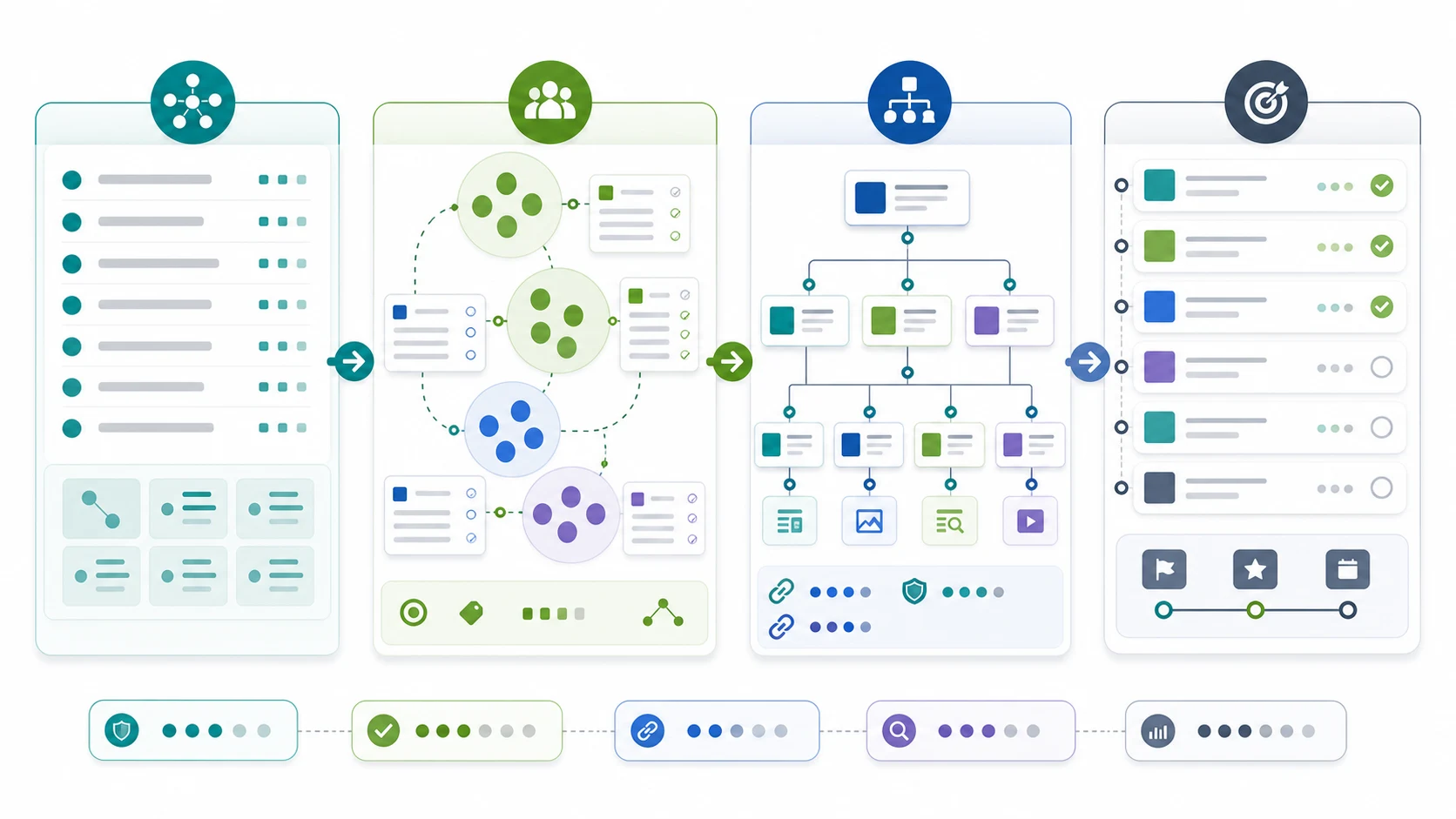
Run the map in four passes:
- Collect the topic inventory. Pull seed topics from customer questions, Search Console, keyword tools, competitor pages, internal search, sales notes, support tickets, and product positioning.
- Group by user task. Put terms together when the same reader would accept the same answer. Separate them when the reader needs a different format or decision.
- Assign page roles. Choose whether each group needs a hub, article, comparison, product page, tool, template, glossary entry, or existing-page update.
- Convert the map into backlog items. Add owner, priority, internal-link source, crawl check, draft requirement, and measurement rule.
The map should be opinionated. If ten terms all point to one decision guide, mark one canonical page. If a topic deserves a hub plus child articles, define the hub first so the child pages know what they support. The content hubs for SEO workflow is the useful reference when the map becomes a larger cluster architecture.
Route Each Topic To The Right Page Type
Topical maps fail when every topic becomes an article by default. The page type should match the job the searcher needs done.
| Topic pattern | Best page role | Reason |
|---|---|---|
| Broad concept with many child tasks | Hub or parent guide | The reader needs orientation and paths into deeper pages |
| Specific how-to workflow | Article | The reader needs steps, examples, validation, and decision rules |
| Tool, checker, generator, or calculator query | Tool page | The reader wants to perform the task, not read around it |
| Product category or solution query | Landing page | The reader is comparing solutions and needs proof, positioning, and CTA clarity |
| A versus B decision | Comparison article or comparison landing page | The reader needs side-by-side tradeoffs and fit scenarios |
| Template, checklist, or worksheet intent | Downloadable asset or article plus asset | The reader needs a reusable output |
| Existing URL already owns the same task | Update, merge, or internal-link change | A new page would split authority and confuse the canonical answer |
This is where the SEO topical map becomes different from generic topic clustering. Topic clustering says "these terms are related." Page-role routing says "this group deserves a hub, this group belongs inside the hub, and this one should update an existing page."
Use keyword strategy as the planning layer when you need to decide publishing order. Use the topical map when you need to decide the shape of the site.
Add Crawl And AI Search Checks Before Drafting
A clean topical map should protect both classic search and AI search visibility. That means the map needs validation fields before drafts begin.
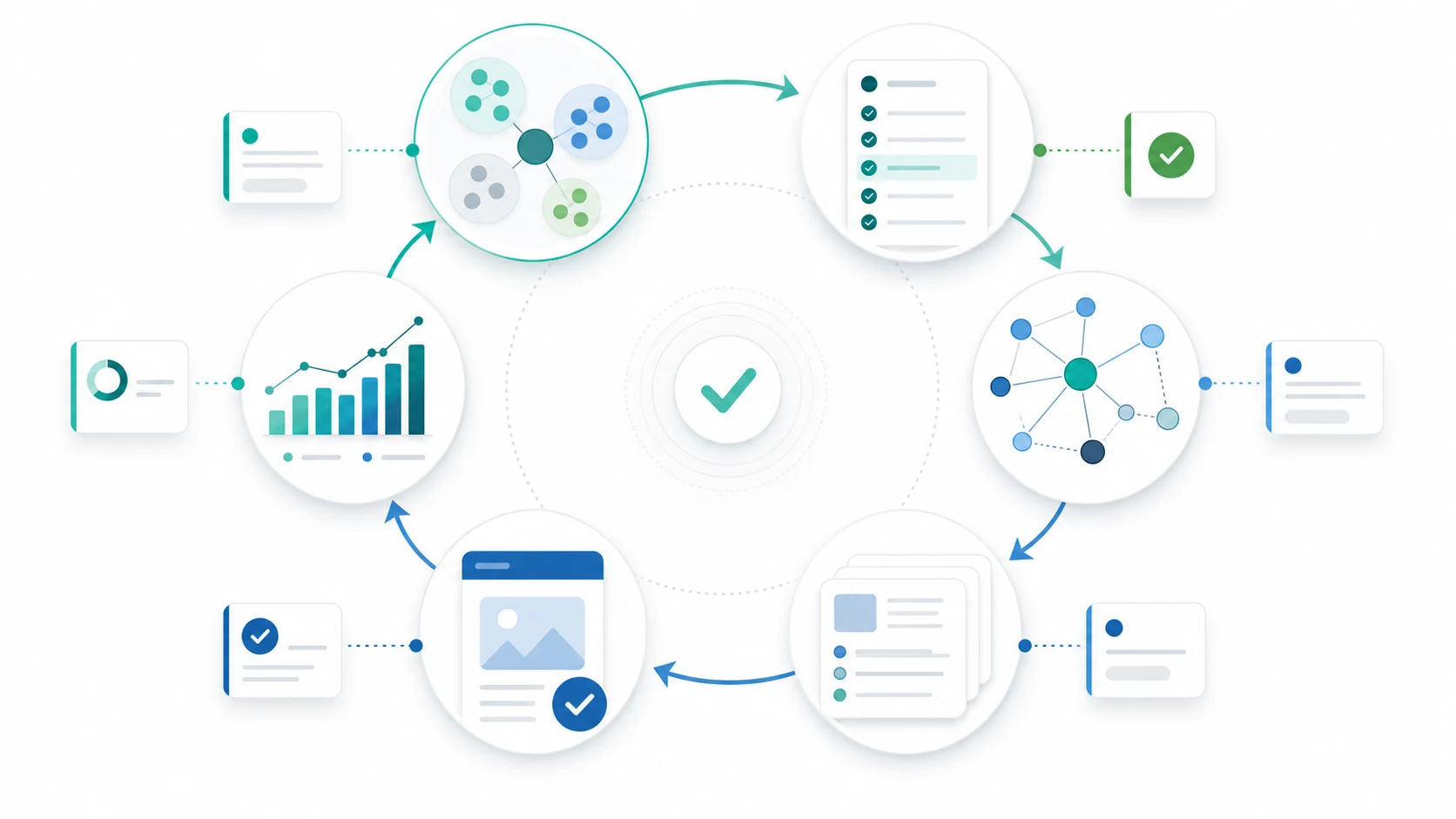
Add these checks to every planned page:
| Check | Question to answer | What to do if it fails |
|---|---|---|
| Canonical owner | Does one URL clearly own this user task? | Merge, redirect, or update the existing page before creating another URL |
| Internal-link path | Can crawlers and readers reach the page from the parent hub or relevant supporting pages? | Add links from the hub, high-context articles, navigation, or product pages |
| Crawl eligibility | Can the page be discovered, rendered, indexed, and consolidated correctly? | Fix robots, canonical, redirects, JavaScript rendering, or sitemap coverage |
| Content evidence | Does the brief include examples, sources, product context, or workflow proof? | Pause drafting until the evidence is available |
| AI-search answer readiness | Does the page define entities, answer direct questions, and show clear source structure? | Strengthen definitions, examples, summaries, schema, and internal citations |
| Measurement rule | What metric will prove whether this page is working? | Pick impressions, clicks, assisted conversions, AI citation visibility, or internal-link lift before launch |
These checks keep the map from becoming a production wish list. If a planned article cannot be internally linked, it may need a hub first. If the existing page already owns the task, the right move may be an update. If the target page depends on a template with canonical or rendering issues, send that work to technical SEO before assigning a writer.
Turn The Map Into A Shipping Backlog
The final SEO topical map should look like a backlog, not a mind map. Each row needs enough context for a strategist, writer, editor, and technical owner to make the same decision.
Use this handoff format:
| Field | What to write |
|---|---|
| Topic group | The cluster or subtopic the page belongs to |
| Primary keyword | The search phrase the page should naturally satisfy |
| Page role | Hub, article, tool, landing page, comparison, template, or update |
| Existing URL | The page that already owns the job, if one exists |
| Planned URL | The recommended slug when a new page is needed |
| Search job | The reader task the page must satisfy |
| Information gain | What your version adds beyond common coverage |
| Internal links | Parent hub, child pages, product page, and supporting articles |
| Technical check | Crawl, canonical, sitemap, rendering, or indexability requirement |
| Owner | SEO, content, product, engineering, localization, or ecommerce |
| Validation | How the team will confirm the page was shipped and is eligible to perform |
This is also the place to prevent cannibalization. Do not block a topic just because it is adjacent to another page. Block it only when the same core keyword, same page type, and same user job are already covered. A hub, a child article, a product page, and a comparison page can live in the same cluster when the map explains why each one exists.
Where Searvora Fits
Searvora AI SEO Consultant fits the decision layer of an SEO topical map. The product surface positions it around pattern diagnosis, priority scoring, fix-ready guidance, and execution alignment. Those are the controls a team needs when a topic map has to become assigned work.
Use the AI SEO consultant when the map needs to answer:
| Mapping decision | Searvora handoff |
|---|---|
| Which topic groups deserve new pages first? | Rank by opportunity, effort, confidence, and business fit |
| Which planned pages are really updates? | Separate create, refresh, merge, and monitor decisions |
| Which technical blockers should stop drafting? | Attach crawl, rendering, indexability, and internal-link checks |
| Which product or content owner should act? | Turn the map into owner-ready tasks with rationale |
| Which pages need production after approval? | Route Shopify or ecommerce blog ideas into Blogify-style content workflows |
An SEO topical map is successful when it changes what the team ships. The map should help you say no to duplicate pages, yes to missing hubs, yes to technical blockers that must be fixed first, and yes to the pages that deserve briefs now.