

PPC keyword research is the process of finding the searches that may trigger paid ads, grouping them around a clear offer, controlling how broadly they can match, and validating the real queries after a campaign starts. The useful output is not the longest possible keyword list. It is a focused plan that connects each keyword group to an ad promise, a landing page, an exclusion rule, and a measurement decision.
The Ahrefs PPC keyword research guide that surfaced this opportunity gives beginners a practical discovery path. Searvora adds the operating layer between discovery and durable search work: page-task clarity, organic-overlap checks, landing-page readiness, and a feedback loop that turns paid query evidence into better assigned work.
The Fast PPC Keyword Research Workflow
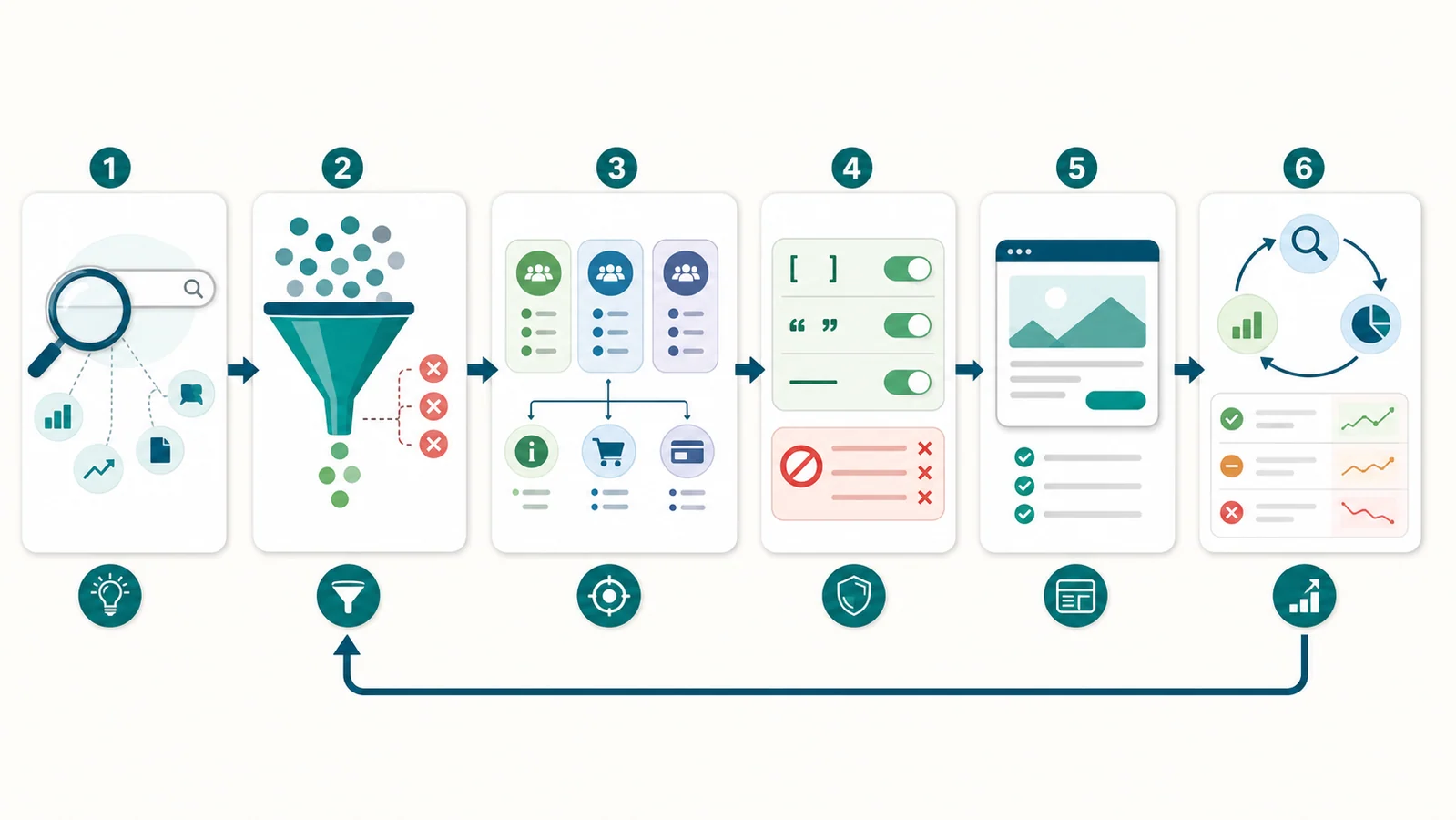
Use this sequence before a keyword enters a campaign:
- Name the offer, audience, location, and conversion you want.
- Collect seed phrases from the product, customer language, current site, and relevant competitors.
- Expand the seeds with a keyword tool, then remove ideas that do not fit the offer.
- Group the remaining keywords by intent and landing-page promise.
- Choose a starting match type for each group.
- Build negative-keyword themes before launch.
- Check whether the landing page can satisfy the query and conversion.
- Launch with a controlled budget and measurement window.
- Review actual search terms, conversions, and landing-page behavior.
- Add, pause, regroup, or exclude keywords from evidence.
Start With The Offer And Conversion
Keyword tools cannot rescue a vague campaign. Before opening one, write down four constraints:
| Constraint | Example | Why it matters |
|---|---|---|
| Offer | Emergency plumbing service | Keeps research tied to something the business can deliver |
| Audience | Homeowners with an urgent leak | Separates buyers from students, job seekers, and general researchers |
| Location | Service area around one city | Prevents research from drifting into markets the business cannot serve |
| Conversion | Qualified phone call | Gives the team a real outcome for judging search terms |
This first pass changes how you read keyword ideas. “How to fix a leaking tap” may be useful content research, while “emergency plumber near me” may belong in a high-intent campaign. Both describe the same topic cluster, but they do not serve the same user job or page.
If the channel decision itself is still unresolved, use the SEO vs SEM comparison before building the list. PPC keyword research is execution work. It should begin after the team knows why paid search should lead or support the search task.
Build A Seed Set From Real Language
A strong seed set is small enough to understand and broad enough to reveal useful variants. Start with evidence the business already owns:
- product and service names
- problems customers describe before buying
- category and use-case language from sales or support
- current landing-page headings and navigation labels
- high-intent organic queries from Search Console
- competitor categories and public product language
- locations, industries, and audience modifiers that change the offer
Do not start by pasting hundreds of loosely related phrases into a tool. A clean seed such as “commercial roof repair” is more useful than mixing roof repair, roofing careers, DIY shingles, home design, and construction software in one discovery pass.
Google's official Keyword Planner guidance recommends thinking like customers, using multiple related phrases, staying specific without becoming too narrow, and handling location deliberately. Those are research constraints, not automatic campaign approvals.
Expand Ideas Without Letting Volume Take Over
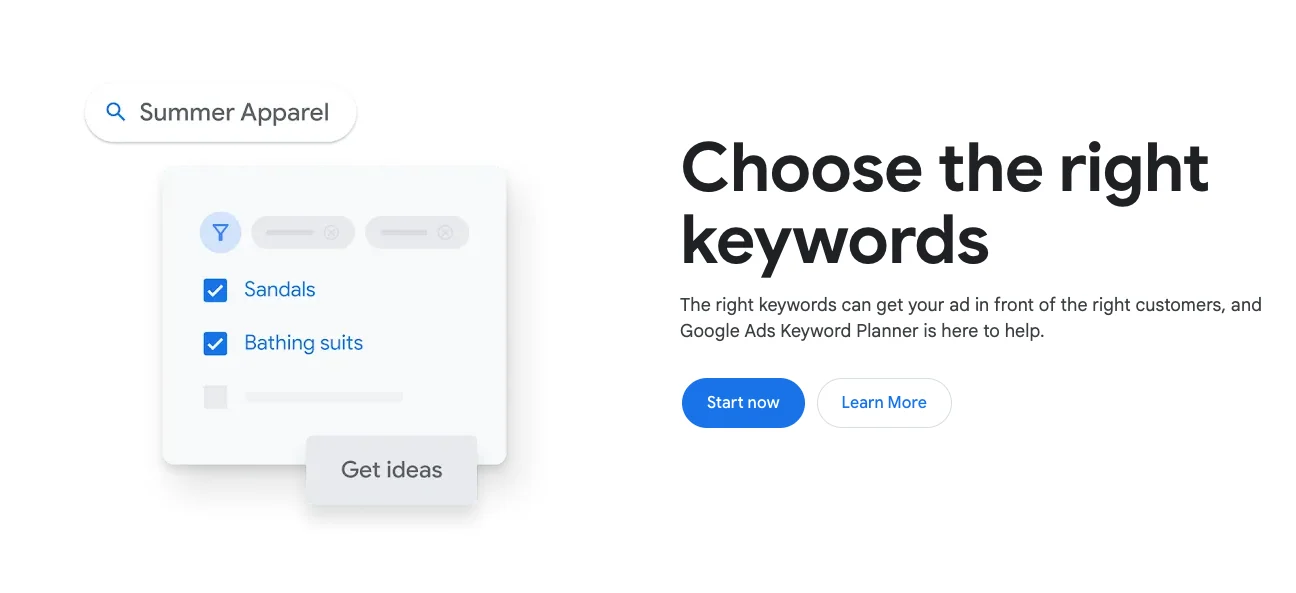
Google's public Keyword Planner page positions the tool around discovering keywords, reviewing search patterns, estimating bids, and building a campaign plan. Use those signals to size and refine ideas, but keep the offer and conversion as the gate.
Review each candidate on five dimensions:
| Dimension | Useful question | Weak signal |
|---|---|---|
| Relevance | Does the phrase describe what we sell? | It shares a noun but asks for another product |
| Intent | Is the searcher learning, comparing, buying, or getting support? | The keyword group mixes incompatible jobs |
| Specificity | Does the phrase reveal a meaningful need or modifier? | It is so broad that the ad promise becomes generic |
| Economics | Could the likely value support paid acquisition? | The click can never justify the cost |
| Landing-page fit | Does a page answer this exact promise? | The ad would send the user to a vague homepage |
Search volume and bid estimates help prioritize attention. They do not decide whether a keyword should be added. A lower-volume term with a clear buyer job and a credible landing page can be more useful than a high-volume phrase that attracts mixed intent.
For organic planning, keep the companion Google Keyword Planner for SEO workflow separate. Paid keywords are campaign controls. Organic keywords become page and content decisions.
Group Keywords Around One Search Job
Ad groups should make the relationship between keyword, ad, and landing page easier to manage. Group keywords when they can share the same promise without forcing vague copy.
Use this test:
| Grouping question | Keep together when | Split when |
|---|---|---|
| Offer | The same product or service solves the need | The product, service, or commercial model changes |
| Intent | Searchers are at a similar decision stage | Informational, comparison, and urgent-buying jobs are mixed |
| Audience | The same buyer language and proof apply | Industry, role, or customer type needs a different message |
| Location | One service area and page can satisfy the query | Location changes availability, pricing, or proof |
| Landing page | One page can answer the promise directly | The destination would need a different headline or conversion |
Google Ads can also suggest how to organize saved ideas. Its organized-keywords documentation explains that suggestions still need review and can be reassigned or rejected. Automation can reduce sorting work, but the operator still owns intent and landing-page fit.
Choose Match Types As Controls
Match types control how closely a search can relate to a keyword before an ad becomes eligible. They are not labels for keyword quality.
Google's current keyword matching documentation describes broad, phrase, and exact match as overlapping reach levels. Broad can reach queries beyond phrase and exact, while account context and landing pages can also influence matching.
Use a starting rule rather than a universal winner:
| Match approach | Useful when | Validation need |
|---|---|---|
| Exact | The query and offer are narrow, valuable, and already understood | Confirm volume and close-variant quality |
| Phrase | The core meaning is stable but useful modifiers vary | Watch which modifiers improve or weaken intent |
| Broad | The campaign has strong conversion data, clear grouping, and room to learn | Review search terms and exclusions frequently |
Do not create an exhaustive list of tiny variants just to feel controlled. Control comes from coherent groups, useful conversion signals, relevant landing pages, match choices, and regular search-term review.
Build Negative Keywords Before The First Click
Negative keywords prevent ads from serving for excluded words or phrases. They protect the offer from predictable mismatches, but they can also remove valuable traffic when applied too aggressively.
Start with themes:
- jobs and careers when the campaign sells a service
- free, DIY, template, or course intent when the offer is paid and done-for-you
- unrelated products that share the same noun
- locations outside the service area
- support or login intent when the campaign targets new customers
- research intent that belongs to an organic article instead of an ad
Google's negative-keyword documentation notes that negative matching works differently from positive matching and does not automatically cover every close variant. Build exclusions from actual query evidence, and check singulars, plurals, synonyms, and context before assuming a rule is complete.
Connect Paid Keywords To The Right Landing Page
The landing page is part of keyword research because it determines whether the ad promise can be fulfilled.
For every group, check:
- The page headline matches the search job without repeating a keyword mechanically.
- The offer, availability, location, and next action are clear.
- The page has the proof the searcher needs at this stage.
- The conversion action is visible and measurable.
- The page works on mobile and loads without obvious friction.
- The page is also technically sound enough to support future organic work when that matters.
This is where paid and organic search can share evidence without sharing the same plan. A paid campaign can reveal which language and offers attract qualified action. Organic planning can then decide whether the durable response should be a product page, comparison, article, tool, support page, or no new page.
Validate With The Search Terms Report
The keyword list is a hypothesis. The search terms report shows which real searches triggered ads and how they performed.
Google's search terms report guidance explains how the keyword and match-type columns connect triggered queries back to the account. Use that evidence to refine the list:
| Search-term result | Next action |
|---|---|
| Relevant query with qualified conversions | Keep, promote, or test a tighter group |
| Relevant query with weak landing engagement | Fix the promise or destination before expanding |
| Irrelevant query with spend | Add a carefully scoped negative keyword |
| Useful organic question with weak paid intent | Route it to keyword and page-type planning |
| Repeated query that needs a distinct offer | Consider a separate ad group and landing page |
| Query already served well by an organic page | Decide whether paid coverage still adds value |
Review on a cadence that matches spend and learning speed. New or broad campaigns need closer attention. Mature campaigns still need checks because offers, match behavior, competitors, and search language change.
Where Searvora Fits
Searvora does not replace Google Ads campaign execution. It fits after paid research produces page and workflow decisions.
Use the AI SEO consultant when the team needs to translate paid search evidence into an organic or cross-team action queue:
| Paid-search evidence | Searvora planning task |
|---|---|
| High-intent search terms | Decide whether an owned landing page or comparison should be improved |
| Weak landing-page fit | Prioritize content, metadata, internal-link, or technical work |
| Organic page already owns the query | Decide whether paid support, a refresh, or no new page is best |
| Repeated informational queries | Route them into the broader keyword research workflow |
| Query-to-page mismatch | Assign the correct page type and owner |
PPC Keyword Research Checklist
Before launch:
- The offer, audience, location, and conversion are explicit.
- Seed phrases come from real product and customer language.
- Every keyword group has one main search job.
- The ad promise and landing page match that job.
- Match types reflect the learning plan and available conversion data.
- Negative themes block predictable irrelevant intent without overreaching.
- Paid and organic keywords are not treated as interchangeable.
- The measurement window, budget limit, and owner are set.
After launch:
- Review actual search terms and their matched keywords.
- Add or tighten negatives from evidence.
- Split groups when one promise can no longer serve the queries.
- Fix landing pages before scaling weak traffic.
- Route useful organic questions into page-type planning.
- Keep, pause, or expand keywords based on qualified outcomes.
PPC keyword research works when it becomes a controlled learning system. Start with a real offer, organize intent before volume, use match types and negatives deliberately, connect every group to a credible landing page, and let actual search terms decide what changes next.