

Programmatic SEO is the practice of creating many search-targeted pages from reusable templates, structured data, and repeatable publishing rules. It can work when every page helps a specific user complete a task. It becomes risky when scale arrives before quality, crawl control, and editorial ownership.
The Ahrefs programmatic SEO explainer that surfaced this opportunity introduces the concept through large page sets and well-known examples. Searvora's angle is the operating layer after that definition: which page patterns deserve scale, which pages should stay out of the index, and which quality gates must pass before templates become thousands of URLs.
Programmatic SEO Starts With A Page Pattern
A programmatic SEO project should not start with "how many pages can we create?" It should start with a repeatable page pattern that solves a repeatable search job.
Good patterns usually combine three things:
- A user task that repeats across many modifiers, locations, products, integrations, or comparisons.
- Structured data that changes the answer in a meaningful way from page to page.
- A template that can explain the answer without producing thin, interchangeable pages.
If any one of those parts is missing, scale makes the weakness visible. A city page without local detail becomes a doorway page. An integration page without integration-specific evidence becomes a template shell. A product collection page without useful context becomes a crawl burden.
Use this first-pass routing table before approving the project:
| Pattern question | Approve when | Do not scale when |
|---|---|---|
| What repeats? | The same user job repeats across clear modifiers | Only the keyword changes |
| What is unique? | Each page has distinct data, examples, inventory, or context | The body is mostly boilerplate |
| What should rank? | The page can stand alone as the best answer for that variant | A parent hub or filtered page already serves the job |
| What should be indexed? | The page is useful, crawlable, and canonical | The page is duplicate, empty, temporary, or low value |
| Who owns quality? | Someone can sample, edit, and retire pages | No one reviews the output after launch |
The Risk Is Not Automation Itself
Automation is not the problem. Google Search Central's guidance on AI content focuses on whether the content helps users and meets Search Essentials, not whether a tool assisted the work. The risk appears when automated or semi-automated pages exist mainly to manipulate rankings without adding value.
Google's spam policies describe scaled content abuse as creating many pages primarily for rankings rather than helping users. Its guidance on generative AI content points to the same practical line: using tools to structure useful work is different from producing large amounts of low-value pages.
For operators, that means the pre-launch question is not "did a system write this?" The better question is "would this page still be worth publishing if it were the only page in the set?"
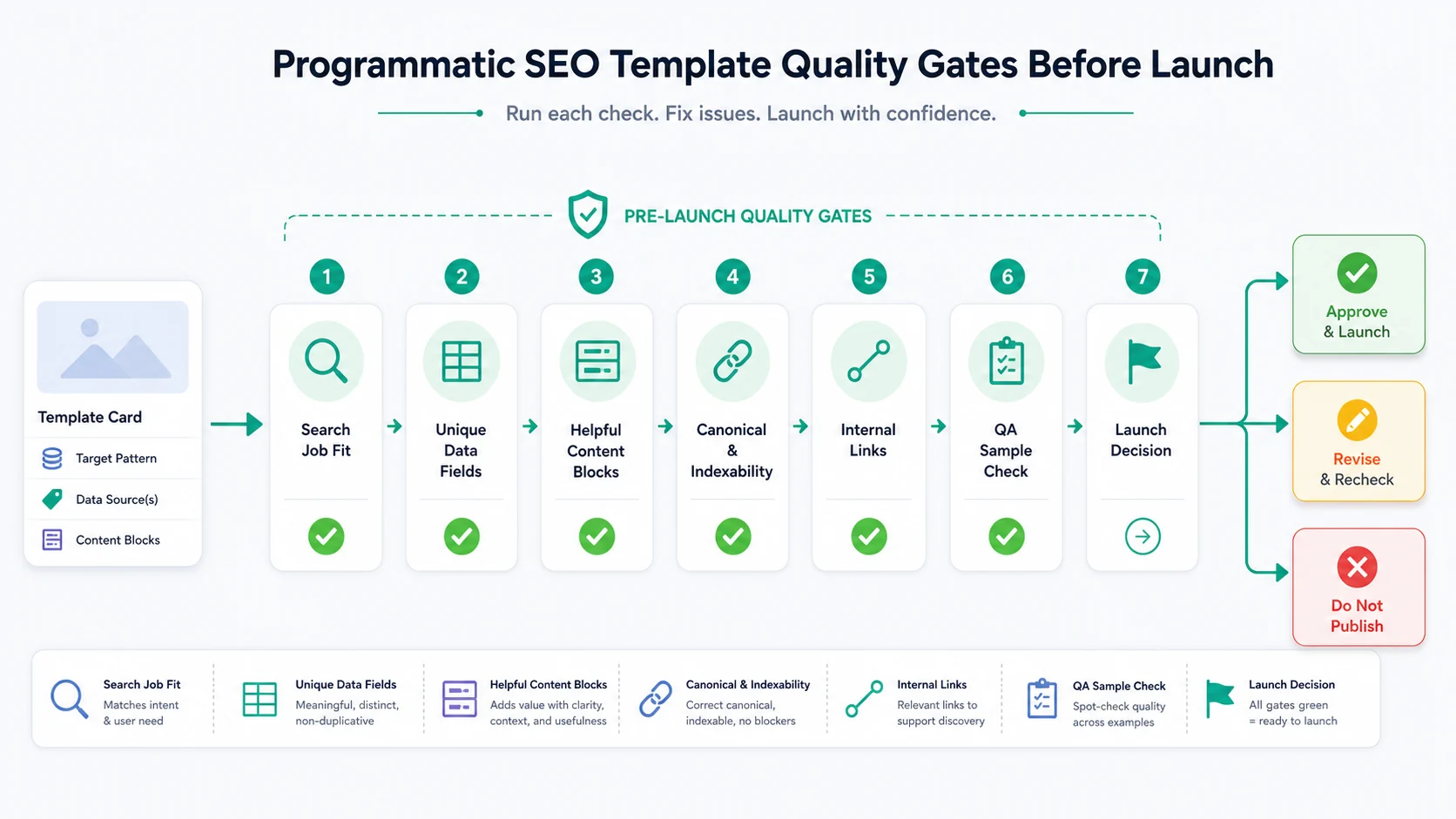
Run this quality gate before the first batch:
| Gate | What to check | Pass condition |
|---|---|---|
| Search job fit | Query, modifier, and page type | The page answers a distinct user task |
| Data quality | Source fields, freshness, completeness | The variable data changes the answer |
| Content usefulness | Intro, body blocks, examples, next step | The page has more than substituted nouns |
| Canonical plan | Canonical URL, variants, filters | Google sees the intended representative URL |
| Indexability | robots, noindex, sitemap, status code | Only useful pages are eligible |
| Internal links | Hub, category, product, and related pages | Crawlers and users can reach the page naturally |
| Sample QA | Human review of representative pages | Weak templates are fixed before scale |
This is where a lot of programmatic SEO projects should slow down. A smaller launch with strong checks is better than a large launch that needs emergency noindex rules later.
Decide What Should Stay Out Of Search
Programmatic systems create edge cases. Some are useful pages. Some are valid user experiences but poor search landing pages. Some should never be indexed.
Google's canonicalization documentation is useful because it explains that canonical signals are hints, and duplicate or very similar pages may be consolidated by Google. That matters for programmatic SEO because similar pages are easy to create accidentally.
Use the following control model:
| Page condition | Better action | Why |
|---|---|---|
| Strong unique data and clear user task | Index and include in sitemap | The page deserves discovery |
| Same task as another URL | Consolidate or canonicalize | Prevents same-job duplication |
| Useful for users but weak as a search result | Keep accessible but noindex | Protects crawl and index quality |
| Empty or thin because data is missing | Do not publish yet | Avoids scaling empty pages |
| Temporary filtered state | Block, noindex, or exclude from sitemap | Keeps search focused on durable URLs |
| Important parent route | Build as hub or landing page | Helps users reach child pages |
Google's documentation on controlling what you share with Search is worth reviewing before launch. For a scaled system, index controls are part of the content plan, not an afterthought.
Build The Template Like A Quality Contract
A programmatic template is not a layout. It is a quality contract. It should define what every page must prove before it becomes indexable.
The template should require:
- A plain-English answer to the page's specific search task.
- Unique facts or examples from the underlying data source.
- A reason the page exists separately from the parent hub.
- Helpful internal links to parent, sibling, product, and supporting pages.
- A canonical and sitemap rule.
- A fallback for missing, stale, or low-confidence data.
- A refresh rule that says when the page should be updated, merged, noindexed, or removed.
This is where programmatic SEO connects to content operations. If a template can only be reviewed by engineers, content quality will drift. If it can only be reviewed by editors, technical eligibility will drift. The template needs shared language for both teams.
For example:
| Template element | Content owner checks | SEO owner checks |
|---|---|---|
| Page title and H1 | Specific to the variant | No duplicates or truncation patterns |
| Opening answer | Useful without reading the whole page | Matches the intended query class |
| Variable data blocks | Accurate and meaningful | Not empty, duplicated, or misleading |
| Supporting copy | Adds context, caveats, and next steps | Not boilerplate across the set |
| Internal links | Helpful to the reader | Crawl path and anchor fit are clear |
| Index controls | Weak pages are held back | Canonical, robots, and sitemap agree |
The goal is not to make every page long. The goal is to make every indexed page useful enough to justify its URL.
Validate The Batch After Launch
The first launch is only the first measurement point. Programmatic SEO needs post-launch validation because failures often appear at the page-set level, not on the single sample page everyone reviewed.
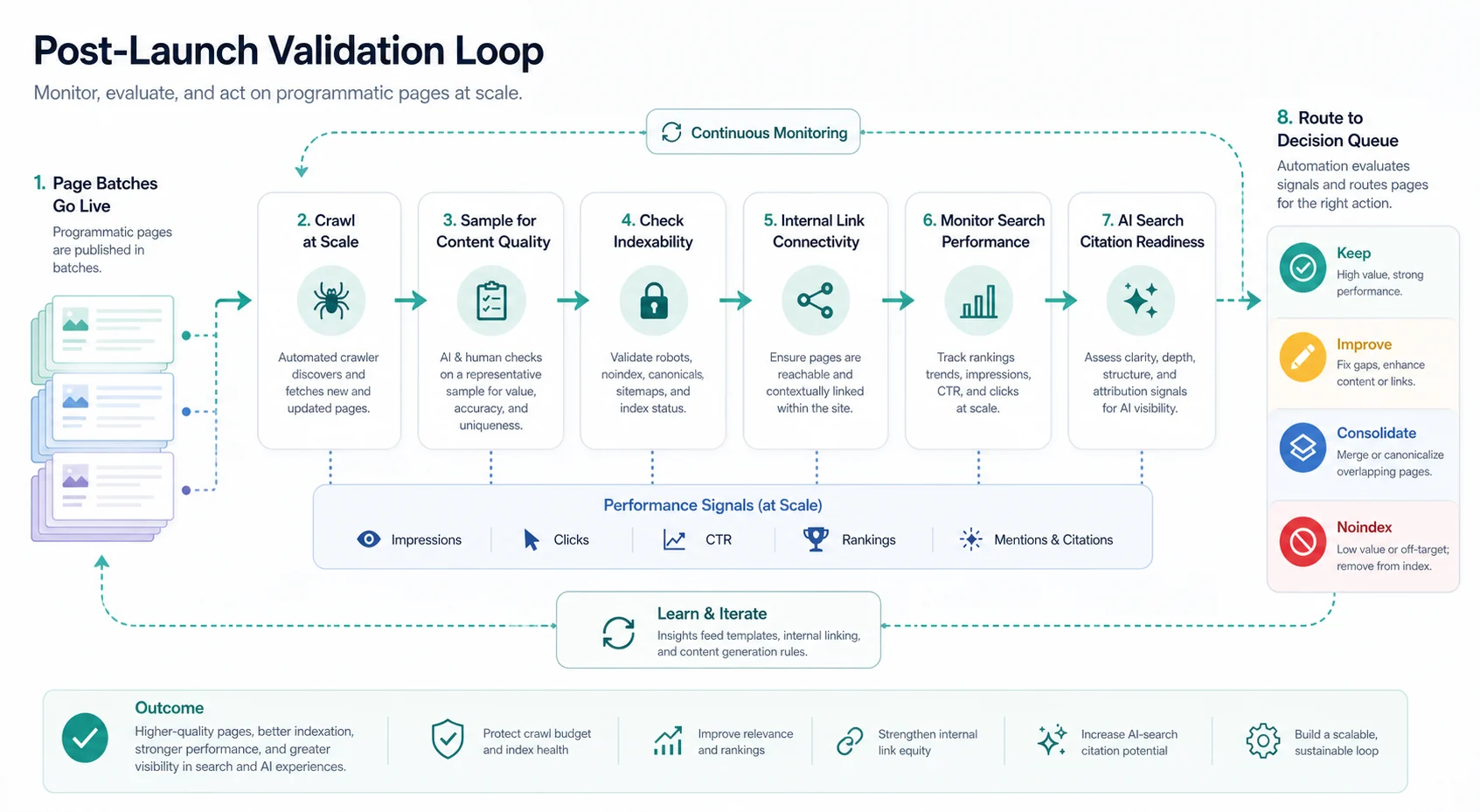
Use this operating loop:
- Crawl the full page set after launch.
- Confirm status codes, canonicals, noindex rules, robots access, sitemap inclusion, and internal links.
- Sample pages from every template branch, not only the best examples.
- Compare indexed, crawled, discovered, excluded, and canonicalized patterns.
- Watch impressions, clicks, CTR, query fit, and page-type cohorts.
- Check whether AI search systems can understand the source page, entity, and answer structure.
- Route pages into keep, improve, consolidate, noindex, or remove decisions.
The validation loop should change the generator. If a page batch attracts the wrong queries, the template may need a clearer opening. If many pages are crawled but not indexed, the data blocks may be too thin or too similar. If internal links are weak, the parent hub may need a stronger directory or cluster structure.
This is why programmatic SEO belongs in an operations system, not only in a CMS script.
Where Searvora Fits
Searvora is useful when a scaled content idea needs a quality workflow before production.
Use keyword research and search intent in SEO to decide whether the pattern deserves pages. Use the technical SEO crawler to validate crawl access, canonicals, indexability, internal links, and sitemap behavior after the first batch. Use the AI SEO dashboard to monitor page-type cohorts and performance changes. Use Blogify when an approved pattern needs structured content production, product context, metadata, internal links, and review-ready drafts instead of uncontrolled page generation.
Programmatic SEO should also connect to the content audit loop. Once pages are live, the same keep, improve, merge, noindex, or remove decisions should apply to generated pages as they do to manually written pages.
A Programmatic SEO Checklist For Operators
Before scaling a programmatic SEO project, confirm these points:
- The target keyword pattern maps to a repeatable user job.
- Each page has meaningful unique data or context.
- The template answers the variant, not only the parent topic.
- Thin, duplicate, empty, and temporary pages are held out of the index.
- Canonical, noindex, robots, status code, and sitemap rules agree.
- Internal links create natural discovery paths from parent and sibling pages.
- Human QA samples multiple template branches before launch.
- The first batch is small enough to measure and repair.
- Post-launch crawls feed a keep, improve, consolidate, noindex, or remove queue.
- The generator is updated when search and crawl evidence shows a pattern problem.
Programmatic SEO can be a real organic growth asset. It just needs to be treated like a publishing system with search eligibility, editorial judgment, and measurement built in. Scale comes last, after the gates prove the pages deserve it.