

Rich snippets are enhanced search results that can show extra details beyond a standard blue link, such as product information, review context, event details, breadcrumbs, or other structured facts. Google now usually describes these experiences as rich results, but many SEO teams still use "rich snippets" when they talk about the operational work behind them.
The useful work is not adding schema everywhere. The useful work is proving that a page has eligible visible content, valid structured data, clean crawl signals, and a monitoring loop after launch.
Start With Eligibility, Not Markup
A rich snippet workflow starts by asking whether the page deserves an enhanced result. Google's structured data documentation explains that structured data can make a page eligible for Search features, but eligibility still depends on the page, query, quality systems, and Search presentation.
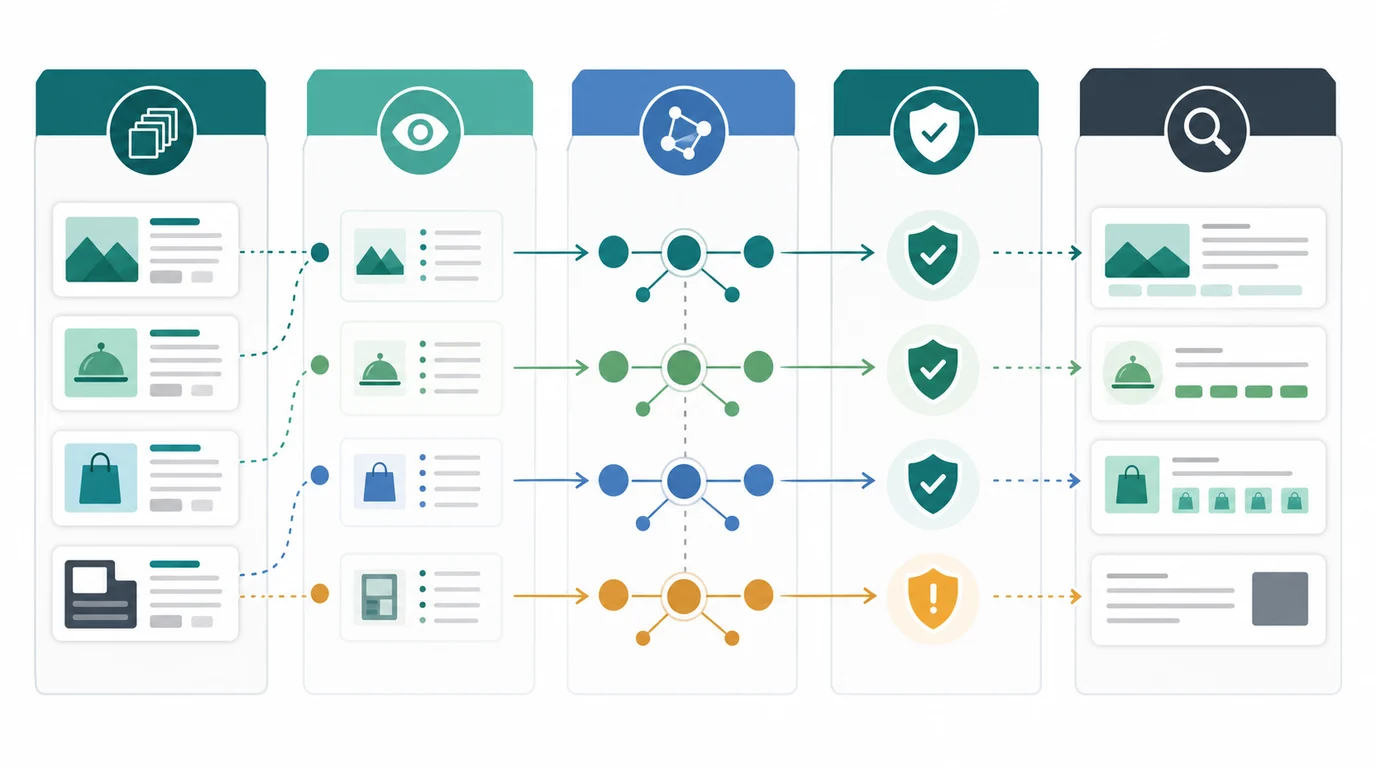
Use this first-pass decision map:
| Decision layer | Question | Evidence to inspect |
|---|---|---|
| Search job | What is the user trying to understand, compare, buy, attend, cook, watch, or navigate? | Query intent, title, H1, page type, visible sections |
| Eligible page type | Does Google support a rich result type for this page job? | Google Search Gallery, page template, content model |
| Visible facts | Are the facts shown to users before markup is added? | Product details, event dates, breadcrumbs, author, price, availability, recipe fields |
| Structured data | Can the CMS or template keep those facts accurate? | JSON-LD source fields, owner, update cadence, localization rules |
| Validation | Does the rendered page pass syntax and eligibility checks? | Rich Results Test, schema warnings, crawl output, canonical URL |
This is why rich snippets belong close to your schema markup workflow. Schema is the expression layer. Rich result eligibility is the page-quality, page-type, and validation layer around it.
Know Which Rich Result Types Fit the Page
Do not treat rich snippets as one feature. They are a family of eligible search appearances. The page type matters because each supported rich result has different required and recommended properties.
| Page or content type | Rich result fit | Common mistake |
|---|---|---|
| Product page | Product information, offers, availability, shipping, or review context when visible | Adding ratings or prices that are not shown or maintained on the page |
| Article or blog post | Article context, author, dates, publisher, and sometimes related media | Expecting article schema alone to create a dramatic SERP enhancement |
| Breadcrumb path | Breadcrumb rich result | Markup path disagrees with internal navigation or canonical URL |
| Event page | Date, location, ticket or event details | Event dates change in the CMS but JSON-LD stays stale |
| Video page | Video result eligibility and key moments when supported | The page hides the video or omits stable watch-page metadata |
| Local business page | Business facts when they match the visible page and public profile | Inconsistent NAP, hours, service area, or organization facts |
Google's structured data policies are the guardrail here. Structured data should describe the main content of the page, use current facts, and avoid misleading users.
The distinction from featured snippets matters. Featured snippets are selected answer-style results; site owners cannot mark a page as one. Rich results depend more directly on supported structured data, but validation still does not guarantee display.
Build Markup From Visible Page Facts
The safest implementation path is boring. Start with the page's visible content, choose the narrowest supported schema type, then wire JSON-LD to fields the publishing system can keep fresh.
Use this implementation checklist before a developer or CMS owner starts:
- Define the canonical URL and the one page job it should serve.
- Pick the rich result type only after checking Google's supported feature docs.
- Map every structured data property to visible page content or a trusted source field.
- Decide who owns each field when the page changes.
- Render the page and inspect the final HTML, not only the CMS preview.
- Run a rich result eligibility test before release.
- Crawl a sample of matching templates after release.
The risk is rarely one broken JSON-LD block. The bigger risk is template drift: product pages lose availability data, event pages keep old dates, FAQ sections move, images change size, or localized pages inherit markup from the wrong market.
Validate Before and After Release
Validation should happen twice. First, validate before launch so syntax, required properties, and obvious policy mismatches are fixed. Then validate after release so the rendered, canonical, crawlable page still contains the expected markup.

Run this loop:
| Stage | What to check | What blocks launch |
|---|---|---|
| Baseline crawl | Status, canonical, indexability, robots, sitemap, internal links, current markup | The wrong URL is canonical, blocked, or missing from discovery paths |
| Implementation | JSON-LD type, required properties, source fields, visible-content match | Markup includes unsupported, hidden, or stale facts |
| Rich result test | Syntax, eligible result types, critical errors, warnings | Required fields fail or the wrong content type is detected |
| Release check | Rendered HTML, canonical, sitemap, template sample, localization | Preview passes but live output is missing or different |
| Monitoring | Search appearance movement, CTR, page group changes, recurring crawl errors | The team cannot tell whether the change worked or drifted |
Use Google's Rich Results Test for Google-supported rich result eligibility. Use broader schema validation when the job is vocabulary correctness rather than Google feature eligibility.
Use Crawl Evidence to Catch Template Drift
Rich snippets are usually a template problem, not a one-URL problem. If one product template has missing offer fields, hundreds of products may share it. If one article template has stale dates or missing author context, the issue can spread every time content is refreshed.
Searvora's technical SEO crawler fits the validation layer because the work is not only "did the test pass once?" It is "which templates changed, which URLs are affected, and who owns the fix?"
For a rich snippets QA pass, group crawl findings by:
| Crawl grouping | Why it matters | Next action |
|---|---|---|
| Template | Finds repeated markup or missing-field issues | Assign one engineering or CMS owner |
| Page type | Separates product, article, event, video, and local pages | Use the right rich result documentation |
| Canonical cluster | Prevents validating a URL Google should not index | Fix canonical alignment before markup work |
| Locale | Catches copied business facts, dates, and product fields | Route to the market owner |
| Sitemap inclusion | Confirms the intended URLs are discoverable | Clean stale or non-indexable URLs |
This also connects to your broader technical SEO workflow. Rich result work can look editorial, but crawl access, canonical state, internal links, and rendered output decide whether search systems can use the page at all.
Monitor Search Appearance Without Overclaiming
Passing validation is not the same as winning a rich result. Treat validation as the release gate and monitoring as the learning loop.
Track the work like this:
| Signal | What it can tell you | What it cannot prove alone |
|---|---|---|
| Rich result eligibility | The page can be interpreted for a supported feature | Google will show the rich result for every query |
| Search appearance changes | SERP presentation or reporting may have shifted | The markup caused the change without other evidence |
| CTR movement | The result promise may be more compelling | Rankings, demand, and SERP layout may also have changed |
| Crawl drift | Template or rendered output changed | The change hurt performance without query data |
| AI-search visibility | The page may be easier to parse as a source | Schema alone caused AI answers to cite the page |
For teams tracking AI search as well as classic SEO, the discipline is similar: keep important facts visible, structured, crawlable, and current. The Google AI Overviews workflow is the broader companion when source-page clarity and citation readiness matter.
Run This Before Publishing a Rich Snippets Change
Use this approval checklist before a structured data release:
- The page has one clear search job and canonical URL.
- The target rich result type is supported by official documentation.
- Every marked-up fact is visible or directly supported by the page's source data.
- JSON-LD fields have owners and update rules.
- The rendered page passes syntax and rich result eligibility checks.
- Crawl output confirms the page is indexable, internally discoverable, and not canonicalized away.
- Warnings are either fixed or logged with a reason.
- Matching templates and locales are sampled after deployment.
- Search appearance and CTR are reviewed after enough data accrues.
- The next action is clear: keep, fix, expand, remove, or monitor.
Rich snippets are not a shortcut around useful pages. They are a proof system. If the page job, visible facts, structured data, crawl signals, and monitoring loop agree, the team can ship with confidence and fix drift before it spreads.