

SEO for financial services is the work of making a bank, credit union, insurer, adviser, lender, or fintech website easy to find without weakening the accuracy, review, and recordkeeping standards that protect its audience. The winning workflow is not "publish more finance content." It is to select the right page, document every material claim, assign qualified reviewers, confirm crawl eligibility, and measure the result after release.
That operating discipline matters because financial information can affect a person's financial stability. Google's people-first content guidance says its systems give stronger weight to signals of E-E-A-T for these YMYL topics, with trust as the most important element. Financial-services teams should treat trust as a production requirement, not a paragraph added after the draft is finished.
Start With The Search Task And The Risk Of The Claim
A financial-services SEO plan becomes manageable when every opportunity is classified by both user task and claim risk. A branch-hours query, a mortgage eligibility question, and an investment-performance comparison should not move through the same workflow.
| Search task | Best starting page | Main evidence owner | Typical review risk |
|---|---|---|---|
| Find a branch, ATM, adviser, or service area | Location or directory page | Local operations | Stale address, hours, coverage, or licensing details |
| Understand an account, loan, policy, or advisory service | Product or service page | Product owner | Missing conditions, fees, eligibility, exclusions, or risks |
| Learn a financial concept | Educational article or resource hub | Subject-matter expert | Oversimplification, unsupported advice, or outdated examples |
| Compare options | Comparison or decision-guide page | Product and compliance | Unbalanced benefits, omitted differences, or ambiguous methodology |
| Verify the organization | About, team, disclosures, security, and support pages | Legal, compliance, and brand | Inconsistent entity facts or unsupported trust claims |
Before anyone creates a brief, write down four fields:
- The exact user decision the page should support.
- The canonical page type that should own that decision.
- The material claims a reviewer must be able to substantiate.
- The named owner who can approve, update, and revalidate those claims.
This prevents a familiar failure mode: an SEO team finds demand, a writer produces an article, and compliance discovers too late that the search promise belongs on a controlled product page or cannot be supported as written.
Build A Claim Review Loop Before Publishing
Financial content should have a visible chain from claim to source to approval. The chain does not need to slow every low-risk update, but it must be strong enough to show why a claim was allowed onto the public site.
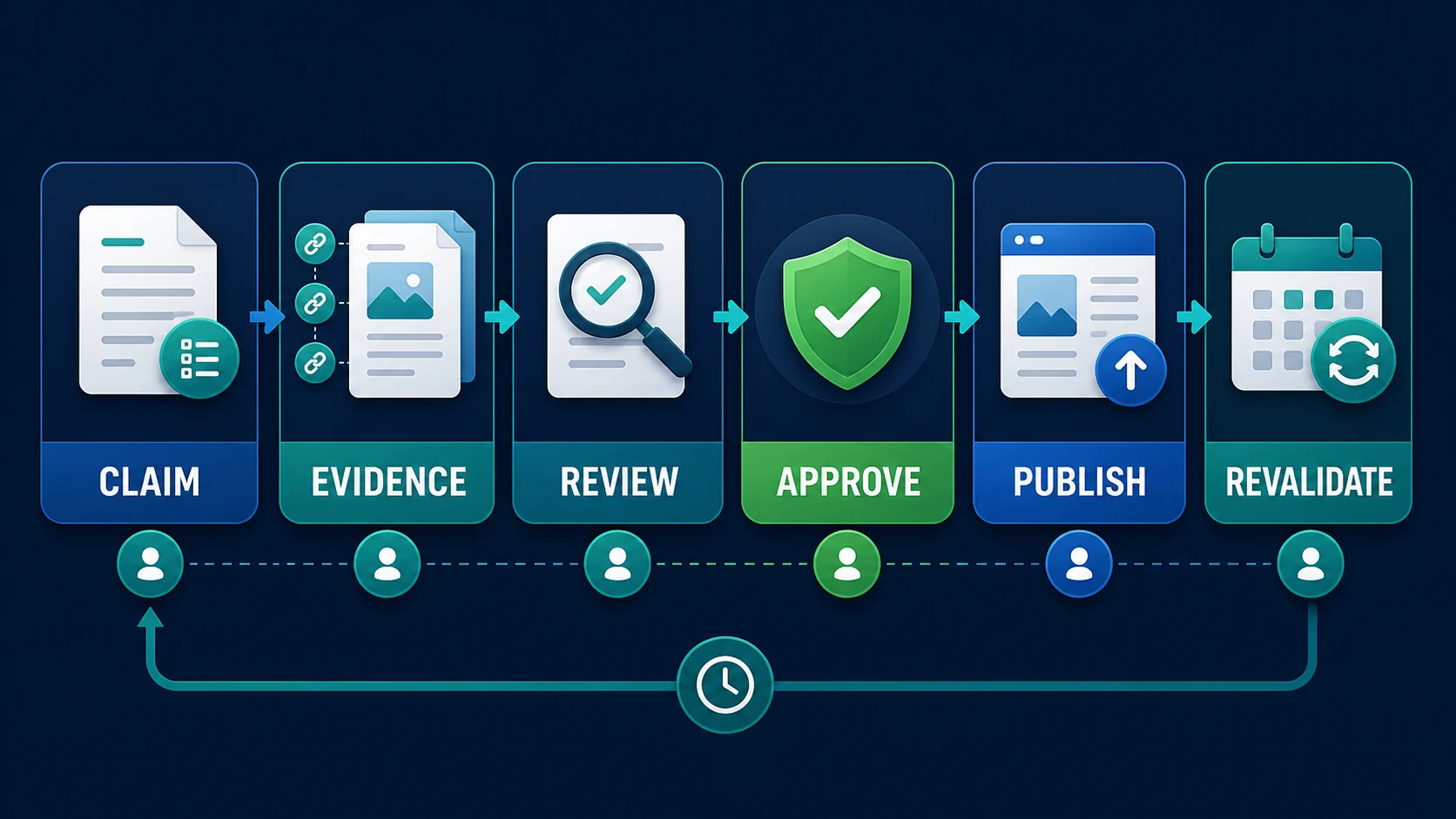
Use a claim ledger for statements about fees, eligibility, availability, performance, guarantees, rankings, testimonials, endorsements, security, licensing, and product comparisons. At minimum, record the claim, source URL or document, source date, page location, reviewer, approval date, next review date, and what should happen when the source changes.
The exact rules depend on the organization and jurisdiction, so this workflow is not a substitute for legal advice. It is an SEO operating layer that helps the firm's qualified legal and compliance teams review the right evidence before publication.
For example, the SEC's investment adviser marketing guide describes prohibitions on materially misleading advertisements and conditions around testimonials, endorsements, third-party ratings, and performance information. FINRA Rule 2210 includes fair-and-balanced content standards plus review and recordkeeping requirements for communications within its scope. These official sources are reminders to route claims to the right internal reviewer, not a universal checklist for every financial company.
A practical publishing loop looks like this:
- Claim: mark every sentence that could change a financial decision or create a material impression.
- Evidence: attach the official product, policy, legal, research, or regulatory source.
- Review: assign subject-matter and compliance review according to the firm's rules.
- Approve: store the reviewer, date, version, and any required qualifier.
- Publish: confirm that the approved language and disclosures survived the CMS and rendered page.
- Revalidate: check the page after product, policy, rate, location, regulatory, or template changes.
This loop also improves SEO quality. Authors can write more precise answers, editors know which sections need durable sourcing, and refresh work starts from a known evidence state instead of guessing what the last team intended.
Design The Site Around Financial Decisions
Financial websites often accumulate several versions of the same answer across product pages, help centers, PDFs, campaign landing pages, branch pages, and blog posts. Search visibility becomes fragile when none of those URLs has clear ownership.
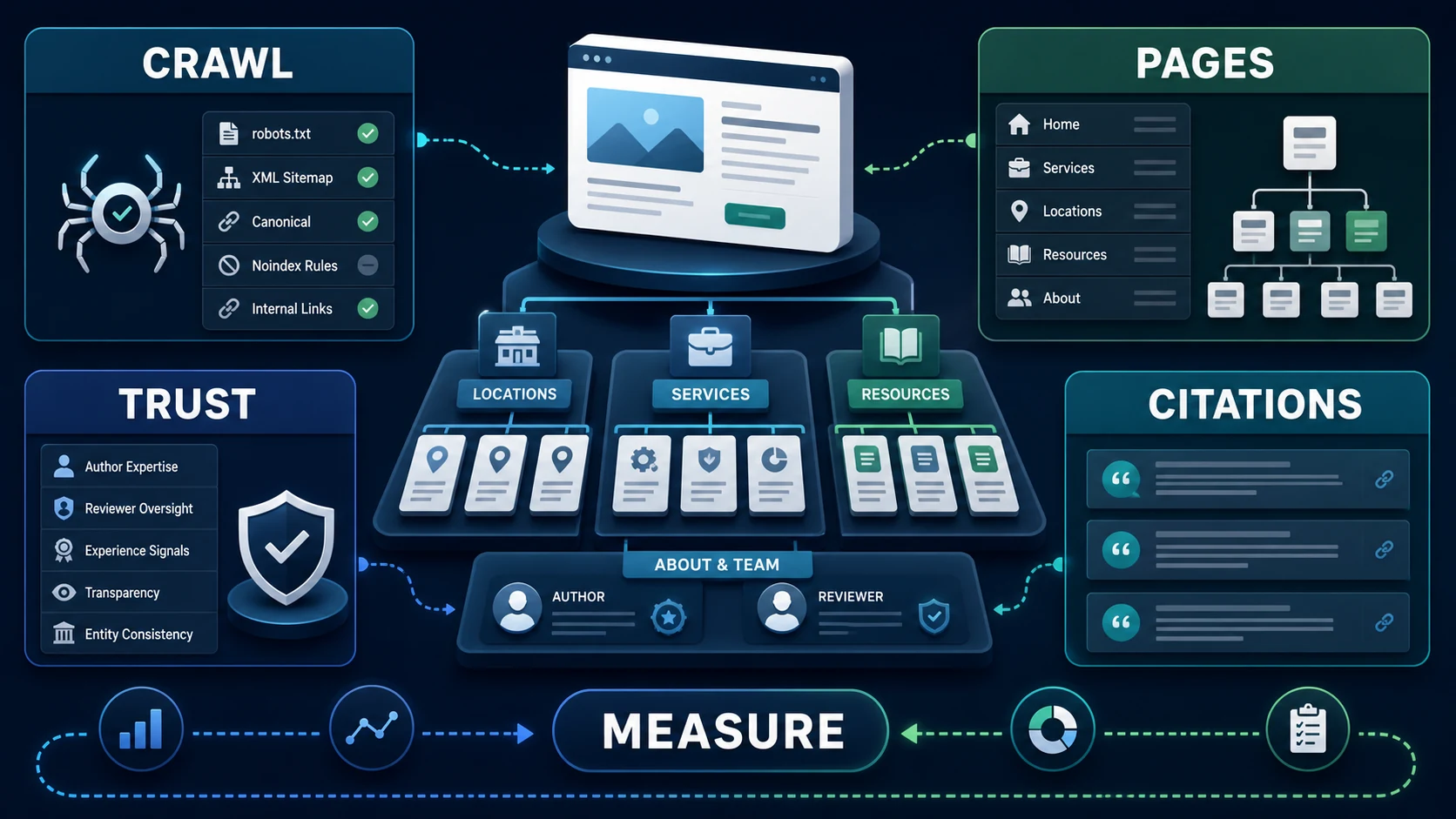
Build the architecture around user decisions rather than departments:
| Page family | Primary job | Required ownership signal | SEO validation |
|---|---|---|---|
| Product and service pages | Explain the offer, eligibility, costs, conditions, and next step | Product owner and required compliance review | Canonical, indexable, internally linked, current structured facts |
| Location pages | Confirm where and how a person can access the service | Local operations owner | Unique local proof, consistent entity data, crawlable location hierarchy |
| Educational resources | Explain a concept without turning education into an unsupported recommendation | Qualified author and reviewer | Clear sources, distinct intent, links to the correct product or support page |
| Trust and disclosure pages | Establish identity, expertise, policies, security, and required disclosures | Legal, compliance, security, or corporate owner | Prominent discovery paths, consistent organization details, fresh dates |
| Support content | Answer existing-customer tasks accurately | Support and product operations | One canonical answer, clean redirects, current screenshots and instructions |
If a product page should own the query, improve that page instead of creating a blog post that competes with it. If the query is educational, the article should answer the concept and route the reader to the product page only when that next step is relevant.
For multi-location institutions, use a governed location template with room for genuinely local evidence. The location landing page workflow explains how to assign URL ownership, avoid doorway-page patterns, and validate location pages after template changes.
Prove Crawl And Index Eligibility Before Rewriting
A well-reviewed page cannot earn organic visibility if search systems cannot reliably discover, render, index, and select it. Run the technical pass before assigning another rewrite.
Check these signals in order:
- The intended URL returns a stable successful response.
- Robots rules and meta directives allow the intended search use.
- The rendered page contains the approved main content and disclosures.
- The canonical points to the URL the team intends to measure.
- Internal links connect the page to relevant product, location, resource, and trust hubs.
- The XML sitemap lists only current canonical URLs.
- Structured facts match the visible page and the organization's public records.
- Retired rates, offers, offices, team members, and product variants redirect or expire cleanly.
Segment crawl findings by page family. Ten broken links on an old newsroom archive do not necessarily outrank one canonical error repeated across every high-value account page. Score technical work by affected template, search demand, business risk, implementation effort, and validation confidence.
This is where a crawl becomes a delivery system. Save the baseline URL set, define the expected live output, release the smallest safe batch, and crawl it again. A fix is complete only when the production page shows the approved content, canonical, directives, links, and structured facts.
Make Financial Expertise Easy To Verify
Trust signals are strongest when they help a reader verify the organization and the specific claim. Decorative badges and generic "trusted" language are weak substitutes for accountable evidence.
For high-impact educational and product content, show:
- who wrote or reviewed the material and why that person is qualified;
- which organization is responsible for the page;
- when the material was published, reviewed, or materially updated;
- which official sources support the important claims;
- what limitations, eligibility rules, conflicts, risks, or material differences the reader needs;
- how to contact the organization or reach the relevant support path;
- where policies, disclosures, security information, and complaint processes live.
Use the E-E-A-T proof workflow to turn those trust requirements into source, author, reviewer, and QA fields. Avoid turning the author box into a ceremonial byline. The reviewer should actually own the accuracy standard for the subject.
Testimonials, ratings, comparisons, and performance statements need special care. Do not scrape a review, quote a ranking, or reuse an award because it looks persuasive. Capture the original source, methodology, period, compensation or conflict information, required disclosures, and approval decision. If the evidence cannot survive that review, remove the claim.
Extend The Same Evidence To AI Search
AI-search visibility does not require a second, disconnected content strategy. Google's guide to generative AI features in Search says foundational SEO still applies: valuable non-commodity content, clear technical structure, crawlability, and useful images remain central. It also warns against manufacturing many thin query variations or relying on unsupported GEO tricks.
For financial-services pages, citation readiness is a useful quality test:
- Can an answer system identify the organization, service, audience, and jurisdiction without guessing?
- Is the important answer present in crawlable HTML rather than only inside a PDF or app?
- Does the page distinguish verified facts from general education?
- Are dates, reviewers, sources, limitations, and material conditions close to the relevant claim?
- Does one canonical page clearly own the answer?
- Can the team repeat the same query set after a release and compare cited sources?
Banks can go deeper with the AI-search visibility workflow for banks, which maps query groups to source pages, crawl checks, evidence owners, and repeatable validation.
Do not promise an AI citation or ranking. Record the query group, market, language, answer state, cited sources, intended source page, shipped change, and next review date. That creates a measurement trail even when answer systems change.
Turn The Strategy Into An Owner-Ready Queue
The final deliverable should be a queue of specific page actions, not a presentation full of generic recommendations.
| Queue field | What to record |
|---|---|
| Canonical URL | The page that should own the search task |
| User decision | What the visitor needs to understand or do |
| Claim risk | Low, moderate, high, or routed by the firm's compliance model |
| Evidence state | Verified, missing, stale, conflicting, or awaiting review |
| Technical state | Crawlable, indexable, canonical, internally linked, and rendered correctly |
| Recommended action | Keep, update, consolidate, redirect, change page type, or create |
| Owners | SEO, content, product, compliance, legal, engineering, local operations, or analytics |
| Release batch | The smallest group of pages that can be shipped and validated safely |
| Validation | Render check, recrawl, sitemap check, query monitoring, and review date |
Prioritize items that combine material user impact, strong demand evidence, repeated template reach, clear ownership, and a validation path. Defer work when the organization cannot yet substantiate the claim or maintain the page. That is better than publishing a fragile answer and treating traffic as proof that it was safe.
Financial Services SEO Checklist
Use this checklist before a financial-services SEO initiative enters production:
- Define the search task and the canonical page type.
- Confirm that no existing URL already serves the same keyword, page type, and user job.
- Inventory material claims, sources, qualifiers, and review owners.
- Route the page through the organization's legal and compliance process where required.
- Verify status code, robots rules, rendered content, canonical, internal links, and sitemap coverage.
- Check organization, author, reviewer, location, product, and disclosure consistency.
- Separate local pages, national service pages, education, support, and trust content by job.
- Keep comparisons fair, sourced, dated, and clear about material differences.
- Publish in a batch small enough to inspect and recrawl.
- Record baseline search and AI-citation evidence before the release.
- Revalidate after product, policy, regulatory, location, personnel, or template changes.
- Keep the approval and measurement trail so the next update starts from evidence.
The durable advantage in financial-services SEO is not volume. It is a system that can publish useful answers, defend the claims, show the right page to search systems, and prove what changed after release.