
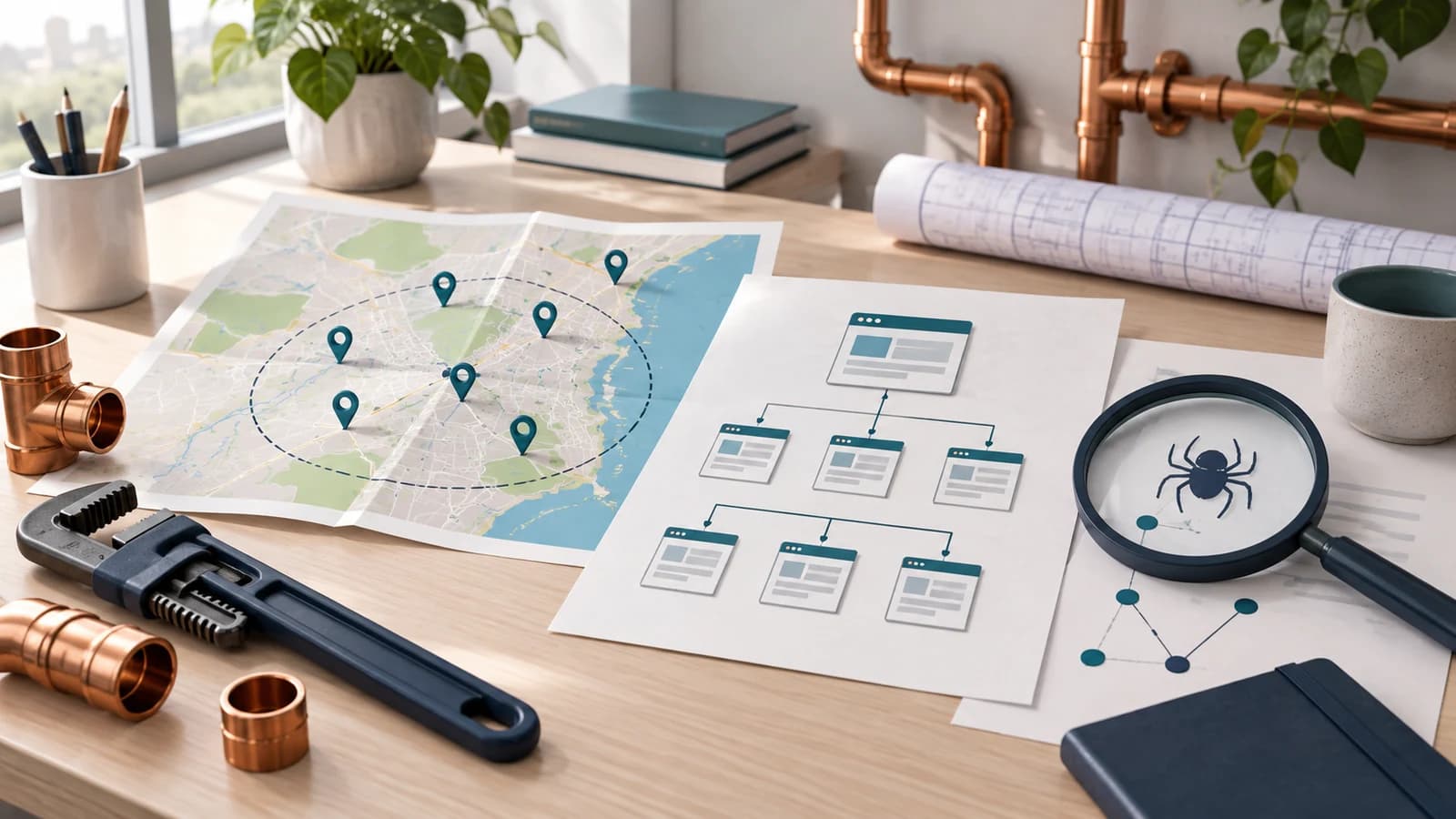
SEO for plumbers is not a generic local SEO checklist with “plumber” pasted into every heading. A plumbing company wins useful search visits when a real service, a truthful service area, an urgent or planned customer task, and a crawlable page all line up.
That gives the team a practical job: map the services the business can actually perform, give each important search task one clear page owner, add evidence that helps a homeowner choose, and validate that those pages are easy for search engines to discover and keep indexed. The result is a cleaner path from a search such as an urgent repair or a scheduled installation to a call, booking, or quote request.
Start With Two Plumbing Search Jobs
Most plumbing queries are not interchangeable. A person with a leak needs a fast path to availability, scope, and contact. Someone planning a water-heater replacement, drain upgrade, or renovation has more time to compare options, proof, and service details. Treating both jobs as one broad “plumbing services” page makes the page less useful for each reader.
Start by splitting demand into page jobs, not by creating a page for every keyword variation:
| Search situation | Page job | Evidence that belongs on the page | Next action |
|---|---|---|---|
| Urgent repair | Help a nearby customer confirm whether the team can handle the immediate issue | Hours, actual emergency coverage, supported repair types, service-area clarity, and a direct contact path | Call or request urgent help |
| Scheduled service | Help a customer evaluate a planned repair, install, or maintenance task | Scope, process, useful FAQs, suitable proof, and a quote or booking path | Request an estimate or appointment |
| Service-area question | Help a customer understand whether the business travels to their location | Honest service-area description, travel constraints when relevant, and a clear contact path | Confirm coverage |
| Trust or comparison question | Help a customer assess whether the business is credible for a higher-consideration job | Credentials, real customer proof, service details, and transparent expectations | Compare options or contact the team |
Do not invent coverage, 24-hour availability, licenses, pricing, staff expertise, or local offices to make a page sound more competitive. Google’s Business Profile guidelines emphasize accurate representation, including precise business and service-area information. For service-area businesses such as plumbers, Google also distinguishes businesses that travel to customers from hybrid businesses that serve customers both on-site and at customer locations in its service-area guidance.
Build Service Pages That Carry Local Proof
A useful plumbing service page should answer four questions quickly: what the team does, whether it serves the customer’s situation and area, what proof supports that claim, and what the customer can do next. It does not need thin city-name variations to do that well.
Map every proposed page before writing it:
| Page element | What to verify | Common failure |
|---|---|---|
| Service promise | The service is real, currently offered, and described in the language customers understand | A vague page that lists every possible plumbing task |
| Local relevance | The market or service area has a truthful operational connection to the business | Swapping a city name into duplicated copy |
| Proof | Visible details, customer themes, credentials, process, or FAQs that the business can support | Generic claims with no useful decision evidence |
| Conversion path | The contact or booking route matches the urgency of the task | Making an emergency searcher hunt through a general contact page |
| Internal role | The page connects to the relevant service hub, local guide, and supporting resources | A useful page that is buried or orphaned |

The existing local SEO workflow is the parent system for profile accuracy, review signals, pages, crawl health, and weekly monitoring. This plumbing-specific workflow narrows that system to the page decisions that matter for a service business: emergency versus scheduled intent, service-area honesty, and proof that is useful before a customer calls.
Use local keyword research before building a new service or service-area URL. It helps the team choose whether a query needs a service page, a location page, a profile update, or an improvement to an existing URL. More pages are not automatically more relevant; each page needs a distinct job and evidence beyond a changed place name.
Make The Business Profile And Website Agree
For a plumber, the public profile and the website should tell the same factual story. If the profile lists a service that the site cannot explain, or the site promises a service area that the business does not actually cover, customers and search systems receive conflicting signals.
Run this alignment pass before expanding content:
- Confirm the real business name, category, phone, hours, and service model.
- List the services that the company can perform, then compare that list with its most important service pages.
- Clarify whether the business is service-area, storefront, or hybrid; do not publish an address customers cannot visit.
- Check that emergency claims, service boundaries, and appointment expectations match the operational team’s reality.
- Turn repeated customer questions into helpful FAQs or process explanations only when the answers are accurate and maintainable.
Google’s service editor documentation explains that service businesses can present supported offerings on their Business Profile. That does not replace a useful website page. The page still needs the deeper proof, scope, and action path that someone evaluating a plumbing job needs.
For marked-up business facts, use Google’s LocalBusiness structured data documentation as an implementation reference. Markup should describe visible, accurate facts. It cannot make a copied location page or a misleading service claim useful.
Run Technical Checks Before Adding More Content
Content cannot solve a page that search engines cannot crawl, index, or understand as the intended destination. Before adding another service page, validate the current inventory so the team does not create competing URLs or send internal links toward a page that canonicalizes elsewhere.
Use this technical checklist for high-value plumbing pages:
| Check | What good looks like | What to fix when it fails |
|---|---|---|
| Status and indexability | The intended page returns successfully and has no accidental crawl or noindex blocker | Fix template rules, redirects, robots instructions, or launch configuration |
| Canonical | The page points to itself unless it is intentionally consolidated | Resolve a canonical that sends the service page to a generic parent |
| Sitemap | The canonical, useful page is included and obsolete variants are not treated as primary | Refresh the sitemap policy after redirects or page consolidation |
| Internal links | Relevant service, local, and hub pages explain the destination with useful anchors | Add contextual links and remove orphaned or buried pages |
| Page promise | Title, H1, visible scope, and contact path describe the same customer task | Rewrite the promise before adding more keyword variants |
| Structured data | Facts in markup match visible business information | Correct stale phone, address, hours, or business-type data |

The Google Maps SEO workflow is a useful companion when the profile, local pages, reviews, and crawl evidence need to be reviewed together. Keep measurement separate from causal claims: a movement in calls or traffic can be a useful signal, but it does not prove that one page edit caused every outcome.
Turn Local Signals Into A Weekly Queue
Plumbing SEO becomes manageable when the work becomes a repeatable queue rather than a list of broad recommendations. Set a small baseline for the pages and markets that matter, ship one evidence-backed change, then inspect what changed before assigning the next task.
Google’s Business Profile performance documentation describes actions such as calls and website clicks alongside discovery and visibility information. Use those signals with page-level organic data and crawl checks; none of them should be treated as a guaranteed ranking result.
| Evidence lane | What it helps the team decide | Example next task |
|---|---|---|
| Service-page performance | Which service pages attract impressions or clicks but fail to earn action | Clarify the service promise, proof, or call-to-action |
| Business Profile actions | Whether customers are discovering and interacting with the profile | Correct hours, services, phone details, or profile-page alignment |
| Crawl evidence | Whether a useful page is buried, duplicated, redirected, or not indexable | Repair the technical blocker before expanding content |
| Customer questions and review themes | Which unanswered concerns should appear on a real service page | Add accurate FAQs, process details, or proof with an owner for updates |
| Market or service cohort | Whether a group of related pages moves together | Prioritize a template, internal-link, or evidence improvement across the cohort |
Use a simple impact, confidence, and effort score. A high-impact page with a clear technical blocker can move ahead of a speculative new article. A promising service-area idea can wait until the business has the local proof and operational support to make it genuinely useful.
Where Searvora Fits
Searvora’s SEO Spider Crawler fits the validation stage of this workflow. Use it to inspect technical SEO signals across a plumbing-site inventory, including page structure, links, sitemap behavior, and indexation risks, then turn the findings into a prioritized fix queue.
SEO For Plumbers Checklist
- Separate urgent and planned-service customer jobs before assigning pages.
- Confirm that each promised service, hour, area, and contact path reflects real operations.
- Give every important service or service-area page a distinct job and useful proof.
- Keep Business Profile facts and website facts aligned.
- Add local proof only where the business can support it honestly.
- Validate status, indexability, canonicals, sitemap inclusion, internal links, and structured data.
- Record a baseline for profile actions, page performance, and crawl findings.
- Ship the highest-confidence fix, then review the same evidence lane before adding more pages.
The durable goal is not to publish the most plumbing pages. It is to make the real service business easier to understand, find, and contact through pages the team can defend technically and maintain operationally.