

SERP volatility is ranking and search result movement that happens before you know whether a page has a real SEO problem. The useful response is not to rewrite the page immediately. First confirm the baseline, segment the affected queries and URLs, check the search result layout, then decide whether the next action is monitoring, snippet work, content improvement, technical validation, or AI visibility review.
The Ahrefs article that surfaced this competitor opportunity explains why rankings move and how volatility affects traffic. Searvora's information gain is the operator workflow: treat volatility as an evidence loop, not a reason to panic.
Know What Changed Before You Diagnose
SERP volatility can come from several places at once. Google can adjust ranking systems, competitors can update pages, result features can expand, AI-style answers can change the click path, and your own site can create crawl or indexability noise.
Start with a baseline:
| Baseline input | What to record | Why it matters |
|---|---|---|
| Query group | The keyword set, intent, market, and device | Prevents one keyword from standing in for the whole topic |
| URL group | The intended ranking pages and any wrong URLs | Separates page performance from cannibalization |
| Review window | Today, seven days, 28 days, and release dates | Stops one-day noise from becoming a false alarm |
| SERP surface | Snippets, ads, local packs, AI answers, and rich results | Explains CTR changes that rankings alone miss |
| Technical state | Crawl access, canonicals, redirects, noindex, sitemap coverage | Catches eligibility problems before content rewrites |
Google's ranking systems guide is a useful reminder that Search uses many systems, not one single ranking switch. The practical implication is simple: diagnose by evidence pattern, not by guessing which factor changed.
Use A Four Step Diagnosis Workflow
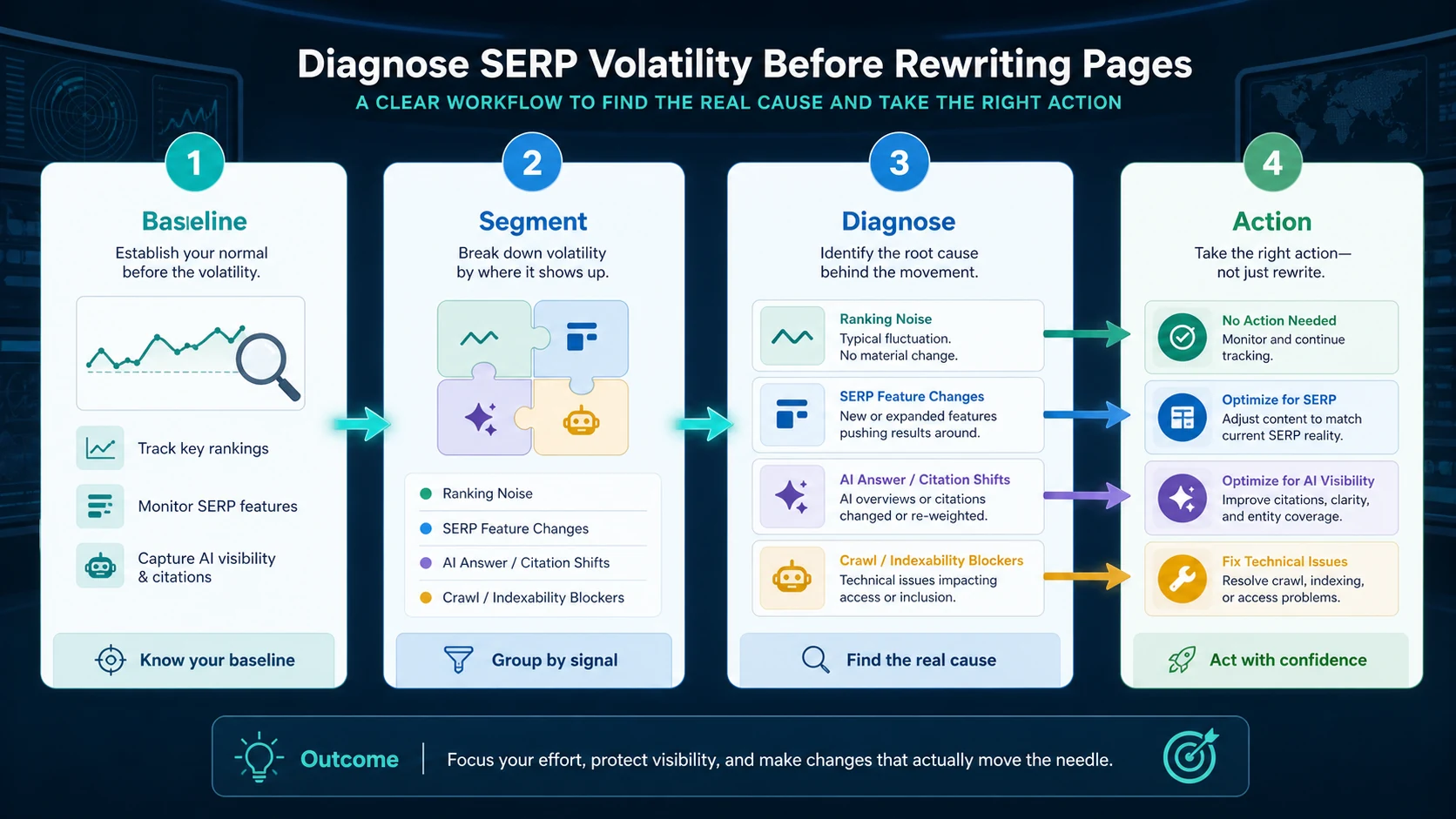
Use this sequence before assigning work:
- Establish the normal range for the query and page group.
- Segment movement by page type, directory, country, device, and intent.
- Identify the primary driver: normal ranking noise, SERP feature change, AI answer or citation shift, content gap, or technical blocker.
- Choose one action with an owner and a recheck date.
This protects working pages. If impressions are stable and clicks are stable, a position change may not deserve work yet. If impressions are stable but CTR changes sharply, the result layout or snippet promise may be the real issue. If a whole directory drops after a release, run a crawl before rewriting copy.
For the measurement layer, pair this article with How to Check Google Rankings. That workflow helps verify the exact ranking URL before you decide whether volatility is harmless or actionable.
Separate Normal Movement From Real Risk
Not every movement is a problem. Treat volatility as a triage input.
| Evidence pattern | Likely diagnosis | Better next action |
|---|---|---|
| Small position movement, stable impressions, stable clicks | Normal volatility | Monitor until the next review window |
| Position stable, impressions stable, CTR down | SERP layout or snippet issue | Review title, meta description, rich result eligibility, and visible promise |
| One template or directory moved together | Site-side pattern | Crawl the group and compare recent releases |
| Impressions dropped across many related queries | Demand, ranking system, or competitor shift | Compare query mix, competitor pages, and update timing |
| Page disappeared or wrong URL ranks | Eligibility or cannibalization issue | Check canonicals, noindex, redirects, internal links, and page intent |
| Classic rankings stable but AI answer visibility changed | AI-search surface shift | Review source clarity, entity coverage, and citation-ready sections |
Google's traffic drop debugging guide recommends separating technical issues, seasonal demand, reporting changes, and ranking changes before deciding what to fix. That same logic applies to volatility. The first job is classification.
Check SERP Features And AI Answer Surfaces
A page can hold roughly the same ranking position and still lose clicks. Ads, featured snippets, video packs, local results, shopping modules, and AI-style answers can change what users see before they reach organic listings.
Build a short SERP review:
| SERP check | Question to answer | Possible action |
|---|---|---|
| Result layout | Did new features push organic listings down? | Improve snippet promise or choose a more realistic target query |
| Featured snippet or rich result | Did another page earn a visible answer block? | Add concise answer structure and validate schema where relevant |
| AI answer presence | Did an AI answer summarize the query job? | Strengthen extractable definitions, examples, and source clarity |
| Competitor page update | Did a competitor add better evidence or format? | Refresh the page with useful information gain |
| Query mix | Did the page start matching broader or weaker queries? | Segment by query intent before changing the page |
This is where The Great Decoupling SEO diagnosis is useful. If impressions rise while clicks fall, the problem may be result-surface behavior rather than a failing page.
Rule Out Technical Eligibility Before Rewriting
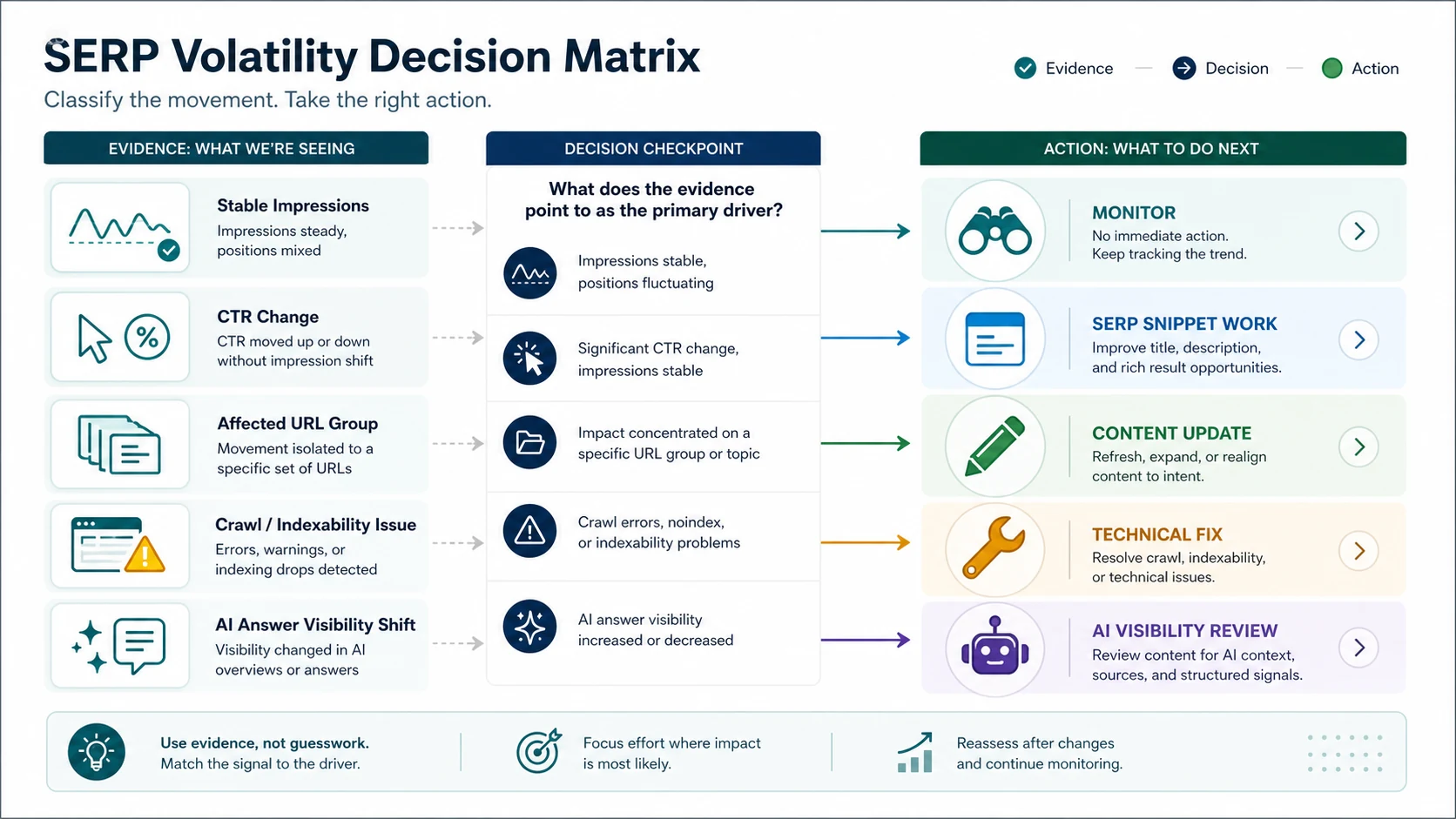
Volatility can expose a technical problem that was already there. A page with weak internal links, canonical conflicts, redirect chains, blocked resources, stale sitemap entries, or intermittent server errors is more vulnerable when search systems re-evaluate results.
Run the technical check in this order:
- Confirm the affected URL returns the expected status code.
- Check robots.txt, meta robots, X-Robots-Tag, and rendered noindex behavior.
- Confirm the canonical target matches the page you want indexed.
- Crawl internal links to the URL and its parent section.
- Review sitemap inclusion, lastmod quality, and redirect final URLs.
- Compare title, H1, meta description, and opening copy against the query job.
Use technical SEO site audit when the affected group is larger than one page. If one template is drifting, crawl evidence is faster and safer than editing pages one by one.
Decide What Action The Volatility Deserves
The final output should be a small decision, not a long theory.
| Decision | Use it when | Validation window |
|---|---|---|
| Monitor | Movement is small, isolated, or unsupported by business metrics | Recheck the same segment in the next review cycle |
| Improve SERP promise | CTR dropped while impressions remain healthy | Compare title/meta changes after enough impressions accumulate |
| Refresh content | The right URL ranks but competitors answer the job better | Watch impressions, position, assisted queries, and engagement |
| Fix technical eligibility | Crawl, indexability, canonical, or sitemap evidence is weak | Re-crawl first, then review Search Console movement |
| Consolidate or separate pages | The wrong owned URL ranks or two pages split the same job | Confirm Google selects the intended canonical page |
| Review AI visibility | AI answers or citations changed around the topic | Track answer presence, citation quality, and source-page clarity |
For official update timing, check the Google Search Status Dashboard and Google's core update guidance. Do not assume every movement is an update. Use those sources to frame timing, then verify whether your affected pages actually match the pattern.
Where Searvora Fits
Searvora fits when SERP volatility needs to become a repeatable review instead of a Slack panic. The AI SEO Dashboard product page positions the dashboard around page-type cohorts, locale drill-down, anomaly detection, opportunity scoring, executive-ready summaries, and action queues. Those are the views a team needs when rankings move across many queries or page groups.
Use the dashboard to group movement by query set, URL folder, template, locale, and owner. Then pair the performance signal with crawl evidence from SEO Spider Crawler when the diagnosis points to redirects, canonicals, metadata, indexability, or sitemap drift.
Run This SERP Volatility Checklist
Before you rewrite a page because rankings moved, confirm:
- The affected query group, URL group, market, device, and date window are documented.
- Search Console impressions, clicks, CTR, and average position tell the same story as your rank tracker.
- The movement is larger than the normal range for that query group.
- SERP feature or AI answer changes have been checked.
- Recent site releases, redirects, canonicals, robots rules, and sitemap changes have been reviewed.
- The intended URL still owns the search job.
- The next action is monitor, snippet work, content update, technical fix, consolidation, or AI visibility review.
- The owner and validation window are clear.
SERP volatility is not a strategy by itself. It is a signal that tells you when to wait, when to investigate, and when to ship a fix with evidence.